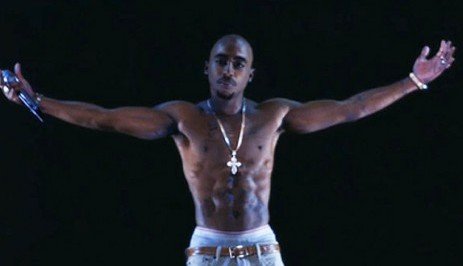
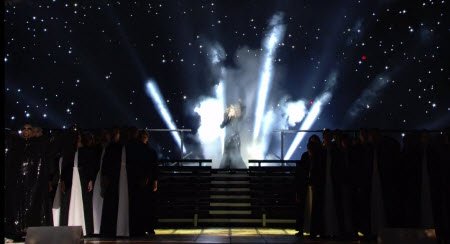
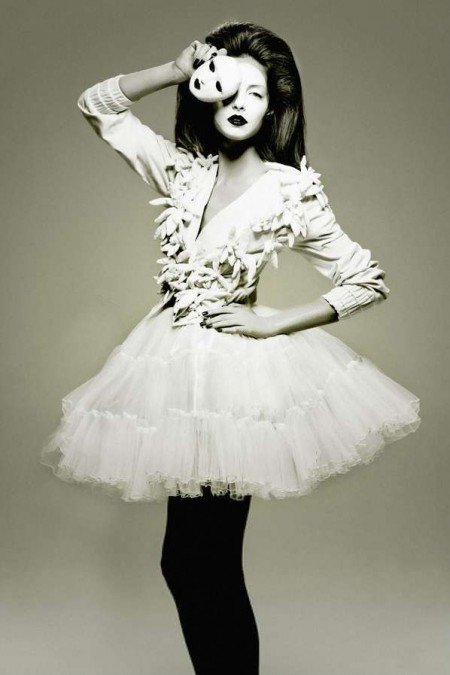
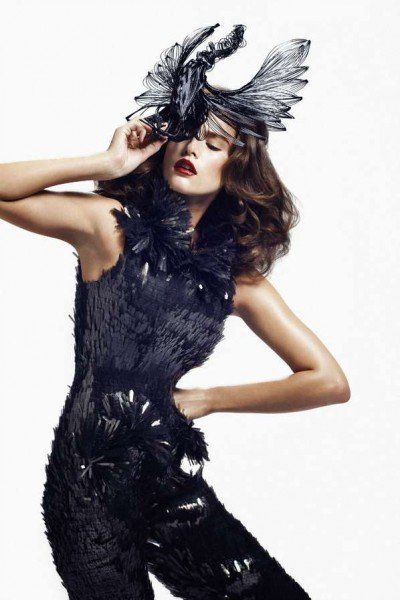
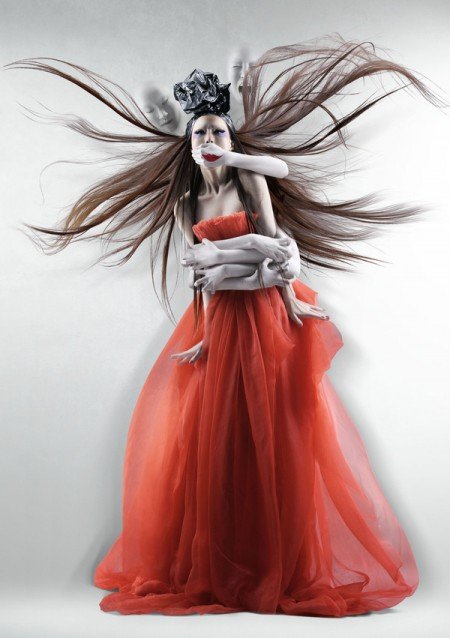
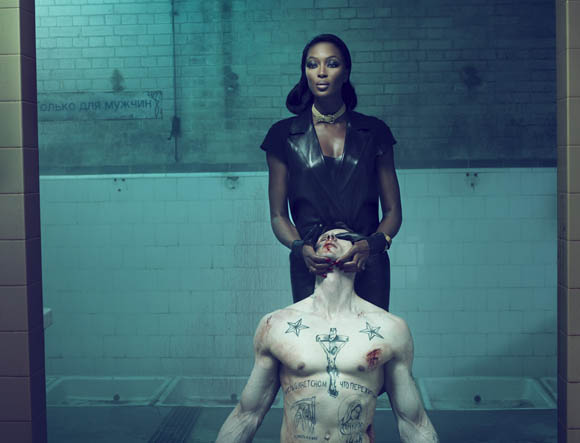
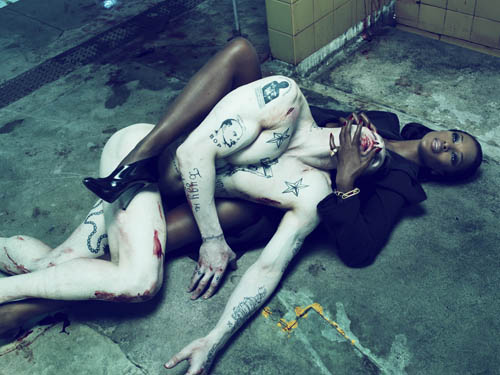
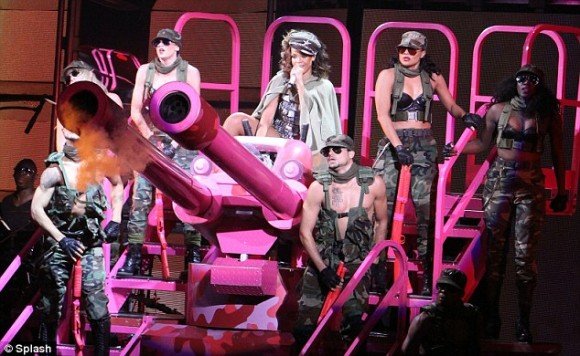
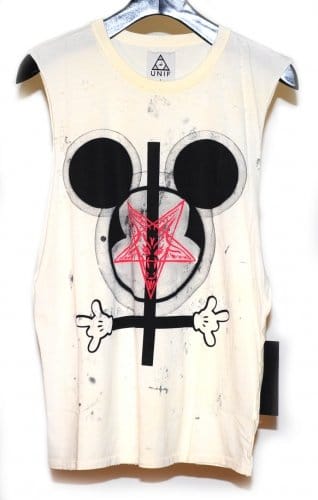
Some articles on this site discussed a rather disturbing trend: The “resurrection” of pop stars who died in mysterious circumstances (possibly sacrificed) to then have their image exploited by the very industry they spoke against. A recent example was the rapper 2Pac who was revived as a hologram (see the article entitled 2Pac Revived as a Hologram at Coachella: Why I Didn’t Like It).
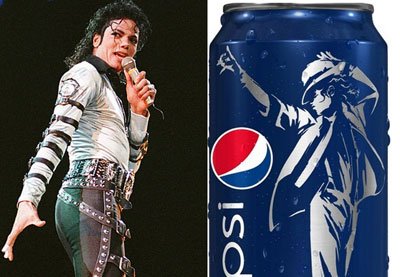
Michael Jackson is probably the biggest (and saddest) example of a star who denounced industry manipulation to then die in very strange circumstances. In the mist of trials attempting to place the blame of MJ’s death on a single person (i.e. a patsy), Pepsi Co. announced that it would feature the King of Pop’s image on over a billion of its cans.
The announcement caused some controversy in mass media as people asked “Is it right to use the image of a dead person to sell products?”. Most people, including me, would instantly reply “Hell No”. Going beyond this ethical question, there is a deeper issue at stake here. Why is the very essence of artists who have been attacked, humiliated and almost destroyed by the industry so thoroughly exploited after their demise? Is it more than simply about money and publicity? Is it the elite’s way of saying “We used them, we sacrificed them and now we own them for eternity”?
Some might say that the controversy might help sell Pepsi cans. I for one won’t be buying Pepsi anytime soon. Here’s an article on MJ image being used by Pepsi.
Michael Jackson To Appear On Pepsi Cans
More than one billion cans will be imprinted with the late pop icon’s image.
PepsiCo Inc. is resurrecting Michael Jackson to try to pump life into its flagship cola, three years after the singer’s death and more than a quarter century after the pop icon’s landmark sponsorship deal to become the voice of the brand.
Following an agreement with Mr. Jackson’s estate, the beverage and snack giant said Thursday that it will roll out a billion Pepsi cans with a silhouette of Mr. Jackson—who died in 2009—as part of its newly launched “Live For Now” global marketing campaign.
PepsiCo and Mr. Jackson’s estate declined to disclose the financial terms of the latest deal. Mr. Jackson signed onto a Pepsi sponsorship deal in 1984 for a then-record $5 million.
The new campaign is part of PepsiCo’s pledge to ramp up spending on its flagship cola, which has been losing ground behind archrival Coca-Cola Co.
PepsiCo is boosting its overall marketing budget this year by as much as $600 million, or by about 20%. The extra money is going to a dozen large global brands, which also include Lay’s potato chips, Gatorade sports drinks and Quaker oatmeal. The company has been pouring more funds into Pepsi, its biggest brand by revenue, since last year.
A spokeswoman for Mr. Jackson’s estate said the PepsiCo campaign represents the first branding deal since Mr. Jackson passed away, but that more such marketing agreements are planned.
Mr. Jackson starred in several Pepsi advertising spots in the 1980s and 1990s, including an infamous commercial shoot in 1984 that inadvertently set the King of Pop’s hair on fire, burning his scalp. Pepsi’s new campaign around Mr. Jackson is timed to coincide with the 25th anniversary of “Bad,” the multi-platinum album.
PepsiCo said it would begin distributing the special-edition cans in China this weekend. The cans will arrive on U.S. store shelves later this month, part of a broader rollout to about 20 other countries in Asia, South America and Europe.
Bringing a deceased celebrity back from the dead for marketing purposes is a risky business.
“It’s like the dead is dancing to sell your product,” said Scott Lerman, chief executive officer of Lucid Brands, a branding firm.
In 2007, ConAgra Foods Inc. reincarnated their company spokesman, Orville Redenbacher, who had died in 1995. It ran a commercial that featured a computer-generated version of Mr. Redenbacher who had gotten a modern makeover. Pundits dubbed the character “Orville Deadenbacher.” An ad critic for Adage, an industry trade magazines, called the posthumous pitchman: “Madison Avenue’s first pitchzombie.”
Following Tiger Wood’s infidelity scandal, Nike Inc. NKE -2.26% aired a black-and-white commercial showing Mr. Woods gazing into a camera as a voice-over of his late father, Earl Woods, spoke to the golfer about taking responsibility for his actions. The ad received mixed reaction, although many labeled the spot “creepy.”
Dead icons also can create enormous buzz. Earlier this year, a digital version of the late-musician Tupac Shakur appeared on stage during a music festival with Snoop Dogg and Dr. Dre. An Internet video of the show became an instant phenomenon.
Frank Cooper, a senior PepsiCo marketing executive, said the Pepsi campaign is respectful toward Mr. Jackson and more “forward looking” than nostalgic by celebrating the pop legend’s continuing influence on music.
Mr. Jackson remains highly popular across the globe, spanning all age groups, Mr. Cooper added.
That appeal is especially important in China, where Coke’s namesake cola had a 26.9% share of the soda market last year, ahead of Pepsi’s 19.0% share, according to Euromonitor International.
In its efforts to narrow that gap, PepsiCo in March secured Chinese government approval for a joint venture with Tingyi Holding Corp., a leading beverage player in China.
Coke, which also enjoys a bigger share of China’s overall beverage market than PepsiCo, said last year it would invest $4 billion over the next three years in the country.
PepsiCo is launching a TV ad in China featuring music from Mr. Jackson’s “Bad” album later this month, but hasn’t decided yet if it will run similar ads in the U.S. It’s launching a TV commercial in the U.S. next week featuring singer Nicki Minaj.
By marrying its cola with famous musicians, Pepsi is returning to its marketing roots. Aside from Mr. Jackson, previous Pepsi pitchmen have included Ray Charles, Madonna and Britney Spears.
It recently invested an estimated $60 million to sponsor “The X Factor,” a TV music-talent show launched in the U.S. last autumn, to compete with “American Idol,” which Coke sponsors. A Pepsi TV ad that premiered last year on “The X Factor” featured a clip of Mr. Jackson after a long hiatus.
Coke also has tapped heavily into music in “Open Happiness,” the global campaign it launched in 2009 for its trademark cola. Coke recently recruited music producer Mark Ronson and singer Katy B to create a new song, “Anywhere in the World,” that it plans to market heavily as part of its Olympic Games sponsorship in London this summer.
This year Pepsi quietly pulled the plug on its “Refresh” campaign, an online social-media campaign, where consumers competed for money to fund favorite charities. Critics said it didn’t help sell more Pepsi.
In addition to the cans with Mr. Jackson’s silhouette, PepsiCo is teaming up with musicians and producers to reinterpret some of the singer’s songs, part of a broader digital campaign. It also promises “epic, live events” tied to Mr. Jackson in the coming months.
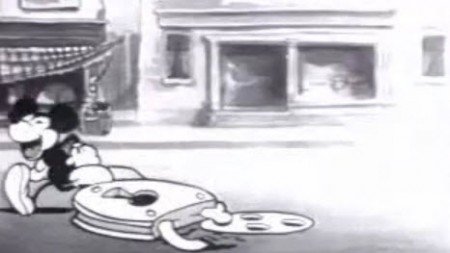
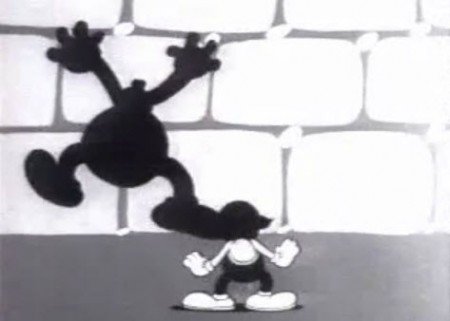
This short video from the 1930’s features beloved cartoon characters and is described on YouTube as “creepy” and “disturbing”. The cartoon is indeed very dark and bizarre but only minimal knowledge of Masonic symbolism is required to realize that the cartoon is all about secret societies and the ordeals an initiate must go through to be accepted. To the symbol-literate, it’s as blatant as it gets.
At the beginning of the cartoon, Bimbo (a good name for a non-initiate?) walks down the street without a care in the world. Suddenly, a certain cartoon character traps Bimbo down a manhole.
Bimbo gets trapped…Mickey Mouse? Funny how this character is the recruiter that lead to Bimbo’s forceful initiation. Is it a thinly veiled comment on Disney’s Masonic ties?
Bimbo then finds himself in the underground lair of a strange secret society composed of masked men with candles on their heads (symbolizing illumination?). One asks him “Wanna be a member? Wanna be a member”. When Bimbo’s answers “NO!”, he is sent to various sadistic chambers that recall the various ordeals that are imposed on new initiates in actual secret societies.
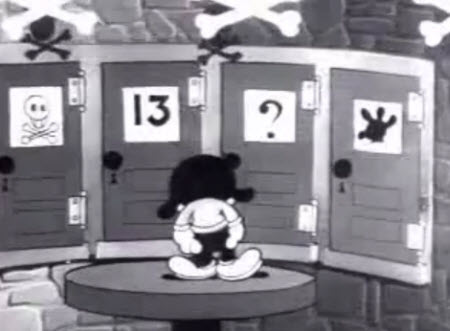
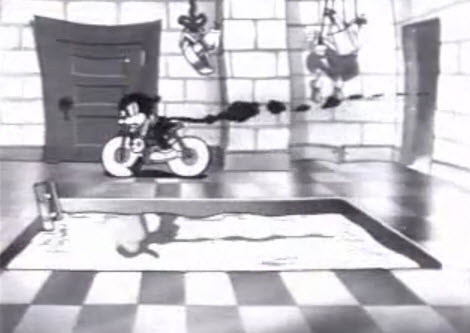
At one point, Bimbo is tricked into thinking he would die. Near-death experiences have been part of secret society initiations since Antiquity.In the ordeal of the “Mystery Door”, Bimbo faces prominent symbols associated with Secret Societies: Skull & Bones and the number 13.After getting his ass severely spanked, Bimbo finds himself in room with a Masonic checkerboard pattern floor.During his terrifying ordeals, Bimbo learns about the illusory nature of the material world, a fundamental concept communicated in occult initiations.
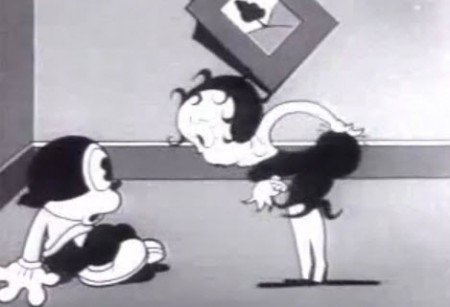
After refusing to become a member several times, the masked man reveals himself and seduces him.
It is Betty Boop! After watching her tap her own behind a few times, Bimbo realized that this secret society was aaaaalright.
When Bimbo finally accepts Betty Boop’s offer, he discovers that all of the members were Betty Boop clones, which makes him very happy. In other words, secret society initiation might be difficult and terrifying but becoming a member provides great rewards.
Looking at the symbolism of Bimbo’s Initiation, we realize that those who produced it were obviously “in the know”. The cartoon is therefore yet another example of occult symbolism that can be seen by all but meant to be fully understood by few.
In this month’s edition of Symbolic Pics of the Month: Rihanna, Beyonce, Lady Gaga and a whole bunch of symbolic images from fashion shoots.
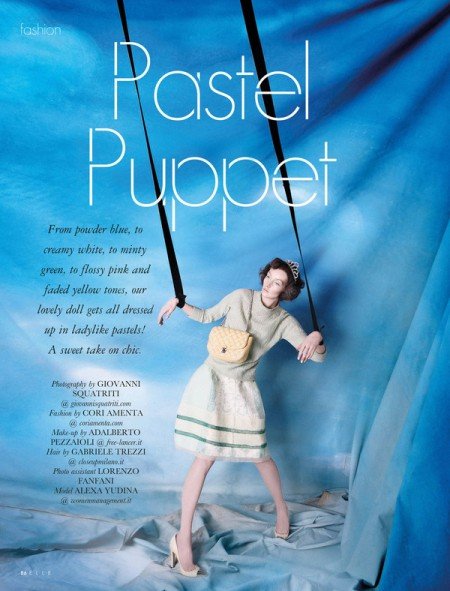
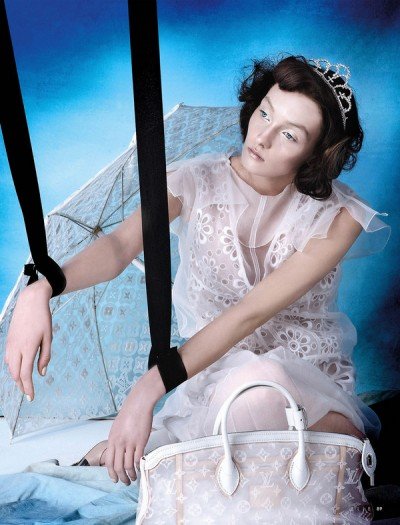
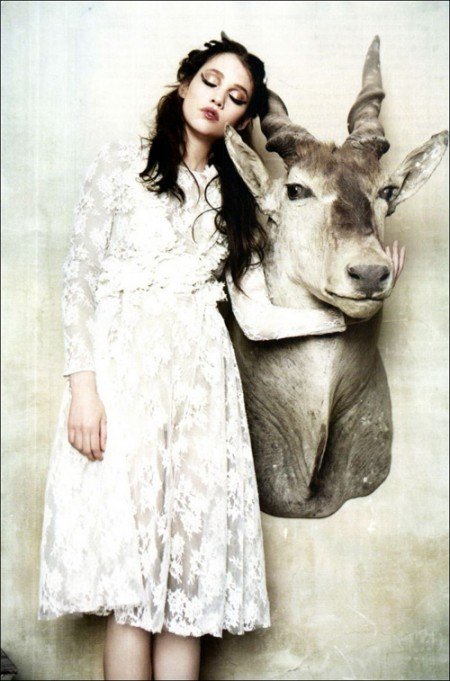
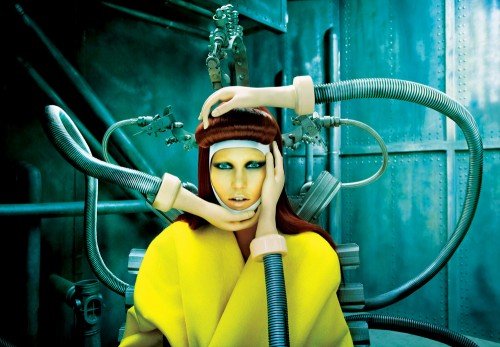
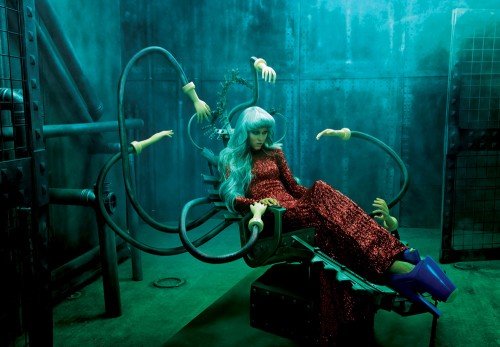
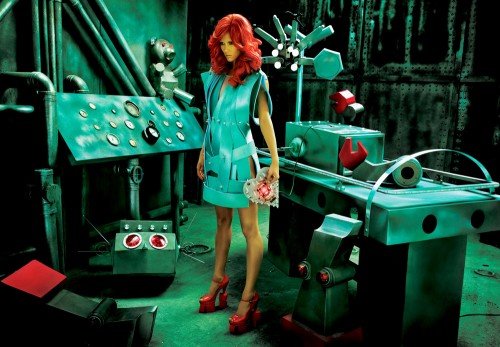
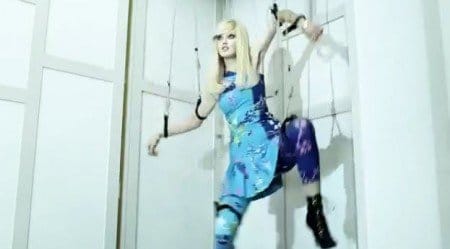
This photoshoot from ELLE Italia features the elite’s favorite way of portraying models: As lifeless puppets controlled by unseen handlers
No life, no control and used to sell products. Yup, that pretty much sums up the fashion model.
This calendar from Bazaar also exploits the concept of a controlled puppet. In this case, the handler is shown with one eye hidden and looks quite evil. There is also an emphasis on one of the models eye – as she is a reflection of her handler’s will. When decoded this symbolic image is an accurate and disturbing portrayal of the fashion world.
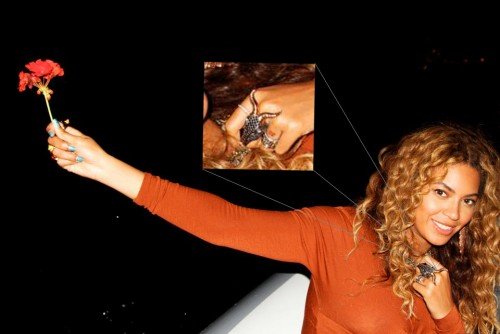
This casual pic found on Beyonce’s Tumblr account. It features a ring the singer appears to love as she has been spotted wearing it several times (notably during a performance at Coachella). The ring appears to be nothing else than the head of Baphomet.
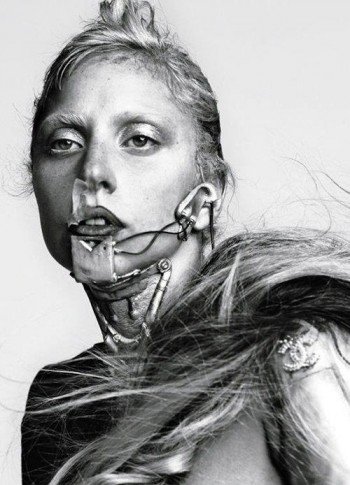
Speaking of Baphomet, here’s a pic taken from a fan during Lady Gaga’s Born This Way Ball Tour. She is wearing a horned mask similar to those worn in Illuminati Balls.
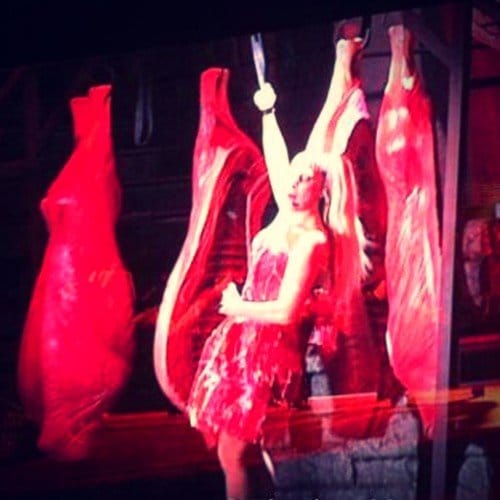
In this other pic, Gaga is hung like a piece of meat with other pieces of meat. She’s always engrossing.
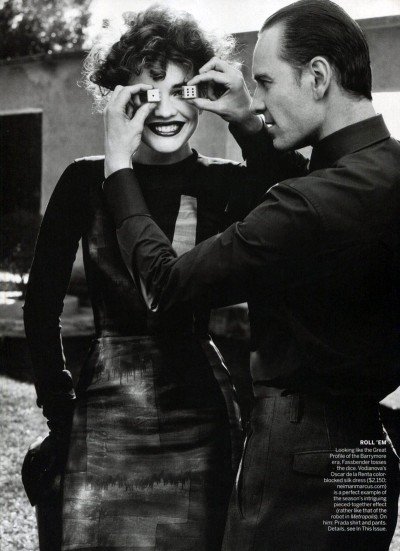
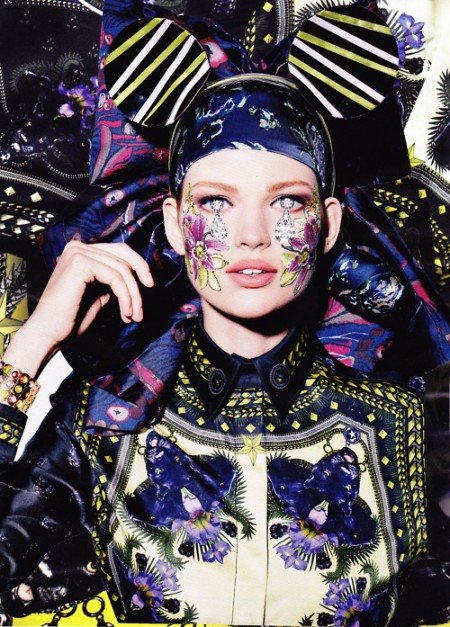
In this photoshoot from Vogue US featuring model Natalia Vodianova contains several familiar symbols. In this image, one of her eyes is hidden. Also, in the description of the pic, it is mentioned that the dressed is “like that of the robot in Metropolis”. As seen in several previous articles, Metropolis (especially Maria the android) is extremely important in the occult entertainment industry.
In the same photoshoot, the model is shown chilling between two Baphomet-looking heads. The same combination of symbols keeps coming back across the entertainment.
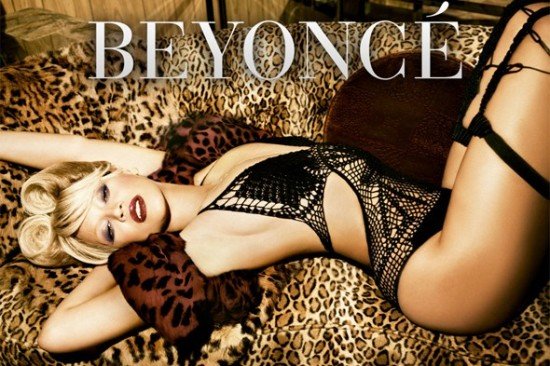
In these pics posted on Rihanna’s Twitter account, the singer is wearing Sex-Kitten leopard prints and is saluting her handlers by hiding one eye.
The cover of Rihanna’s single “Where Have You Been” also features a prominent one-eye sign.
Speaking of one-eye, here’s Kreayshawn’s girl Lil’ Debbie.
Speaking of one-eye, here’s the main image on Cheryl Cole’s website.
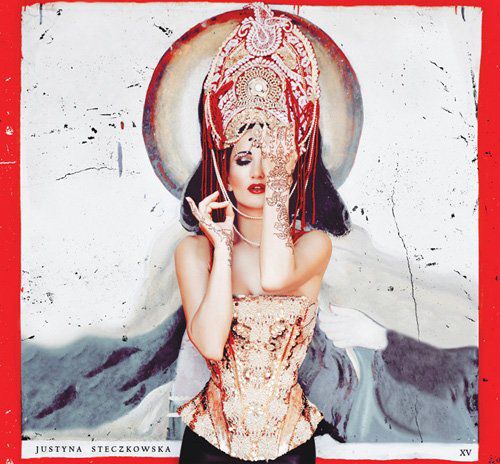
Speaking of one-eye, here’s the album cover of popular polish singer Justyna Steczkowska.
Speaking of one-eye, here’s another polish singer Magda Steczkowska.
Speaking of one-eye, here’s the cover of Fiona Apple’s new album.
Speaking of one-eye, here’s an ad for shoes (or something).
Here’s a new creepy trend: Girls looking like real life Barbie dolls. I have no idea where this originated from but I believe it is a result of the constant glamorization of deshumanization in mass media.
Is it becoming cool to be lifeless?
The logo of USDA Foods. Is there a chemtrail in the sky?
We’ve seen in several previous articles (notably The Transhumanist and Police State Agenda in Pop Music) that the normalization of transhumanism is an important part of the Agenda in mass media. The merging of humans and robots in order to for a new kind of “upgraded” transhuman is a concept that is heavily promoted in movies, music videos and video games.
Almost all major pop stars have been portrayed as a robot at one point or another in their career. Not only does this make the concept of transhumanism cool and sexy for young people, it also makes a profound statement about the nature of the industry (pop stars being robots with no minds programmed to perform).
In Japan, the widely popular group Perfume brings the same message and imagery to young Asians with videos such as Spring of Life. During the entire video, the members of the group are robots that are being tinkered with by unseen programmers. During the chorus, they do a dance routine attached to wires – not a lot of freedom going on there. Also, they hide one eye a bunch of times to salute those who control them.
At one point, the fembots appear to be feeling love and start acting more naturally – which is the next step in the development of this technology: Natural looking and feeling robots that can even simulate emotions. Here’s the video.
http://www.youtube.com/watch?v=5kWFGTH8K5g#
While this video in itself will probably not change one’s outlook on life and the concept of humanity, it is another piece in the gigantic puzzle that is mass media around the world. This particular video is aimed at the millions of young people in Japan, but other videos and media are aimed at other people around the world and of different age groups. The combination of all forms of media pushing the same idea ultimately normalizes it – especially when the idea is promoted to young people. So, whether you like transhumanism or not, it is being aggressively pushed around the world.
On April 15th, Tupac Shakur was revived in the form of a hologram to perform a few songs at Coachella. At first, I did not even bother watching the performance because this kind of stuff has been going on in Japan for years. However, after reading reactions to the performance and future plans for holographic artists, I felt the need to check it out. Here’s a video of the performance.
Quite a few people asked me what I thought of it. Well, to be honest, I did not like it. I just had a visceral, gut feeling that it wasn’t right. Of course, this is a very personal opinion and many probably won’t agree with me. However, before jumping to the comments to curse me out, please read on.
2Pac was more than a rapper signed to record label. He was an iconic character that represented an entire generation. He did not just record songs and act cool in music videos. He spoke out about issues, he brought to light the reality of America’s underprivileged, he even called out crooked cops and politicians. He did not only sing gimmicky singles to sell records, he said what was on his mind – and what was on many other people’s minds.
However, although he had a kind of “larger-than-life” aura surrounding him (which only amplified after his death) 2Pac was very human. Like all of us, he had strengths, weaknesses and emotions. And he was not afraid to show them. He could rap about gangster street life and, in the next song, rap about how he loved his mama. In interviews, he could be either loud, cocky and arrogant or soft spoken, smart and insightful. Like many compelling artists, the were many sides to him, like there are many sides to all of us. All of his sides were apparent because, unlike most record industry artists, he was real.
Sadly, that hologram at Coachella, wasn’t.
It was 2Pac – if he was stripped of everything that made him real, human and authentic and then infused with a bunch of synthesized computer hocus pocus. Although it was somewhat interesting to see a 2Pac on stage in 2012, witnessing a dead person artificially re-animated and controlled by unseen programmers felt wrong. 2Pac was anything but an empty shell controlled by unseen programmers…but that’s what I saw at Coachella.
One of the first things the 2Pac hologram said was “What’s up Coachella!”. This was obviously not 2Pac’s voice because Coachella did not even exist prior to his death. It was therefore probably the voice of an imitator making 2Pac say things he never said. In short, it was fake. The hologram then sings the song Hail Mary. Interesting fact: For some reason, the first words of the song “Makaveli in this… Killuminati, all through your body” were removed. Hail Mary was an odd song choice by Dr. Dre – the mastermind behind this hologram experiment – considering the fact that the very next song on the Makaveli album was Toss it Up, in which 2Pac thoroughly insulted Dre. Then Snoop came out and performed 2 of Amerikas Most Wanted with the hologram, complete with pre-arranged interactions with it. Again, fake, staged, artificial.
Maybe if this was a one-time novelty experiment, I wouldn’t have written about it. But there are now talks of bringing this 2Pac hologram on tour and making a bunch of money off it. Even worse, there are talks of bringing other artists back from the dead like Jimi Hendrix and…Kurt Cobain *shudders*. These artists all became legends due to their authenticity, originality and their ability to touch their listener’s soul. They were the exact opposites of pre-programmed, dehumanized and synthesized visual illusions. Furthermore, they were often at odds with the record industry’s shady ways and hypocrisies, which caused them lots of troubles with the powers that be. Seeing their likeness used by this industry to make them say and act a certain way is simply the opposite everything they stood for.
Maybe those behind the 2Pac hologram did it with good intentions. Maybe it was even done out of love and respect for him. But I did not feel it. It was creepy, awkward and, most importantly, it wasn’t 2Pac. Here’s the real deal and let him rest in peace.
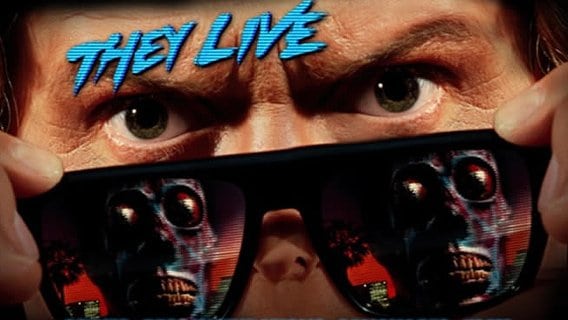
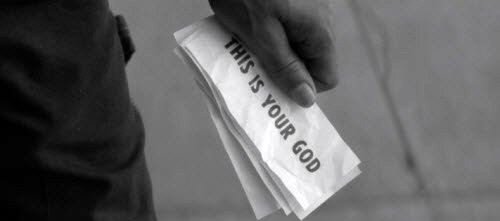
‘They Live’ is a science-fiction movie from the Eighties that features aliens, a WWF wrestler and a whole lot of sunglasses. What’s not to like? While, at first glance, the movie appears to be a bunch of nonsense, ‘They Live’ actually communicates a powerful message about the elite and its use of mass media to control the masses. Is the movie describing what we call the Illuminati? This article looks at the deeper meaning of John Carpenter’s strange but fascinating movie ‘They Live’.
Warning: Major spoilers ahead (get over it, the movie is 24 years old).
Watching They Live is a conflicting experience. It is an odd combination of eye-opening messages with lackluster acting, powerful social commentary with 1950’s B-movie special effects and gripping satire with odd punchlines. Constantly making viewers oscillate between “Wow, that was genius!” to “Wow, that was corny!”, it is difficult to properly evaluate the movie from a cinematographic point of view. However, from a “message” point of the view, They Live is gold. Based on Ray Nelson’s short story Eight O’Clock in the Morning, the movie is one of those rare subversive stories that forces viewers to question their world and their surroundings. Because, despite the fact that the movie is about ghoulish aliens, it communicates truths to the viewers that are only alluded to in mainstream movies. In fact, looking deeper into the storyline, one might realize that there’s probably more “science” than “fiction” in the story of They Live … especially when one has “truth-seeing sunglasses”.
The hero of the movie, played by WWF wrestler Rowdy Roddy Pipper, is a drifter that is apparently nameless. In the short story and the movie’s credits, he is referred to as Nada, which means ‘nothing’ in Spanish. While this nameless nothing is broke and homeless, he still manages to expose the alien’s hidden rule of the world. How did he accomplish that? With the only thing he’d ever need: The Truth. Oh, and also guns. He used a lot of guns. Most importantly, despite the fact that Nada was tempted several times to shut up in exchange for “generous compensation”, he kept his integrity and never agreed to sell out to the aliens. Now, that’s a role model. To top it off, he says the best things ever.
“I’m here to kick ass and chew bubble gum … and I’m all out of bubble gum”.
Are the aliens in the movie an imaginative way to portray the world’s elite, those who secretly run the world, those we call the Illuminati? Let’s revisit this cult classic and see how it describes the hidden rule of the elite.
The Premise
Right from the beginning, as we see Nada walking around Los Angeles with his backpack, the movie sets a particular mood: Something is not quite right. While Nada appears to be a happy-go-lucky kind of guy, the city is not happy and it is not too kind to happy-go-lucky kind of guys. Quite the contrary, there is a sense of impending doom in the air: Poverty is rampant, helicopters fly around the city and street preachers speak of soulless beings ruling the world.
“The venom of snakes is under their lips. Their mouths are full of bitterness and curses. And in their paths, nothing but ruin and misery. And the fear of God is not before their eyes! They have taken the hearts and minds of our leaders. They have recruited the rich and powerful, and they have blinded us to the truth! And our human spirit is corrupted. Why do we worship greed? Because outside the limit of our sight, feeding off us, perched on top of us from birth to death are our owners. Our owners — they have us. They control us. They are our masters. Wake up. They’re all about you, all around you!”.
Is the preacher’s description of the “masters” applicable to the Illuminati? I believe so.
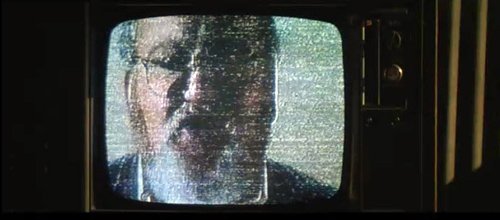
As we follow Nada’s aimless drifting across the city, the camera often focuses on people gazing blankly at television screens, mindlessly absorbing the vapid messages it communicates. Regular Joes appear to truly enjoy their television shows … until an obscure organization hacks the airwaves to broadcast subversive messages about the hidden rulers of the world.
“Our impulses are being redirected. We are living in an artificially induced state of consciousness that resembles sleep. (…) The poor and the underclass are growing. Racial justice and human rights are nonexistent. They have created a repressive society, and we are their unwitting accomplices. Their intention to rule rests with the annihilation of consciousness. We have been lulled into a trance. They have made us indifferent to ourselves, to others. We are focused only on our own gain. Please understand. They are safe as long as they are not discovered. That is their primary method of survival. Keep us asleep, keep us selfish, keep us sedated.”
Can the above statement be applied to the Illuminati? I believe so.
The Average Joes who watch this pirated TV broadcast all get a massive headache – the raw truth is indeed too much for most people to bear. One such viewer switches the channel after telling the guy on TV: “Blow it out your ass”. Just like today, most people do not want to hear about this kind of stuff … they just want to go back to their mindless TV viewing.
Nada realizes that the street preacher and the man on television are connected through a local church. When he sneaks into the church, he discovers that it is actually the headquarters of an underground organization.
On a wall inside the church is written “They Live We Sleep”, a phrase that describes the fundamental difference between the elite and the masses. Those in power know the truth about the world and possess the means and the power to truly “live”. The rest of the population is sedated, dumbed-down and manipulated into a zombie-like status in order for it to be as easily manageable as possible by the masters. The masses’ ignorance equals a state of endless slumber.
Nada learns that the rebellious organization is attempting to recruit people to take down the rulers. However, a few days later, Nada discovers what happens to those who plot against those in power.
Helicopters, bulldozers, and police in riot gear raid the place, destroy everything and violently arrest the members of the underground organization. That is how the elite responds to contrary views.
After witnessing the violent police shakedown, Nada begins to realize that something is wrong in America. The happy-go-lucky guy who believed in working hard and following the rules is starting to believe that something is amiss here.
Determined to learn more, Nada re-enters the church and finds a few interesting things.
The police painted over “They Live We Sleep”. Obviously, “They” don’t want that message to be known.
More importantly, Nada discovers a box full of sunglasses that allows him to see the world as it is. Added bonus: They also look pretty cool.
Seeing the Truth
While the sunglasses found by Nada appear on the surface to be worthless, they actually provide him with the greatest gift of all: The Truth. When Nada first puts on the sunglasses, the experience is shocking.
When he has his sunglasses on, Nada sees through the smoke and mirrors projected by advertisement and mass media. He only sees the core of their message and the only reason why they exist.No matter which magazine Nada flips open, he sees the same subliminal messages, which tells a lot about the true function of “celebrity” and “fashion” magazines. Despite the fact that they are all different, they all ultimately serve the same purpose: To reinforce messages from the elite to the masses.
Nada also quickly understands the truth about money.
“In God We Trust”?
Nada’s most shocking discovery concerns people around him.
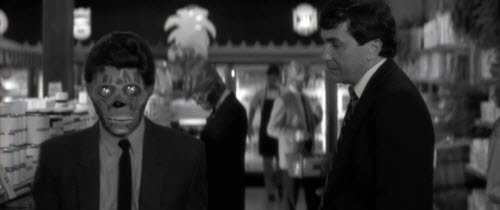
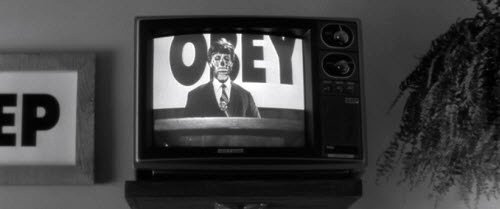
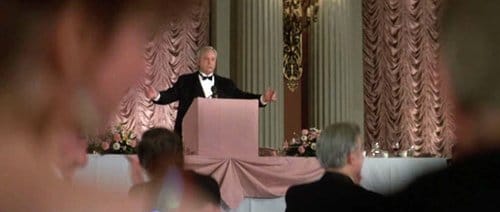
Some people are not human. They are of another race that has infiltrated society.Nada realizes that they are everywhere and that they hold positions of power, like this politician giving a typical “politician” speech on television. Is this a way to portray the Illuminati?
Upon discovering this truth, Nada became pissed off. REALLY pissed off. How did he react to the situation? He did not go home and write a poem about it. Nope, he grabbed a shotgun and started shooting aliens.
When the aliens realize that Nada can see through their disguise, they immediately alert the authorities saying “I’ve got one that can see”. Being able to “see” is obviously frowned upon by the aliens – they do not like to be exposed. Nada quickly becomes a social pariah and aliens start closing in on him. Confronted with this situation, Nada says profound and timeless words: “I don’t like this ooooooooone bit”.
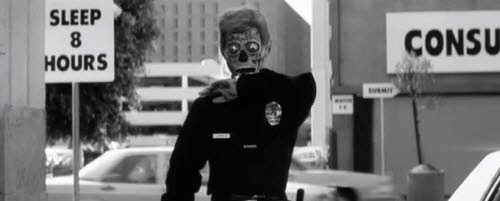
Many aliens are part of the police force as its sole purpose is to ensure that the alien’s rule is not disturbed. Most policemen are however regular humans and just follow the orders because that’s their job … a little like actual policemen who do the Illuminati’s work.
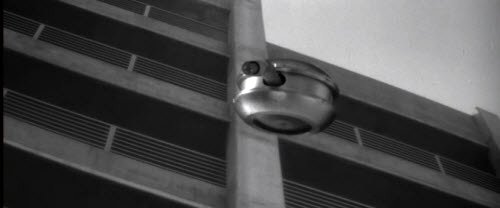
Nada and everyone in the city are constantly monitored by flying surveillance cameras that are oddly similar to the new unmanned drones that are currently appearing around the world.
Flying surveillance cameras were considered science fiction in 1988. They are a reality today.An actual, modern unmanned drone mounted with a video camera.
The concept of truth-seeing sunglasses is an interesting way to illustrate the importance of knowledge in one’s world perception. Two people can be looking at the exact same thing yet perceive two very different realities, depending on the level of information and awareness possessed by each person. Nada’s sunglasses can, therefore, represent one’s knowledge of the truth, which allows a clear perception of reality.
Looking for Others Who Know the Truth
Upon learning the shocking truth about the world, Nada feels the need to share this vital information with his friend Frank Armitage. Nada however quickly realizes some people do not want to hear about it. In fact, many actually get angry and offended at the simple mention of something that alludes to it. When Nada asks Frank to put on his sunglasses so he can see what he sees, Frank firmly refuses and calls him a “crazy motha…”. Nada replies with another classic line “Either you put these sunglasses on or start eating that trash can”.
Then ensues one of the longest one-on-one fight scene I’ve ever seen (eight minutes of punching and kicking), a scene that is dragged out for so long that it becomes utterly absurd and even comical. While the scene might seem ridiculous, it says something about the difficulty of making regular, average people wake up from their blissful ignorance.
Frank finally sees the truth. All it took is Nada beating the crap out of him, sticking the sunglasses on his face against his will and forcing him to look around. Yes, convincing other people of the truth can be a hard task.
It takes a lot of effort on Nada’s part, but Frank finally sees the aliens controlling the world. The two pals are then invited to a secret meeting of the underground organization that is attempting to rid the earth of the aliens.
During the meeting, Nada and Frank are given truth-seeing contact lenses. The sunglasses gave truth-seers a nasty headache, especially when they are taken off. When first exposed to the truth, adapting to the new reality can indeed be difficult, and even painful. However, after a while, it becomes a seamless part of the person. A little like wearing contact lenses.
During the meeting, Nada and Frank learn that humans are being recruited by the aliens in exchange for wealth and power. As the leader of the underground organization says: “Most of us just sell out right away”. It is rather easy to make a correlation between the movie and actual politicians and celebrities we’ve seen in previous articles on this site who readily sell out to the Illuminati in exchange for wealth, power and celebrity.
The meeting doesn’t last long, however, as police barge in the place and start shooting everyone there. They are designated a “terrorist organization” by the elite. Nada and Frank manage to escape and accidentally find themselves behind enemy lines, in the alien’s underground base.
Behind Enemy Lines
While exploring the aliens’ underground base, Nada and Frank stumble upon a party thrown by the aliens for human collaborators to thank them for their “partnership”. Although humans will never be considered equals to the aliens, those who sell out to them get monetary benefits … much like those who are not part of today’s elite who nevertheless sell out to push the elite’s New World Order Agenda.
“Our projections show that by the year 2025, not only America but the entire planet will be under the protection and the dominion of this power alliance. The gains have been substantial, both for ourselves and for you, the human power elite.”
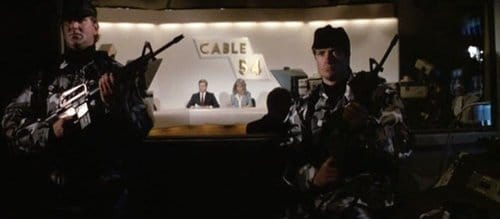
Frank and Nada then discover the source of the aliens’ brainwashing signals: A television studio. The aliens use the network to broadcast hypnotic and subliminal signals to humans, blinding them from the truth about their rulers and the world. The message that is communicated here: Mass media is the elite’s favorite tool indoctrinate the masses and to keep them in servitude.
The TV station ‘Cable 54’ is used by the aliens to hypnotize humans. Is this science-fiction? Barely.
Nada realizes that the only way to save humanity from the grips of the aliens is to go to the roof of the TV station’s building and to take down the emitter of the subliminal messages, disguised as a satellite dish. Indeed, without an elite-controlled mass media, indoctrinating the masses will be a lot more difficult. So Nada and Frank start shooting their way towards the roof, not an easy task.
The Disinformation Agent
While this lady appeared to be nice at first, she tried to mislead, deceive and even kill Nada during his quest. She ends up shooting his pal Frank in the head.
Nada met Holly Thomspon, a Cable 54 network executive, at the beginning of his wild rampage. While Nada appears to be somewhat enamored with her, she always somehow brings trouble. During the “terrorist organization” meeting, Holly infiltrated the group, posing as a sympathizer and claiming that Cable 54 “was clean” and was not the source of aliens’ signal, which was false and misleading. Today, disinformation is widely used by the elite to confuse and mislead those who attempt to discover the truth about the world.
During Nada’s rush towards the roof of the network’s building, Holly appears again, claiming that she wants to help him. However, she is simply trying to kill him before the mission is accomplished. She is, therefore, another human that sold out to the aliens being used to disrupt non-corrupted humans attempting to liberate themselves and others.
Taking Down the Aliens
Here’s the biggest spoiler of them all: Nada manages to take down the aliens’ transmitter and saves humanity. This heroic move gets him killed, however, as a policeman inside a helicopter shoots him dead. Nada, therefore, becomes the quintessential hero, sacrificing his life for the good of humanity – a martyr for human freedom from soulless rulers.
Even though it cost his life, Nada visibly does not regret exposing the aliens to the world. With his last ounce of strength, Nada gives the aliens a uniquely human parting gift: the finger.
Once the aliens’ satellite dish is down, the masses are able to see the world as it is: the alien’s ugly faces are exposed to the world.
TV viewers around the world now realize that those giving the daily news were also those who controlled them.
In Conclusion
Although They Live is usually described as “a science-fiction movie that criticizes consumer culture”, the scope of its message actually goes way beyond the usual “consumerism is bad” lecture. They Live can indeed be interpreted as a treatise on the thorough and systematic conditioning of human experience in order for a hidden elite to covertly control, manipulate and exploit the masses. In the movie, the rulers are portrayed as a completely different race that perceives humans as inferior – something that can easily be correlated to the attitudes about the bloodlines of the Illuminati. The presence of these strong messages in the movie is one of the reasons They Live became somewhat of a cult-classic, despite the fact that it was panned by movie critics. As the years go by, the movie’s message is becoming increasingly relevant … and freakishly realistic.
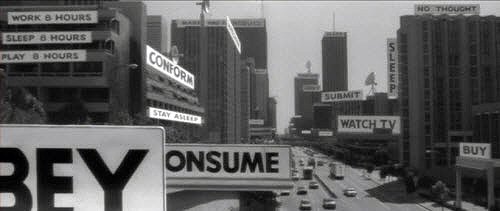
Many of those who seek the truth about the world realize that its reins are held by an unelected elite, one that is essentially hidden from the public eye. As the movie’s promotional poster says: “You see them on the street. You watch them on TV. You might even vote for one this fall. You think they’re people just like you. You’re wrong. Dead wrong.” Working behind the scenes, this secretive elite constantly works towards the creation of a global system that would serve its interests: a New World Order, ruled by one world government. As a human collaborator says in the movie to justify his selling-out: “There ain’t no countries anymore. No more good guys. They’re running the whole show. They own everything. The whole goddamn planet!” To facilitate the rulers’ work, the masses are kept in the dark and are distracted by the fake puppet show that is politics and the “no independent thought” programming that is mass media. Apathy, ignorance, and indifference are the elite’s best friends.
Despite its unimpressive special effects and odd dialogue, They Live manages to describe the world elite’s motives and strategy in a way that can be understood by all. And that is no simple task. However, in order to fully understand the movie’s message, one must be wearing truth-seeing sunglasses. Do you have yours on?
The Judge Rotenberg Educational Center is a facility that provides services for children and adults with “severe developmental disabilities and emotional or behavior disorders”. In the past decades, the Center garnered negative criticism due to its use of aversives such as electric shock, the withholding of food, spanking with a spatula, pinching of the feet and forced inhaling of ammonia.
The recent release of disturbing footage from the Judge Rotenberg Educational Center – featuring a restrained teenager who gets electroshocked 31 times – brought the controversy to a whole other level. While the Center claimed that the use of electroshock was a form of “therapy” to change behavior, the footage shows an all-out torture session under the watchful eyes and laughs of Center employees.
Here’s a news report on the recently released of the footage from 2002 (the administration of the Center somehow managed block the broadcasting of the tape in the past).
Graphic video of teen being restrained, shocked played in court
Video of a student restrained and shocked for hours at the Judge Rotenberg Center was played in court on Tuesday after a years-long battle by the center to keep it from the public eye.The video, which shows former resident Andre McCollins screaming, writhing in pain, and begging for help, was played at the start of McCollins’ trial against the Canton-based Judge Rotenberg Center.The Rotenberg Center convinced a judge eight years ago to seal the video, and the battle continued up until Tuesday morning when their attorneys asked Superior Court Judge Barbara Dortch-Okara to bar FOX Undercover’s camera from recording the video as it was played.
Dortch-Okara denied the center’s request, clearing the way to give the public the first look at how these controversial electric shocks are used. The video was taken by one of the center’s classroom cameras.
McCollins, then 18 years old, was shocked 31 times that day in 2002. Lawyers for the center and its clinicians say it was part of the treatment he needed to quell his aggressive behavior.
“These are dramatic tapes, there’s no question about that,” said attorney Edward Hinchey, who represents two of the Rotenberg Center’s clinicians. “But the treatment plan at the Rotenberg Center, the treatment plan that Andre had in place on October 25, was followed.”
It was an emotional day for McCollins’ mother, Cheryl, who was in court watching as the beginning of her son’s ordeal was played.
Andre is shown seated at a desk inside a classroom as a staff member asks him several times to remove his coat. He stays still, apparently not responding or removing his coat, until he is given a shock.
He screams and falls to the floor, yelling as he tries to hide under his desk. He was eventually restrained face-down, a helmet on his head, without breaks for food, water or the bathroom.
“I never signed up for him to be tortured, terrorized and abused,” Cheryl McCollins told the jury. “I had no idea, no idea, that they tortured the children in the school.”
She also testified what her son was like when she visited him three days later after the incident. She said she found him in a “catatonic” state.
“I couldn’t turn Andre’s head to the left or the right. He was just staring straight. I took my hands and went like this,” she said, waving them as if in front of his eyes. “He didn’t blink.”
McCollins did get Andre to Children’s Hospital that day, where he was diagnosed with acute stress response caused by the shocks. The jury also heard her testify about watching the video and hearing staff members laughing while her son was on the floor.
– Source: Fox News
Inspired by MK-Ultra?
“Going over the rainbow” is a code used in Mind Control to signify dissociation.
We’ve seen in previous articles that electroshock torture is a major tool used in mind control programming (see the article entitled Origins and Techniques of Monarch Mind Control). The intense trauma and pain caused by the shocks pushes the victims’ brain to completely dissociate from reality. In the above news article, the victim’s mother stated that she found her son in a “catatonic” state, that he was just “staring straight” and the he “didn’t blink” – all signs of someone who has dissociated in order to evade trauma.
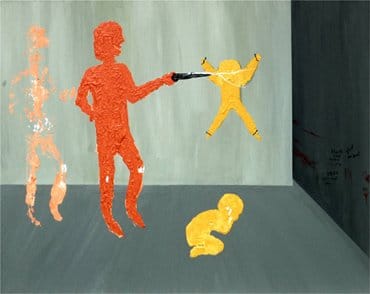
Is the Judge Rotenberg Educational Center a MK-Ultra programming center? If it is not, its techniques are, at the very least, heavily inspired by Monarch mind control. In the article entitled The World of Mind Control Through the Eyes of an Artist with 13 Alter Personas, one of Kim Noble’s paintings depicts exactly what Andre McCollins was subject to: Strapped by the hands and feet and electroshocked repeatedly.
Kim Noble’s painting named “Too Much” depicts a horrifying scene of torture that is very similar to what was filmed at the Judge Rotenberg Educational Center.
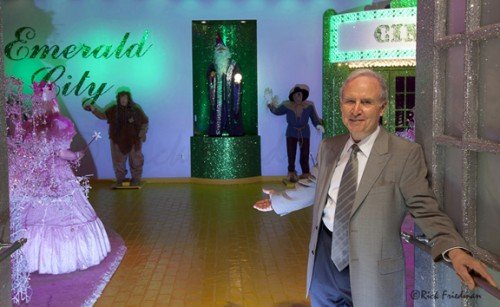
One of the features of the Center is “Rewards Street”, a place that is meant to be a replica of the Yellow Brick Road in The Wizard of Oz. As seen in previous articles, the fairy tale is heavily used Mind Control programming by handlers to make their slaves “go over the rainbow”, a code for dissociation (incidentally, the Center’s logo features a rainbow). Here are some pictures of Rewards Street taken by photojournalist Rick Friedman.
Dr. Matthew Israel welcomes guests to Rewards Street or ”Yellow Brick Road”
Students are strapped with fanny packs and holsters and can be electroshocked at any time.Dr. Israel and “Dorothy” in the “Crystal Forest”
In 2011, Dr. Israel, was charged with misleading a grand jury over the school’s destruction of the tapes, as well as being an accessory after the fact. The Center was also banned banned from subjecting new admissions to severe behavioral interventions including electric shock, long-term restraint, or aversives that pose risk for psychological harm. Let’s hope the McCollins win their case against the dispensers of these sadistic treatments.
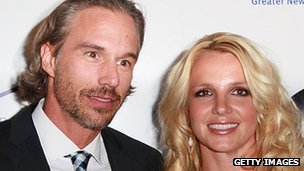
We’ve seen in previous posts that Britney Spears shows signs of being a mind control victim and that some people close to her may actually be her handlers. Jason Trawick, Britney’s manager who recently became her fiance (hint), has asked to be Britney’s co-conservator, meaning that he would have legal control over several facets of Britney’s life. The singer’s father is currently her conservator and is in charge of all things Britney, including her finances as she is deemed psychologically unfit to do so herself.
If accepted, Trawick’s request would grant him legal powers over Britney’s life on details such as food, clothing and medical care. If many artists have handlers in their entourage, Britney’s case is somewhat special as it is particularly obvious. How come Britney is deemed unfit to take care of basics such as food and clothing but can still record songs and perform in shows? How come she is set to marry a man who will also be a legal guardian? Bizarre. Here’s a BBC article on Britney’s fiance’s request for co-conservatorship.
Britney Spears’ fiance ‘asks to become guardian’
Britney Spears’ fiance has applied to become her joint guardian, according to US media reports.
The pop star’s personal and financial affairs have been under the legal control of her father since 2008, after a protracted public breakdown.
According to People magazine, her fiance Jason Trawick has now asked the court to make him a co-conservator.
If the request is accepted, the 40-year-old would have shared legal power over Spears’ general well-being.
This would include food, clothing and medical care – but not her financial dealings.
The couple were engaged in December 2011, on the night of Trawick’s 40th birthday.
He stepped down as her manager shortly afterwards, saying he would concentrate on plans to open an arts and entertainment division for Famos LLC – a company whose partners include Mick Jagger and Dave Stewart.
Undue influence
Jamie Spears was originally granted temporary conservatorship after his daughter was admitted to hospital for psychiatric treatment in February 2008.
Her lawyers originally tried to have the ruling overturned. But in October that year, the courts agreed the arrangement should continue indefinitely.
At the time, a judge ruled the singer was “susceptible to undue influence” and that continued oversight of her affairs was “appropriate” given the complexity of her financial situation.
One advantage of the ruling, as far as the pop star is concerned, is that it shields her from some legal action.
On at least one occasion, she has been spared from giving evidence in court because her conservators argued that she was not mentally competent to sit through the questioning.
Conversely, she will not be allowed to marry Trawick without the court’s approval.
News of Trawick’s application came from US websites People and E! News over Easter weekend.
Lawyer Jeffrey S Cohen, who is not directly involved with the case, told People: “This is probably a compromise between Britney, her father and Trawick to get the marriage off on the right foot.
“Obviously, her future husband needs to have a say in her well-being.”
The conservatorship will only be lifted once a judge rules that Spears is fit to manage her own affairs.
The iconic heavy metal band Megadeth never shied away from controversial and politically charged lyrics. With album names such as Killing Is My Business…and Business Is Good!, Youthanasia, The System Has Failed and United Abominations it is not difficult to see that the leader of the group David Mustaine has strong opinions about lots of things and is not afraid to share them in his songs. Among his favorite topics: the vileness of the military-industrial complex, the hypocrisy of world politics and the brainwashing of the youth. Mustaine also often touches on spiritual topics, whether it be the black magic of his early years or the Biblical themes that appeared in his songs after his conversion to Christianity.
After nearly 30 years of existence, Megadeth shows no signs of taming down as Mustaine’s lyrics are as incisive as ever. Here are two songs from the band’s latest album TH1RT3EN that addresses topics such as the Illuminati, the New World Order and the fall of freedom. Nope, he ain’t no puppet.
New World Order – Lyrics
Where hath the apostles gone?
Joining hands with wicked ones
Revelation has come to pass, New World Order
will hold the mass
A book written by the man
used to control and command
All rights will be denied,
without the mark you shall die
No confession, all is known, all is known
New world order, you shall be shown shall be shown
Monitoring all wages
New world order comes in stages
Currency is obsolete
Feel the agony of defeat
Symbol of society today,
A must have or you shall pay
As humans flesh leads the mind
Just as a pawn the last martyr dies
No confession, all is known, all is known
New world order, you shall be shown shall be shown
Where hath the apostles gone?
Joining hands with wicked ones
Revelation has come to pass, new world order,
will hold the mass
We The People – Lyrics
Secret bureaucracy, it’s just a lie
The devil’s henchmen, in suit and tie
A sacred brotherhood, an ancient rite
Politicians and the double lives they hide
Violate your rights, no more equality
Surrender freedom, your Social Security
We the people face unconstitutional lies
In greed we trust, in revolution we die
Our founding fathers are rolling in their graves
The land of liberty needs a regime change
Until you no longer know right from wrong
The constitution isn’t worth the paper it’s written on
Violate your rights, no more equality
Surrender freedom, your Social Security
We the people face unconstitutional lies
In greed we trust, in revolution we die
In revolution we die
Screams from the future, warn of calamity
The coming plagues of the new disease
The Illuminati, one world currency
One world religion, one world everything
[Solo – Mustaine]
Violate your rights, no more equality
Surrender freedom, your Social Security
We the people face unconstitutional lies
In greed we trust, in revolution we die
We the people face unconstitutional lies
In greed we trust, in revolution we die
The hit movie “The Hunger Games” takes place in a dystopian future where the poor and wretched masses live under the high tech tyranny of a wealthy elite. Is the movie depicting the kind of society the elite is trying to establish for the New World Order? We’ll look at characteristics of the world presented in “The Hunger Games” and how they relate to plans for a New World Order.
Pushed by a gigantic marketing campaign, The Hunger Games did not take long to become a world-wide sensation, especially among teenagers and young adults. Sometimes referred to as the new Twilight, The Hunger Games has similar components to the previous book-to-movie craze (i.e. a young girl torn between two guys) but takes place in a very different context.
Set in a dystopian future (why is the future always “dystopian”?), The Hunger Games paints a rather grim picture of the world of tomorrow, whether it be from a social, economical or political point of view. In short, it is a big-brotherish nightmare where a rich elite thrives on the backs of a starving population. Meanwhile, the perversity and voyeurism of mass media is taken to absurd levels and is used by the government as a glue to keep its unjust social order intact. Is The Hunger Games giving teenagers a glimpse of a not-too-distant future? It doesn’t take a crystal ball to see the elite are trying to take the world in that direction. Is the author Suzanne Collins communicating a strong anti-NWO message to the youth by showing its dangers or is it getting the youth used to the idea? Let’s look at the fictional, yet possible, future world of The Hunger Games.
Note: This article is about the movie and not the book series. The movie has been formatted in a different way and conveys a slightly different message.
The NWO for Teenagers
The Hunger Games takes place in a context that is strikingly on-par with descriptions of the New World Order as planned by today’s global elite. One of the main characteristics of the New World Order is the dissolving of regular nation-states to form a single world government to be ruled by a central power. In The Hunger Games, this concept is fully represented as the action takes place in Panem, a totalitarian nation that encompasses the entire North-American territory. The United States and Canada have therefore merged into a single entity, a step that many predict that will happen before the full-on creation of the NWO.
The President of Panem addressing the Nation.
In Panem, the concepts of democracy and freedom have disappeared from America to be replaced by a high-tech dictatorship based on surveillance, monitoring, mass-media indoctrination, police oppression and a radical division of social classes. The vast majority of the citizens of Panem live in third-world country conditions and are constantly subjected poverty, famine and sickness. These difficult living conditions are apparently the result of a devastating event that engendered the complete economic collapse of North America. In District 12, home of the hero Katniss Everdeen, the locals live in conditions similar to the pre-industrial era where families of coal miners lived makeshift in shacks and eat rodents as meals.
While the masses look as if they are living in the 1800s, they are nevertheless subjugated to the high-tech rule of the Capitol, which uses technology to monitor, control and indoctrinate the masses. Surveillance cameras, RFID chips and 3D holograms are abundantly used by the government to manipulate the will of a weak and uneducated population (although there are signs of solidarity and rebelliousness among the peasants). To preserve the fragile social order, the Capitol relies on a massive police force that is always ready repress any kind of uprising. The workers are often rounded up in civilian camps where they are shown state-sponsored propaganda videos. Panem is therefore a high-tech police state ruled by a powerful elite that seeks to keep the masses in poverty and subjugation. As we’ve seen in previous articles on this site, all of these concepts are also thoroughly represented in other forms of media as there appears to be a conscious effort to normalize the ideas of a high-tech police state as the only normal evolution of the current political system.
Living in sharp contrast to the proletariat, the elite in The Hunger Games inhabits the glistening Capitol city and indulges in all sorts of extravagances and fashion trends. This upper-echelon of society perceives the rest of the population as an inferior race to be ridiculed, tamed and controlled. All valuable resources have been vacuumed from the people living in the districts to profit the Capitol, creating a clear and insurmountable divide between Regular People and The Elite. The concept of an opulent elite ruling over the dumbed-down and impoverished masses (thus making them easily manageable) is an important aspect of the New World Order and it is clearly depicted in The Hunger Games. The government’s reliance on high-tech surveillance and mass media to keep the population in check is something we are already seeing and, if we keep going in that direction, the world of The Hunger Games will soon become reality. There is another concept important to the occult elite that is at the heart of The Hunger Games, however: Blood sacrifices to strike fear and gain power.
Blood Sacrifices for the Elite
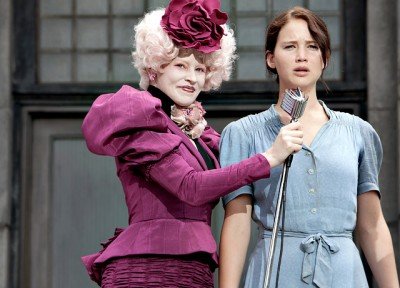
Katniss is selected as tribute of her district.
The government of Panem created the Hunger Games in order to remind the masses of the “great treason” they have committed by engaging in a rebellion. As punishment for their insubordination, the twelve districts of Panem must offer to the Capitol one boy and one girl between the ages of 12 and 18 to be part of The Hunger Games. The teenagers must fight to the death in an outdoor arena in a Roman Gladiator-like event that is televised across the nation. The rules of the Games reflect the elite’s contempt and total lack of respect for the masses. The name of the Games itself is a reminder of the state of perpetual starvation the lower class is purposely kept in by the rulers in order to better control it.
The boys and girls that are selected to take part in The Hunger Games are called “tributes”, a term that usually describes a payment rendered by a vassal to his lord and thus even reflects the servitude of the mass to its rulers. Since time immemorial, blood sacrifices were considered to be the highest form of “tribute” to gods and, on an occult level, were said to wield the most potent power to be tapped by rulers and sorcerers. The same way ancient Carthaginians sacrificed infants to the god Moloch, inhabitants of Panem sacrifice their children to the Capitol. The Hunger Games are therefore a modern version of these ancient rituals that the masses had to participate in to avoid the wrath of their superiors. The entire nation of Panem is forced to watch the sacrificial ritual that takes place in the Capitol, stirring up fear, anger and blood lust within them, amplifying the power of the ritual. We’ve seen in previous articles that the deaths of specific people (Whitney Houston, Heath Ledger, Amy Winehouse) become such a media event that they are, in fact, mega-rituals that entire nations participate in. The Hunger Games reflect this concept of highly publicized mega-rituals.
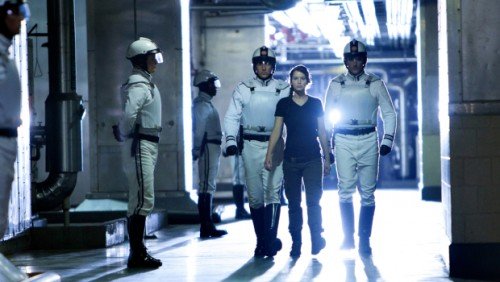
“Tributes” for The Hunger Games become the property of the state and are revoked of all their rights.
In The Hunger Games, the ritualistic death of young people chosen from the mass is sold as a sporting event, a nation-wide celebration that is packaged as a reality show. Not only do the poor people participate in these demeaning events, they even cheer for their favorites. Why do they accept all of this? One of the reasons is that mass media can get people to accept anything … if it is entertaining.
Appealing to the Basest Instincts
The games are broadcast to the nation in the form of a reality-show, complete with TV hosts who analyze the action, interview the tributes and judge their performance. The tributes are so indoctrinated in this culture that they readily accept the rules of the game and turn are fully willing to start killing to win the Games. The masses also actively participate in the event, cheering for their district’s representatives, even though the entire event celebrates the sacrifice of their own. This reflects a sad but true fact concerning mass media: Any kind of message can reach people if it manages to capture their attention. There are two things that automatically, almost irresistibly, grab our attention: Blood and sex, the remnants of our primal instincts. The sheer violence of the event grabs the attention of the masses, who forget that the Games serve as a reminder of the people’s servitude to its elite. This concept is already well-known and fully exploited in today’s mass media, as elite-sponsored messages are constantly sold to consumers as being “entertainment”. The Hunger Games therefore aptly portray the role of media in the manipulation of public opinion. Will the movie help young people realize this fact?
At one point in The Hunger Games, the death of a little girl shocked the people to a point that it brought a brief moment of lucidity and solidarity as the kill highlighted the atrocity of the Games. The live broadcasting of the death lead to a violent uprising in her district as the locals realized that they were willing participants in something terrible. The uprising was quickly quelled however, by the ever-present police force of the state. Furthermore, in order to prevent further social trouble, the producers of the show introduced a new element to the show: Love between Katniss Everdeen and Peeta Mellark, the girl and the boy from District 12. By introducing love (and, by extension, sex) into the show, the producers managed to quell the masses and brought them back to their usual state of silent stupor. This part of the movie reflects how mass media is used by the powers that be today. The worldwide reach of The Hunger Games series itself proves that stories that cleverly feature the ingredients of sex and violence are bound to get people hooked. And, even though The Hunger Games seems to be denouncing the perversity of violence in mass media, it sure brings more of it into movie theatres.
Desensitizing to a New Type of Violence
While there is no shortage of violence in Hollywood, The Hunger Games movie crosses a boundary that is rarely seen in movies: Violence by minors and towards minors. In this PG-13 movie we see kids aged between 12 and 18 violently stabbing, slashing, strangling, shooting and breaking the necks of other children – scenes that are seldom seen in Hollywood movies. While it is surely a way for the movie the grab the attention of the movie’s target audience (which happens to be teenagers aged 12 to 18) The Hunger Games brings to the forefront a new form of violence that was previously deemed too disturbing to portray in movies. But in the particular kill-or-be-killed scenario of The Hunger Games, the viewers easily go beyond this psychological barrier and find themselves yelling stuff at the movie like “Come on, Katniss, take your bow and shoot that vicious little f**cker in the head!”.
In Conclusion
The Hunger Games is set in world that is exactly what is described to be the New World Order: A rich and powerful elite, an exploited and dumbed-down mass of people, the dissolving of democracies into a police state entities, high-tech surveillance, mass media used for propaganda and a whole lot of blood rituals. There is indeed nothing optimistic in the dystopian future described in The Hunger Games. Even human dignity is revoked as the masses are forced to watch their own children killing each others as if they were caged animals. That being said, there is little to no difference between movie goers who watch the movie The Hunger Games and the masses in the movie that witness the cruelty of the Games. Both are willing participants in an event that portrays the sacrifice of their own under the amused eye of the elite. Furthermore, one can argue that the movie accomplishes the same functions as the Games in the movie: Distracting the masses with blood and sex while reminding it of the elite’s power.
Is The Hunger Games attempting to warn an apathetic youth of the danger of allowing the current system to devolve into a totalitarian nightmare? Or is it simply programming it to perceive the coming of a New World Order as an inevitability? That question is up for debate. But reading what is being said in the mass media about The Hunger Games, it seems there is an even more important question up for debate: Are you Team Peeta or Team Gale?
We’ve seen in the past months a variety of laws aiming to monitor and censor the internet. The UK (aka Oceania to George Orwell readers) is taking a step further by proposing laws allowing the monitoring of emails, phone calls, text messages and even visited websites in real time. These laws are not a long-term project; they are to be brought in “as soon as parliamentary time allows”. As usual, these big-brotherish laws are justified with noble causes such as “fighting terrorists” but the reality is that the right to privacy of the entire population is being revoked. Furthermore, the definition of “terrorist” has been so distorted in recent years that it will probably end up meaning “someone with an opinion about something” in the near future. Here are two articles from the BBC (who always slightly sugar coat these things) on the proposed web monitoring laws.
Email and web use ‘to be monitored’ under new laws
The government will be able to monitor the calls, emails, texts and website visits of everyone in the UK under new legislation set to be announced soon.
Internet firms will be required to give intelligence agency GCHQ access to communications on demand, in real time.
The Home Office says the move is key to tackling crime and terrorism, but civil liberties groups have criticised it.
Tory MP David Davis called it “an unnecessary extension of the ability of the state to snoop on ordinary people”.
Attempts by the last Labour government to take similar steps failed after huge opposition, including from the Tories.
‘Unprecedented step’
A new law – which may be announced in the forthcoming Queen’s Speech in May – would not allow GCHQ to access the content of emails, calls or messages without a warrant.
But it would enable intelligence officers to identify who an individual or group is in contact with, how often and for how long. They would also be able to see which websites someone had visited.
In a statement, the Home Office said action was needed to “maintain the continued availability of communications data as technology changes”.
“It is vital that police and security services are able to obtain communications data in certain circumstances to investigate serious crime and terrorism and to protect the public,” a spokesman said.
“As set out in the Strategic Defence and Security Review we will legislate as soon as parliamentary time allows to ensure that the use of communications data is compatible with the government’s approach to civil liberties.”
But Conservative MP and former shadow home secretary David Davis said it would make it easier for the government “to eavesdrop on vast numbers of people”.
“What this is talking about doing is not focusing on terrorists or criminals, it’s absolutely everybody’s emails, phone calls, web access…” he told the BBC.
“All that’s got to be recorded for two years and the government will be able to get at it with no by your leave from anybody.”
He said that until now anyone wishing to monitor communications had been required to gain permission from a magistrate.
“You shouldn’t go beyond that in a decent civilised society, but that’s what’s being proposed.”
‘Attack on privacy’
Nick Pickles, director of the Big Brother Watch campaign group, called the move “an unprecedented step that will see Britain adopt the same kind of surveillance seen in China and Iran”.
“This is an absolute attack on privacy online and it is far from clear this will actually improve public safety, while adding significant costs to internet businesses,” he said.
Shami Chakrabarti, director of Liberty, added: “This is more ambitious than anything that has been done before. It is a pretty drastic step in a democracy.”
The Internet Service Providers Association said any change in the law must be “proportionate, respect freedom of expression and the privacy of users”.
The Sunday Times quoted an industry official who warned it would be “expensive, intrusive [and] a nightmare to run legally”.
Even if the move is announced in the Queen’s Speech, any new law would still have to make it through Parliament, potentially in the face of opposition in both the Commons and the Lords.
The previous Labour government attempted to introduce a central, government-run database of everyone’s phone calls and emails, but eventually dropped the bid after widespread anger.
The then Home Secretary Jacqui Smith did pursue efforts similar to those being revisited now, but the Conservatives and Liberal Democrats continued to voice their concerns.
The shadow home secretary at the time, Chris Grayling, said the government had “built a culture of surveillance which goes far beyond counter terrorism and serious crime”.
Chris Huhne, then the Lib Dem home affairs spokesman, said any legislation requiring communications providers to keep records of contact would need “strong safeguards on access”, and “a careful balance” would have to be struck “between investigative powers and the right to privacy”.
Email and web monitoring laws ‘to be brought in soon’
The Home Office says new laws to allow the monitoring of all emails, texts and web use in the UK will be brought in “as soon as parliamentary time allows”.
The statement comes despite widespread criticism of plans to allow GCHQ “real time” access to communications data.
In a further sign of a determination to push on with the plan, Home Secretary Theresa May said “ordinary people” would have nothing to fear.
But “criminals, paedophiles and terrorists” would, she told the Sun.
She said the idea was to update legislation to stop them being able to cover their tracks and “keep their communication secret”.
“There are no plans for any big government database… only suspected terrorists, paedophiles or serious criminals will be investigated,” she wrote in the newspaper.
‘Gangland thugs’
MPs from all sides of the House of Commons have warned against the plan to force internet service providers to install hardware tracking telephone and website use.
Mrs May said that at the moment phone records are often used to solve crimes – including child murderer Ian Huntley, as well as the “gangland thugs who gunned down Rhys Jones”, the 11-year-old shot dead in Liverpool.
But the Home Office says changes are needed to ensure that communication using social media and internet phone services such as Skype can also be recorded.
Attempts by the last Labour government to create a giant central database containing all UK web and telephone use were dropped after huge opposition, including from the Conservatives and Liberal Democrats.
‘Nation of suspects’
Instead internet service providers have had to keep details of users’ web access, email and internet phone calls for 12 months under an EU directive from 2009.
Although the content of the calls themselves is not kept, the sender, recipient, time of communication and geographical location does have to be recorded.
The proposed new law – which may be announced in the Queen’s Speech in May – would reportedly allow GCHQ to access that data as it happens, without a warrant, rather than retrospectively.
David Davis, the Conservative MP and former shadow home secretary, countered Mrs May’s argument in the Sun: “We already have a law which lets the secret services eavesdrop on suspected criminals and terrorists.
“The new law does not focus on terrorists or criminals. It would instead allow civil servants to monitor every innocent, ordinary person in Britain, and all without a warrant.
“If they want to see all this information they should be willing to put their case before a judge or magistrate. This will force them to focus on the real terrorists rather than turning Britain into a nation of suspects.”
Information Commissioner Christopher Graham’s office has said the case for retaining such data had yet to be made.
A briefing paper on the issue in October 2010, obtained by Conservative MP Dominic Raab, said: “There needs to be some recognition that this additional data will be a honey pot as it will reveal the browsing habits of celebrities, politicians, etc.”
‘China and Iran’
It suggested that a new offence, possibly attracting a custodial sentence, could be created to punish any wrongful disclosure.
Critics have warned that any new law could end up being used more widely than originally intended – similar to the controversial Regulation of Investigatory Powers Act, which has been used, not just to tackle serious crime by police but also been by local authorities to check on children’s school catchment areas.
The information commissioner said public bodies not involved in dealing with serious crime or national security, such as the Department for Work and Pensions, should have to apply to a court before access was granted.
The plans have been criticised by civil liberties groups and several Conservative backbenchers.
Nick Pickles, director of campaign group Big Brother Watch, called the move “an unprecedented step that will see Britain adopt the same kind of surveillance seen in China and Iran”.
Mr Raab said it was “a plan to privatise Big Brother surveillance” and turned every individual “into a suspect”.
‘Saving lives’
When Labour attempted to push for similar changes, the Conservative shadow home secretary at the time, Chris Grayling, said the government had “built a culture of surveillance which goes far beyond counter-terrorism and serious crime”.
But Lord Carlile, the former official reviewer of terrorism legislation, said that “having come into government, the coalition parties have realised this kind of material has potential for saving lives, preventing serious crime and helping people to avoid becoming victims of serious crime”.
Shadow Home Secretary Yvette Cooper said the police and security services had to be able to keep up with new technology, but there must be “clear checks and balances” on what they were able to do and “strong safeguards to protect people’s privacy”.
Even if the move is announced in the Queen’s Speech, any new law would still have to make it through Parliament, potentially in the face of opposition in both the Commons and the Lords.
The Internet Service Providers’ Association said any change in the law must be “proportionate, respect freedom of expression and the privacy of users”.
This ain’t no April fools, all of the following pics are real. In this edition’s of Symbolic Pics of the Month: Justin Bieber, Taylor Momsen and a bunch of other Hollywood weirdness.
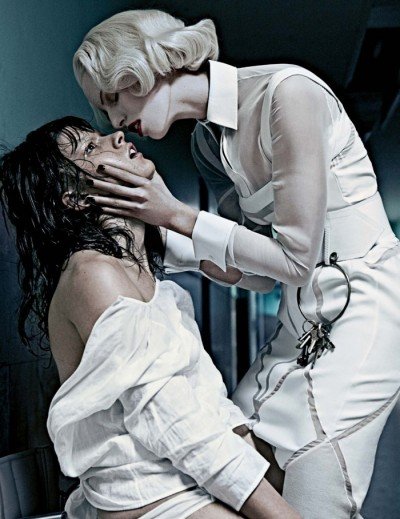
This disturbing photoshoot from Interview magazine features a sadistic “nurse” torturing a bewildered patient. There’s an obvious handler/mind control victim relationship depicted here.
Having victims tied and gagged up is the kind of crap MK handlers do to their slaves. Notice the emotionless look on the handler’s face – many handler’s are MK’ed themselves.
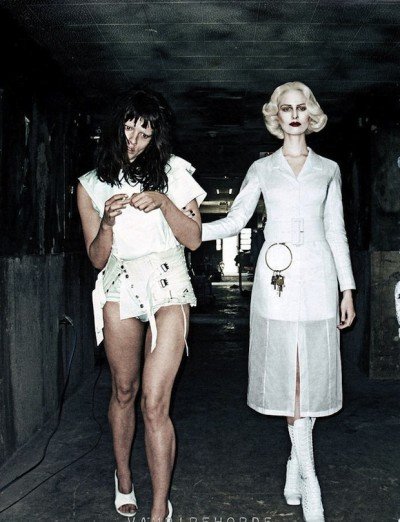
Another disturbing torture scene. I often ask this but…is this fashion? Really?
The victim appears to be prepped for sexual abuse. This is another “tool” used to program mind control slaves and I am not sure what “snuff”-looking shoot is doing in a fashion magazine.
I’d say she looks traumatized.
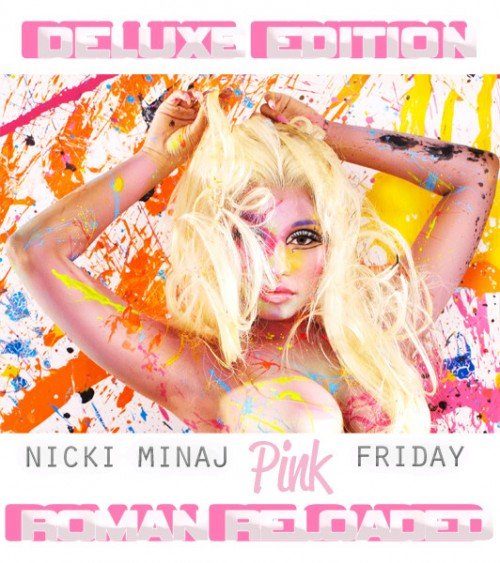
The cover Nicki Minaj’s new album puts an emphasis on the all-important one-eye symbol.
Justin Bieber hides one eye with a slab of meat. Interesting way to show who’s in charge of his career.
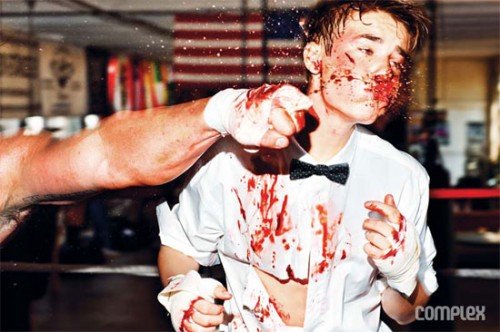
He also gets the crap beaten out of him by an unknown guy. While some might find this pic to be the most satisfying thing they ever saw, it still goes with this new trend of showing people being violently abused in photoshoots.
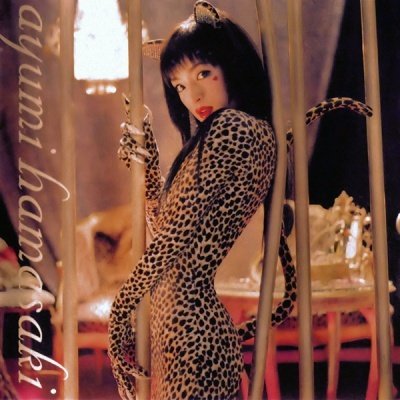
A poster for the upcoming Japanese movie “Helter Skelter”. It tells the story of a woman named ‘Ririko’ (Sawajiri) who received cosmetic surgery on her entire body, thus allowing her to become a shining top star in the entertainment industry. The imagery of the poster makes it clear that it is about mind control in the entertainment industry. The following movie trailer also places an emphasis on butterflies, even showing a Monarch tattoo on Ririko.
Yup, Japan is all into this Illuminati symbolism. This pic of Gackt is all about the one-eye thing.
…but it’s all over the world. We see here the one-eye thing on the cover of German magazine Tush.
Amanda Seyfried also has to do it.
This ad for the Cirque du Soleil has an open eye on America…shut eye on Asia?
Visa is also letting you know what they’re about (debt is slavery).
This photoshoot from Vogue Italia depicts perfect what mind control is about.
…the model also has to give love a Baphomet-looking head.
Taylor Momsen in an orgy-like scene wearing a shirt with a Church of Satan symbol, complete with inverted crosses.
Kris Kylie and Kendall Jenner (from the Kardashians) as creepy twins in a photoshoot that was featured on America’s Next Top Model. Notice the mom pointing to an image dividing a female body as if it was butcher meat. The fashion world loves dehumanization. And, as an added bonus, a creepy clown.
This poster of the “Immortal” tour is full of Monarch butterflies. Is it hinting to what happened to MJ during his career (Monarch mind control)?
Megan Fox as a plastic mannequin. A favorite way to portray Monarch slaves.
A “candid” picture by celebrity photographer Terry Richardson featuring cute cookies…with a bunch of inverted crosses on them.
Schools in northern Brazil are now embedding their uniforms with locator chips that allow the tracking and monitoring of their students. Advertised as a “way of informing parents in case their children skip school”, the widespread use of these devices and the information they can potentially gather is rather unsettling. There no “off function” on these chips. I read some comments stating that these chips will “help finding kidnapped kids”. Really? What if the kidnappers made the kid, like, um, NOT wear the shirt? Lame excuses to hide the real agenda here, constantly increasing surveillance and monitoring in the name of “security”. Here’s an article on the “intelligent uniforms” that are actually worn by 20,000 students and required on all 43,000 of the Brazilian locale in 2013.
Locator chips keep track of students in Brazil
Grade-school students in a northeastern Brazilian city are using uniforms embedded with locator chips that help alert parents if they’re cutting classes, the city’s education secretary said Thursday.
Twenty thousand students in 25 of Vitoria da Conquista’s 213 public schools started using T-shirts with chips earlier this week, secretary Coriolano Moraes said by telephone.
By 2013, all of the city’s 43,000 public school students, aged 4 to 14, will be using the chip-embedded T-shirts, he added.
Radio frequency chips in “intelligent uniforms” let a computer know when children enter school and it sends a text message to their cell phones. Parents are also alerted if kids don’t show up 20 minutes after classes begin with the following message: “Your child has still not arrived at school.”
“We noticed that many parents would bring their children to school but would not see if they actually entered the building because they always left in a hurry to get to work on time,” Moraes said in a telephone interview. “They would always be surprised when told of the number times their children skipped class.
After a student skips classes three times parents will be asked to explain the absences. If they fail to do so, the school may notify authorities, Moares said.
The city government invested $670,000 to design, test and make the microchipped T-shirts, he said.
The chips, similar to those used to track pets in many countries, are placed underneath each school’s coat-of-arms or on one of the sleeves below a phrase that says: “Education does not transform the world. Education changes people and people transform the world.”
The T-shirts, can be washed and ironed without damaging the chips, Moraes said adding that the chips have a “security system that makes tampering virtually impossible.”
Moraes said that Vitoria da Conquista is the first city in Brazil “and maybe in the world” to use this system.
“I believe we may be setting a trend because we have received many requests from all over Brazil for information on how our system works,” he said.
In my article on Whitney Houston and the Grammy Awards, I quoted an article that describes the odd presence of a guy named Raffles van Exel at the time of Whitney’s death. Described as a “Hollywood mystery”, the article states Raffles “trades on being an “insider” when there’s a scandal; No one really knows him, but he’s always where there’s action and celebrities.” He was also around Micheal Jackson during his difficult periods.
It was then discovered that Raffles was the one who took pictures of Whitney in her casket to then sell them to the National Inquirer. Today, another odd piece of information is out: Raffles admitted to removing “evidence” from Whitney’s room. How come this weird fellow with no family ties whatsoever has an all-access pass around celebrities in trouble? Is he an Illuminati insider that “facilitates” the sacrifices? Here’s an article on him removing evidence from Whitney’s room.
Man Confesses He Removed Evidence From Whitney Houston Death Scene: ‘Someone Had To Do It’ (EXCLUSIVE DETAILS)
A close confidant of the late pop diva Whitney Houston has admitted he cleaned up the hotel room where she drowned, Celebuzz has learned.
In an interview with respected Dutch newspaper The Telegraph on February 15, just four days after the singer’s death, Raffles van Exel confessed: “The room had to be emptied.”
“Someone had to do it,” van Exel told the newspaper, according to a translation of the article published online.
Van Exel stopped short of telling The Telegraph what exactly he removed from the suite and he has not returned Celebuzz’s request for comment.
Last week, the Los Angeles County Coroner’s Office declared Houston, 48, died from an accidental drowning in a hotel bathtub with the “effects of atherosclerotic heart disease and cocaine use.”
Sources tell Celebuzz that Beverly Hills police are still investigating how Houston acquired the drugs that contributed to her death and whether they were hidden from police and first responders.
No cocaine or drug paraphernalia were found in the suite at the Beverly Hilton Hotel in Beverly Hills, Calif., the source adds.
However, Houston’s cocaine use appeared to have occurred “in the time period just immediately prior to her collapse in the bathtub at the hotel,” Chief Coroner Craig Harvey said when he announced the findings of his report, last week.
“(Houston’s case) is still an open investigation for us… I can’t disclose any details about the investigation,” BHPD Lt. Mark Rosen told People on March 23.
In various media released, Van Exel, a Dutch national, touts himself as a “highly respected entertainment consultant” who has “guided some of the world’s most acclaimed executives and celebrities.”
His relationship with Houston and other stars, including late King of Pop Michael Jackson, have been the focus of investigation on two websites, including the urban blog Diary of a Hollywood Street King and Forbes.
In her music video ‘Part of Me’, Katy Perry ditches her wigs and latex dresses to put on a Marines uniform. While some might find this style change “refreshing”, the video for ‘Part of Me’ has a very specific agenda: To entice young people to enlist in the military. We’ll look at how ‘Part of Me’ is a three-minute long advertisement to recruit new soldiers for the U.S. military.
Katy Perry is usually known for wearing blue wigs and sexy dresses, but she gives it all up in Part of Me. Yup, watch out terrorists, Katy Perry is an army girl now. While “pop culture observers” welcomed Katy Perry’s image change, qualifying it as “refreshing”, most missed an important fact: In Part of Me, Katy Perry is used to push yet another agenda of the elite – the recruitment of young people into the military. If we look at it objectively, Part of Me is, in fact, a three-and-half-minute long “Join the Military” advertisement disguised as a music video. It contains all of the components found in regular TV ads for the Marines and any other army-related ads: cool high-tech war machines, excitement, and action, being “All You Can Be” and so forth. But most importantly, it presents the military and, by extension, war, as the perfect escape from the bummers of regular life.
The video was shot at an actual U.S. Marine base, using actual Marines, which means that the video is truly a “sponsored message” from the Marines. By appealing to young people using singers they look up to and themes they can relate to, the U.S. military is looking to address an important issue: Getting more young people to enlist. There is indeed a growing need for fresh blood in the military as the U.S. government and other Western countries are putting intense pressure on so-called “Axis of Evil” regional powers such as Iran and Syria. The numerous military expeditions of the past few years (Iraq, Afghanistan, Libya), and increasing calls to bring home enlisted soldiers who have done multiple tours of duty means that as the U.S. prepares for upcoming conflicts, new soldiers are needed to enlist and be shipped abroad. Instead of paying for a 30-second TV commercial, military marketing specialists probably realized that they could get better results by investing in the music video of a star that is popular with teenagers. While regular “Be All You Can Be” TV commercials were effective in the past, today’s young generation watches less TV and more YouTube. So why not use pop stars who get hundreds of millions of YouTube views and who are already used to push other aspects of the elite’s agenda?
Not a New Concept
A 1917 Uncle Sam poster used to recruit soldiers during WWI
Governments have always used the most advanced forms of mass media advertising to entice citizens to enlist in the armed forces. During World War I, the face of Uncle Sam was plastered all over the United States in order to recruit new soldiers. However, as the years went by, and television made its appearance, posters of the bearded fellow pointing at you with a stern look somewhat lost its effectiveness.
During the 1950s, although mandatory drafts were in full force, the military still looked for opportunities for good PR. When Elvis Presley, the hottest and most controversial artist of the time, joined the army as a regular soldier, the press was given “full access”, and were even allowed take pictures of him in his drawers while getting weighed in.
Elvis’ career as a soldier was highly publicized, as countless pictures of him flooded mass media.
Elvis’ immense charm, charisma, and popularity gave the army great visibility, successfully enticing young people of the rebellious “Rock’n’Roll” generation to be interested in the military.
Since the 1950s, marketing techniques have improved in both efficiency and sophistication. In fact, today, the best advertisement often parades itself as no advertisement – in the advertising industry, messages are known to be received more effectively when indirectly reaching an audience that believes it is being entertained. To achieve this, celebrities and pop stars are often used as vehicles to reach the minds of young people with specific messages without them even realizing it. Katy Perry’s Part of Me is an example of this technique, as nowhere in the video does it state that it is an advertisement for the U.S. military. Perry’s video was simply used by the military to reach its target audience–teenagers approaching the age of enlistment–but the whole thing appears as if it was a “creative” decision of Katy Perry the Artist.
Watching Part of Me immediately reminded me of the Simpsons episode where Bart and his friends were chosen by a producer to form a boy band. The group’s hit single was Yvan Eht Nioj, which was “Join the Navy” in reverse. It was later discovered that Bart Simpson’s group was used by the Navy to push subliminal messages to young people in order to get them to become soldiers.
Party Posse’s music video featured the group doing cool army things in Iraq such as driving dunebuggeys and flying jet fighters.
While Perry’s video relies on overt imagery rather than subliminal messages (as far as I know), Part of Me is based on the same agenda as portrayed in the Simpsons: To reach teenagers using the great appeal of pop stars. Let’s look at the most important scenes of the video.
Part of Me
The video begins with a concept most teenagers can relate to: Heartbreak. Katy catches her boyfriend kissing another woman. so she barges in and breaks up with him.
Katy walks away from her douchebag boyfriend. Although the video is basically a commercial for the United States military, it begins with a relationship-related scene in order to make the video relatable and to give it an emotional element.
Katy then drives to a gas station. She is very mad, confused and impulsive, so she obeys to the first advertisement she encounters. I bet marketers would love to have more people like Katy.
When Katy reads this actual US Marines sticker, she is immediately sold.
When facing heartbreak, some people might try to feel better with a chocolate fudge sundae or maybe a nice walk around the block. But in Katy’s case, she joins the US industrial-military complex and gets trained to fight guerrilla warfare abroad. Don’t get me wrong, I have respect for soldiers in the military, but I think a life-changing decision like joining the Marines should not be made in a moment of emotional frenzy.
Nevertheless, Katy makes this decision, cutting her hair in a boyish fashion and trading her Blackberry for a Marines uniform.
Katy is now the property of the U.S. military complex.
The rest of the video is very similar to armed forces commercials seen on TV where big guns, big machines, and scenes of hardcore combat training are presented in a dynamic matter to appeal to young people who are bored with their lives. The lyrics of the song are cleverly mixed with the images of the video to make the advertisement even more effective. For instance, when Perry sings “I just wanna throw my phone away, Find out who is really there for me”, she is seen with her fellow soldiers, implying that her Marines buddies will never let her down.
Katy burns a letter from her boyfriend (representing her old life) while hanging out with her Marines buddy. He’s REALLY there for her. The camaraderie between soldiers is an important selling point to help recruit personnel and is heavily promoted in this video.
When Katy sings: “I fell deep and you let me drown, But that was then and this is now … Now look at me”, she is shown firing a rifle as if it was a great accomplishment. Yep, look at her:
Katy is now in a military base, shooting a rifle and will most likely be shipped to a war zone in the near future. Take THAT cheating boyfriend, that’ll show you!
During the bridge of the song, Katy sings “Now look at me, I’m sparkling, A firework, a dancing flame, You won’t ever put me out again, I’m glowing, oh woah oh”. During that time she is shown patrolling a mock Middle-Eastern village, used for real-life military training for guerrilla warfare simulations. This is another clever association between the song’s lyrics and the images in the video, provoking a positive association between the two.
Katy, you say you’re “sparkling” but you’re being trained to fight guerrilla warfare in the Middle East, which is known to be extremely bloody, violent and often involves civilian casualties. So, yeah, I’m not sure that “sparkling” is the best word to describe your situation.
Later in the video, the positive and uplifting words of the chorus are mixed with all-out war scenes involving soldiers running, tanks rolling and helicopters flying. There’s definitely some cognitive dissonance here because, in case some people don’t know, war is NEVER positive nor uplifting. It is ALWAYS terrible, violent and horrifying. However, in order to recruit new soldiers, advertisers need to make the whole “military experience” appear wonderful.
Katy is now caught up in the business of war, where death, mutilation, horror, and trauma can get in the way of conquering Third World countries for resources and power. But hey, at least Katy’s douchebag boyfriend isn’t there!
So, in short, discovering that her boyfriend is cheating on her has Katy Perry enlist in the Marines, to be trained for combat, and, ultimately, be used as cannon fodder in conflicts she likely doesn’t fully understand. The elite seems to be looking for lost youth to fight their wars. Was Part of Me an Illuminati-sponsored message to find new recruits for its armed branch, the U.S. military-industrial complex?
A single eye above the trigger of a gun indicates that this military-themed video is a product of the elite’s agenda … who happen to have a bunch of wars planned in the coming years.
In Conclusion
Watching a bit of “international news” is enough to make one realize that there is currently a lot of pressure on “bad” countries such as Syria, Iran, and Uganda and that public opinion is being prepped for new military conflicts. The prospect of future wars, along with the countless existing warzones around the world, is generating a great need for new soldiers military in the U.S. and other Western countries. Since military drafts are no longer an option, new and innovative ways are being used to reach the army’s target audience (teenagers) and to get them interested in enlisting in armed forces. Katy Perry’s Part of Me is an obvious Marines recruitment advertisement disguised as a music video, with the Marine’s “cool” weaponry, intensive training and soldier camaraderie all presented in a dynamic and appealing matter. The military and war are presented as ideal escapes from life’s bummers, like a cheating boyfriend, and geared to appeal to a generation of bored teenagers. But is war really the perfect way to forget about a bad relationship? Go ask a war veteran.
The NSA is building an enormous spy center, probably the biggest ever, in Bluffdale Utah. When construction is completed in 2013, the heavily fortified $2 billion facility will encompass 1 million square feet, including four 25,000-square-foot areas to house endless rows of high-powered servers. The center will be fed data collected by the agency’s eavesdropping satellites, overseas listening posts, and secret monitoring rooms in telecom facilities throughout the US.
The incredible processing power of this facility will be used to scan e-mails, phone calls, text messages, tweets or any other kind of communication. As a former NSA officer states in his article, while holding his thumb and forefinger close together “We are that far from a turnkey totalitarian state.” Here’s an article from Wired about this massive facility.
The NSA Is Building the Country’s Biggest Spy Center (Watch What You Say)
The spring air in the small, sand-dusted town has a soft haze to it, and clumps of green-gray sagebrush rustle in the breeze. Bluffdale sits in a bowl-shaped valley in the shadow of Utah’s Wasatch Range to the east and the Oquirrh Mountains to the west. It’s the heart of Mormon country, where religious pioneers first arrived more than 160 years ago. They came to escape the rest of the world, to understand the mysterious words sent down from their god as revealed on buried golden plates, and to practice what has become known as “the principle,” marriage to multiple wives.
Today Bluffdale is home to one of the nation’s largest sects of polygamists, the Apostolic United Brethren, with upwards of 9,000 members. The brethren’s complex includes a chapel, a school, a sports field, and an archive. Membership has doubled since 1978—and the number of plural marriages has tripled—so the sect has recently been looking for ways to purchase more land and expand throughout the town.
But new pioneers have quietly begun moving into the area, secretive outsiders who say little and keep to themselves. Like the pious polygamists, they are focused on deciphering cryptic messages that only they have the power to understand. Just off Beef Hollow Road, less than a mile from brethren headquarters, thousands of hard-hatted construction workers in sweat-soaked T-shirts are laying the groundwork for the newcomers’ own temple and archive, a massive complex so large that it necessitated expanding the town’s boundaries. Once built, it will be more than five times the size of the US Capitol.
Rather than Bibles, prophets, and worshippers, this temple will be filled with servers, computer intelligence experts, and armed guards. And instead of listening for words flowing down from heaven, these newcomers will be secretly capturing, storing, and analyzing vast quantities of words and images hurtling through the world’s telecommunications networks. In the little town of Bluffdale, Big Love and Big Brother have become uneasy neighbors.
Under construction by contractors with top-secret clearances, the blandly named Utah Data Center is being built for the National Security Agency. A project of immense secrecy, it is the final piece in a complex puzzle assembled over the past decade. Its purpose: to intercept, decipher, analyze, and store vast swaths of the world’s communications as they zap down from satellites and zip through the underground and undersea cables of international, foreign, and domestic networks. The heavily fortified $2 billion center should be up and running in September 2013. Flowing through its servers and routers and stored in near-bottomless databases will be all forms of communication, including the complete contents of private emails, cell phone calls, and Google searches, as well as all sorts of personal data trails—parking receipts, travel itineraries, bookstore purchases, and other digital “pocket litter.” It is, in some measure, the realization of the “total information awareness” program created during the first term of the Bush administration—an effort that was killed by Congress in 2003 after it caused an outcry over its potential for invading Americans’ privacy.
But “this is more than just a data center,” says one senior intelligence official who until recently was involved with the program. The mammoth Bluffdale center will have another important and far more secret role that until now has gone unrevealed. It is also critical, he says, for breaking codes. And code-breaking is crucial, because much of the data that the center will handle—financial information, stock transactions, business deals, foreign military and diplomatic secrets, legal documents, confidential personal communications—will be heavily encrypted. According to another top official also involved with the program, the NSA made an enormous breakthrough several years ago in its ability to cryptanalyze, or break, unfathomably complex encryption systems employed by not only governments around the world but also many average computer users in the US. The upshot, according to this official: “Everybody’s a target; everybody with communication is a target.”
For the NSA, overflowing with tens of billions of dollars in post-9/11 budget awards, the cryptanalysis breakthrough came at a time of explosive growth, in size as well as in power. Established as an arm of the Department of Defense following Pearl Harbor, with the primary purpose of preventing another surprise assault, the NSA suffered a series of humiliations in the post-Cold War years. Caught offguard by an escalating series of terrorist attacks—the first World Trade Center bombing, the blowing up of US embassies in East Africa, the attack on the USS Cole in Yemen, and finally the devastation of 9/11—some began questioning the agency’s very reason for being. In response, the NSA has quietly been reborn. And while there is little indication that its actual effectiveness has improved—after all, despite numerous pieces of evidence and intelligence-gathering opportunities, it missed the near-disastrous attempted attacks by the underwear bomber on a flight to Detroit in 2009 and by the car bomber in Times Square in 2010—there is no doubt that it has transformed itself into the largest, most covert, and potentially most intrusive intelligence agency ever created.
In the process—and for the first time since Watergate and the other scandals of the Nixon administration—the NSA has turned its surveillance apparatus on the US and its citizens. It has established listening posts throughout the nation to collect and sift through billions of email messages and phone calls, whether they originate within the country or overseas. It has created a supercomputer of almost unimaginable speed to look for patterns and unscramble codes. Finally, the agency has begun building a place to store all the trillions of words and thoughts and whispers captured in its electronic net. And, of course, it’s all being done in secret. To those on the inside, the old adage that NSA stands for Never Say Anything applies more than ever.
A swath of freezing fog blanketed Salt Lake City on the morning of January 6, 2011, mixing with a weeklong coating of heavy gray smog. Red air alerts, warning people to stay indoors unless absolutely necessary, had become almost daily occurrences, and the temperature was in the bone-chilling twenties. “What I smell and taste is like coal smoke,” complained one local blogger that day. At the city’s international airport, many inbound flights were delayed or diverted while outbound regional jets were grounded. But among those making it through the icy mist was a figure whose gray suit and tie made him almost disappear into the background. He was tall and thin, with the physique of an aging basketball player and dark caterpillar eyebrows beneath a shock of matching hair. Accompanied by a retinue of bodyguards, the man was NSA deputy director Chris Inglis, the agency’s highest-ranking civilian and the person who ran its worldwide day-to-day operations.
A short time later, Inglis arrived in Bluffdale at the site of the future data center, a flat, unpaved runway on a little-used part of Camp Williams, a National Guard training site. There, in a white tent set up for the occasion, Inglis joined Harvey Davis, the agency’s associate director for installations and logistics, and Utah senator Orrin Hatch, along with a few generals and politicians in a surreal ceremony. Standing in an odd wooden sandbox and holding gold-painted shovels, they made awkward jabs at the sand and thus officially broke ground on what the local media had simply dubbed “the spy center.” Hoping for some details on what was about to be built, reporters turned to one of the invited guests, Lane Beattie of the Salt Lake Chamber of Commerce. Did he have any idea of the purpose behind the new facility in his backyard? “Absolutely not,” he said with a self-conscious half laugh. “Nor do I want them spying on me.”
For his part, Inglis simply engaged in a bit of double-talk, emphasizing the least threatening aspect of the center: “It’s a state-of-the-art facility designed to support the intelligence community in its mission to, in turn, enable and protect the nation’s cybersecurity.” While cybersecurity will certainly be among the areas focused on in Bluffdale, what is collected, how it’s collected, and what is done with the material are far more important issues. Battling hackers makes for a nice cover—it’s easy to explain, and who could be against it? Then the reporters turned to Hatch, who proudly described the center as “a great tribute to Utah,” then added, “I can’t tell you a lot about what they’re going to be doing, because it’s highly classified.”
And then there was this anomaly: Although this was supposedly the official ground-breaking for the nation’s largest and most expensive cybersecurity project, no one from the Department of Homeland Security, the agency responsible for protecting civilian networks from cyberattack, spoke from the lectern. In fact, the official who’d originally introduced the data center, at a press conference in Salt Lake City in October 2009, had nothing to do with cybersecurity. It was Glenn A. Gaffney, deputy director of national intelligence for collection, a man who had spent almost his entire career at the CIA. As head of collection for the intelligence community, he managed the country’s human and electronic spies.
Within days, the tent and sandbox and gold shovels would be gone and Inglis and the generals would be replaced by some 10,000 construction workers. “We’ve been asked not to talk about the project,” Rob Moore, president of Big-D Construction, one of the three major contractors working on the project, told a local reporter. The plans for the center show an extensive security system: an elaborate $10 million antiterrorism protection program, including a fence designed to stop a 15,000-pound vehicle traveling 50 miles per hour, closed-circuit cameras, a biometric identification system, a vehicle inspection facility, and a visitor-control center.
Inside, the facility will consist of four 25,000-square-foot halls filled with servers, complete with raised floor space for cables and storage. In addition, there will be more than 900,000 square feet for technical support and administration. The entire site will be self-sustaining, with fuel tanks large enough to power the backup generators for three days in an emergency, water storage with the capability of pumping 1.7 million gallons of liquid per day, as well as a sewage system and massive air-conditioning system to keep all those servers cool. Electricity will come from the center’s own substation built by Rocky Mountain Power to satisfy the 65-megawatt power demand. Such a mammoth amount of energy comes with a mammoth price tag—about $40 million a year, according to one estimate.
Given the facility’s scale and the fact that a terabyte of data can now be stored on a flash drive the size of a man’s pinky, the potential amount of information that could be housed in Bluffdale is truly staggering. But so is the exponential growth in the amount of intelligence data being produced every day by the eavesdropping sensors of the NSA and other intelligence agencies. As a result of this “expanding array of theater airborne and other sensor networks,” as a 2007 Department of Defense report puts it, the Pentagon is attempting to expand its worldwide communications network, known as the Global Information Grid, to handle yottabytes (1024 bytes) of data. (A yottabyte is a septillion bytes—so large that no one has yet coined a term for the next higher magnitude.)
It needs that capacity because, according to a recent report by Cisco, global Internet traffic will quadruple from 2010 to 2015, reaching 966 exabytes per year. (A million exabytes equal a yottabyte.) In terms of scale, Eric Schmidt, Google’s former CEO, once estimated that the total of all human knowledge created from the dawn of man to 2003 totaled 5 exabytes. And the data flow shows no sign of slowing. In 2011 more than 2 billion of the world’s 6.9 billion people were connected to the Internet. By 2015, market research firm IDC estimates, there will be 2.7 billion users. Thus, the NSA’s need for a 1-million-square-foot data storehouse. Should the agency ever fill the Utah center with a yottabyte of information, it would be equal to about 500 quintillion (500,000,000,000,000,000,000) pages of text.
The data stored in Bluffdale will naturally go far beyond the world’s billions of public web pages. The NSA is more interested in the so-called invisible web, also known as the deep web or deepnet—data beyond the reach of the public. This includes password-protected data, US and foreign government communications, and noncommercial file-sharing between trusted peers. “The deep web contains government reports, databases, and other sources of information of high value to DOD and the intelligence community,” according to a 2010 Defense Science Board report. “Alternative tools are needed to find and index data in the deep web … Stealing the classified secrets of a potential adversary is where the [intelligence] community is most comfortable.” With its new Utah Data Center, the NSA will at last have the technical capability to store, and rummage through, all those stolen secrets. The question, of course, is how the agency defines who is, and who is not, “a potential adversary.”
Before yottabytes of data from the deep web and elsewhere can begin piling up inside the servers of the NSA’s new center, they must be collected. To better accomplish that, the agency has undergone the largest building boom in its history, including installing secret electronic monitoring rooms in major US telecom facilities. Controlled by the NSA, these highly secured spaces are where the agency taps into the US communications networks, a practice that came to light during the Bush years but was never acknowledged by the agency. The broad outlines of the so-called warrantless-wiretapping program have long been exposed—how the NSA secretly and illegally bypassed the Foreign Intelligence Surveillance Court, which was supposed to oversee and authorize highly targeted domestic eavesdropping; how the program allowed wholesale monitoring of millions of American phone calls and email. In the wake of the program’s exposure, Congress passed the FISA Amendments Act of 2008, which largely made the practices legal. Telecoms that had agreed to participate in the illegal activity were granted immunity from prosecution and lawsuits. What wasn’t revealed until now, however, was the enormity of this ongoing domestic spying program.
For the first time, a former NSA official has gone on the record to describe the program, codenamed Stellar Wind, in detail. William Binney was a senior NSA crypto-mathematician largely responsible for automating the agency’s worldwide eavesdropping network. A tall man with strands of black hair across the front of his scalp and dark, determined eyes behind thick-rimmed glasses, the 68-year-old spent nearly four decades breaking codes and finding new ways to channel billions of private phone calls and email messages from around the world into the NSA’s bulging databases. As chief and one of the two cofounders of the agency’s Signals Intelligence Automation Research Center, Binney and his team designed much of the infrastructure that’s still likely used to intercept international and foreign communications.
He explains that the agency could have installed its tapping gear at the nation’s cable landing stations—the more than two dozen sites on the periphery of the US where fiber-optic cables come ashore. If it had taken that route, the NSA would have been able to limit its eavesdropping to just international communications, which at the time was all that was allowed under US law. Instead it chose to put the wiretapping rooms at key junction points throughout the country—large, windowless buildings known as switches—thus gaining access to not just international communications but also to most of the domestic traffic flowing through the US. The network of intercept stations goes far beyond the single room in an AT&T building in San Francisco exposed by a whistle-blower in 2006. “I think there’s 10 to 20 of them,” Binney says. “That’s not just San Francisco; they have them in the middle of the country and also on the East Coast.”
The eavesdropping on Americans doesn’t stop at the telecom switches. To capture satellite communications in and out of the US, the agency also monitors AT&T’s powerful earth stations, satellite receivers in locations that include Roaring Creek and Salt Creek. Tucked away on a back road in rural Catawissa, Pennsylvania, Roaring Creek’s three 105-foot dishes handle much of the country’s communications to and from Europe and the Middle East. And on an isolated stretch of land in remote Arbuckle, California, three similar dishes at the company’s Salt Creek station service the Pacific Rim and Asia.
Binney left the NSA in late 2001, shortly after the agency launched its warrantless-wiretapping program. “They violated the Constitution setting it up,” he says bluntly. “But they didn’t care. They were going to do it anyway, and they were going to crucify anyone who stood in the way. When they started violating the Constitution, I couldn’t stay.” Binney says Stellar Wind was far larger than has been publicly disclosed and included not just eavesdropping on domestic phone calls but the inspection of domestic email. At the outset the program recorded 320 million calls a day, he says, which represented about 73 to 80 percent of the total volume of the agency’s worldwide intercepts. The haul only grew from there. According to Binney—who has maintained close contact with agency employees until a few years ago—the taps in the secret rooms dotting the country are actually powered by highly sophisticated software programs that conduct “deep packet inspection,” examining Internet traffic as it passes through the 10-gigabit-per-second cables at the speed of light.
The software, created by a company called Narus that’s now part of Boeing, is controlled remotely from NSA headquarters at Fort Meade in Maryland and searches US sources for target addresses, locations, countries, and phone numbers, as well as watch-listed names, keywords, and phrases in email. Any communication that arouses suspicion, especially those to or from the million or so people on agency watch lists, are automatically copied or recorded and then transmitted to the NSA.
The scope of surveillance expands from there, Binney says. Once a name is entered into the Narus database, all phone calls and other communications to and from that person are automatically routed to the NSA’s recorders. “Anybody you want, route to a recorder,” Binney says. “If your number’s in there? Routed and gets recorded.” He adds, “The Narus device allows you to take it all.” And when Bluffdale is completed, whatever is collected will be routed there for storage and analysis.
According to Binney, one of the deepest secrets of the Stellar Wind program—again, never confirmed until now—was that the NSA gained warrantless access to AT&T’s vast trove of domestic and international billing records, detailed information about who called whom in the US and around the world. As of 2007, AT&T had more than 2.8 trillion records housed in a database at its Florham Park, New Jersey, complex.
Verizon was also part of the program, Binney says, and that greatly expanded the volume of calls subject to the agency’s domestic eavesdropping. “That multiplies the call rate by at least a factor of five,” he says. “So you’re over a billion and a half calls a day.” (Spokespeople for Verizon and AT&T said their companies would not comment on matters of national security.)
After he left the NSA, Binney suggested a system for monitoring people’s communications according to how closely they are connected to an initial target. The further away from the target—say you’re just an acquaintance of a friend of the target—the less the surveillance. But the agency rejected the idea, and, given the massive new storage facility in Utah, Binney suspects that it now simply collects everything. “The whole idea was, how do you manage 20 terabytes of intercept a minute?” he says. “The way we proposed was to distinguish between things you want and things you don’t want.” Instead, he adds, “they’re storing everything they gather.” And the agency is gathering as much as it can.
Once the communications are intercepted and stored, the data-mining begins. “You can watch everybody all the time with data- mining,” Binney says. Everything a person does becomes charted on a graph, “financial transactions or travel or anything,” he says. Thus, as data like bookstore receipts, bank statements, and commuter toll records flow in, the NSA is able to paint a more and more detailed picture of someone’s life.
The NSA also has the ability to eavesdrop on phone calls directly and in real time. According to Adrienne J. Kinne, who worked both before and after 9/11 as a voice interceptor at the NSA facility in Georgia, in the wake of the World Trade Center attacks “basically all rules were thrown out the window, and they would use any excuse to justify a waiver to spy on Americans.” Even journalists calling home from overseas were included. “A lot of time you could tell they were calling their families,” she says, “incredibly intimate, personal conversations.” Kinne found the act of eavesdropping on innocent fellow citizens personally distressing. “It’s almost like going through and finding somebody’s diary,” she says.
But there is, of course, reason for anyone to be distressed about the practice. Once the door is open for the government to spy on US citizens, there are often great temptations to abuse that power for political purposes, as when Richard Nixon eavesdropped on his political enemies during Watergate and ordered the NSA to spy on antiwar protesters. Those and other abuses prompted Congress to enact prohibitions in the mid-1970s against domestic spying.
Before he gave up and left the NSA, Binney tried to persuade officials to create a more targeted system that could be authorized by a court. At the time, the agency had 72 hours to obtain a legal warrant, and Binney devised a method to computerize the system. “I had proposed that we automate the process of requesting a warrant and automate approval so we could manage a couple of million intercepts a day, rather than subvert the whole process.” But such a system would have required close coordination with the courts, and NSA officials weren’t interested in that, Binney says. Instead they continued to haul in data on a grand scale. Asked how many communications—”transactions,” in NSA’s lingo—the agency has intercepted since 9/11, Binney estimates the number at “between 15 and 20 trillion, the aggregate over 11 years.”
When Barack Obama took office, Binney hoped the new administration might be open to reforming the program to address his constitutional concerns. He and another former senior NSA analyst, J. Kirk Wiebe, tried to bring the idea of an automated warrant-approval system to the attention of the Department of Justice’s inspector general. They were given the brush-off. “They said, oh, OK, we can’t comment,” Binney says.
Sitting in a restaurant not far from NSA headquarters, the place where he spent nearly 40 years of his life, Binney held his thumb and forefinger close together. “We are, like, that far from a turnkey totalitarian state,” he says.
The screening of KONY 2012 in Northern Uganda was not met with the appraise it got in America. Quite to the contrary, Ugandans were appalled by the “Make Him Famous” campaign that gave Joseph Kony superstar status. I perfectly understand what they mean. The definition of “famous” is having a widespread reputation, usually of a favorable nature. Synonyms of “famous” are famed, notable, illustrious, celebrated, eminent, distinguished. One does not need to be a specialist in neurolinguistics to understand that the “Make Him Famous” campaign might be perceived by the brain in a perverse way. And the Ugandans are not fans of the merchandising. Also very understandable.
Facing this criticism, representatives of Invisible Children stated that KONY 2012 “was targeted to educate a younger Western audience”. In other words, the video was tailor-made to indoctrinate young gullible American and European kids (as we’ve seen in the article KONY 2012: State Propaganda for a New Generation) and no one else. Good comeback. Here’s an article from The Guardian about the screening.
Kony 2012 video screening met with anger in northern Uganda
Victims of the LRA slam film which went viral across world as not representing them and say campaign’s merchandise is offensive
It had been viewed more than 77m times around the world, but not by those who know the Joseph Kony best: his victims in northern Uganda.
That changed on Tuesday night when thousands flocked to watch Kony 2012, the video made by a US charity urging a grassroots campaign against the fugitive warlord that has gone viral.
The film was projected on to an ersatz cinema screen fashioned from a white sheet, held up by metal poles, in a town park. The reaction? Puzzlement, then anger, which boiled over into scuffles and stone-throwing that sent organisers fleeing for cover.
There was particular criticism of the Stop Kony campaign’s use of merchandise, such as bracelets and T-shirts, which victims said they find offensive.
“People were very angry about the film,” said Victor Ochen, director of a local charity, the African Youth Initiative Network (Ayinet), which arranged the screening. “They were all saying, ‘This is not about us, it does not reflect our lives’.”
Ochen said he had wanted to provide an opportunity for victims to see the film made by the charity Invisible Children, mindful that less than 2% of Ugandans have internet access.
The video, posted on YouTube on 5 March and narrated by one of Invisible Children’s founders, Jason Russell, had drawn the support of celebrities including George Clooney and Angelina Jolie, but provoked criticism for oversimplifying the conflict and not making clear that Kony was driven out of Uganda several years ago.
Before sunset on Tuesday two metal rods were hammered into dry dirt and grass and a white sheet hoisted to create an open-air cinema in the mayor’s gardens in the centre of Lira, 220 miles north of the capital, Kampala.
Word about the “premiere” spread on local radio, drawing a crowd on foot and bicycle that grew over several hours and was estimated at more than 35,000 by Ochen, though others put it at more like 5,000.
The expectant, excited spectators, many of whom cannot speak English, included victims who have been left scarred and maimed by Kony’s atrocities.
But Ochen, whose own father and brother were abducted by Kony’s Lord’s Resistance Army (LRA), said on Wednesday: “Reacting to the film, there was a strong sense that the video was definitely not produced for an African audience, and that it was not sensitive enough to the victims.
“It was very hurtful for them and their families to see posters, bracelets and buttons, all looking like slick campaign ads of the person most responsible for their shattered lives. One young man who lost four brothers and one of his arms said afterwards: ‘How can anybody expect me to wear a T-shirt with Kony’s name on it?'”
He added: “For all the victims, the attempt to make Kony famous so as to prop up public support for his apprehension is laudable but the way this goal is pursued in the video is inappropriate and ignores their feelings.
“That fame is not what Kony deserves for causing so much suffering was one overwhelming reaction. People were asking: Why give such criminals celebrity status? Why not prioritise addressing the plight of the victims whose sufferings are visible?”
The screening ended amid jeers and scuffles, with some angry viewers throwing stones. Ayinet has decided to suspend planning screenings of Kony 2012 in other parts of northern Uganda indefinitely due to the hostile reaction.
Emmy Okello, a radio journalist in Lira, said: “I cannot understand the intention of this video. It is difficult to account to us if you are not including local people. What has angered people is that the video is about a white person, not about the victims. All of them came here hoping to see video that tells their story.”
Okello Jifony, who was forced to fight under Kony for 18 months, told Reuters: “We expected serious action, Americans fighting Kony like in a real movie.”
He added: “Why didn’t they use the real victims in this film?”
On Wednesday there were calls in Uganda to ban the campaign’s “Stop Kony” T-shirts from entering the country. One caller to a radio phone-in said: “The government must protect us victims not only from Kony but also from things that hurt us like these T-shirts.
“And as people of northern Uganda we will not accept anyone to cross Karuma (a bridge across the Nile that connects north to central Uganda) with that T-shirt.”
Al-Jazeera reporter Malcolm Webb blogged: “One woman I spoke to made the comparison of selling Osama Bin Laden paraphernalia post 9/11 – likely to be highly offensive to many Americans, how ever well intentioned the campaign behind it.”
Kony, a self-proclaimed mystic, is wanted by the international criminal court for crimes against humanity.
On Tuesday a Congolese general said Kony and other LRA leaders have been chased out of the Democratic Republic of Congo to the neighbouring Central African Republic and no longer pose a threat in his country.
General Jean Claude Kifwa, in charge of fighting the LRA in Congo, told journalists: “We have reduced the capacity of the LRA. For us it’s no longer an issue of defence. It’s a public order issue.”
The comment follows a complaint by nearby Uganda that Congo was obstructing its US-backed hunt for Kony.
– Source: The Guardian
The overnight viral sensation KONY 2012 brought worldwide awareness to the African war criminal Joseph Kony. Beneath this commendable cause, lies however an elaborate agenda that is presented in the video in a very manipulative way. We’ll look at the agenda behind KONY 2012 and how it uses reverse psychology to not only justify a military operation in Africa, but to actually have people demand it.
KONY 2012 is a viral sensation that swept the entire world in less than 24 hours. Its main subject is the African rebel leader Joseph Kony, his war crimes and the clearly defined “movement” to stop him. Countless celebrities have endorsed the movement, news sources have reported it and social media is buzzing with it. While the problem of guerrilla warfare and child soldiers has plagued Africa for decades, and several documentaries have already been produced regarding the issue, this particular 29-minute video made managed to obtain mass exposure and support.
KONY 2012 is less of a documentary than it is a highly efficient infomercial that is tailor-made for the Facebook generation, using state-of-the-art marketing techniques to make its point. Young people like “underground movements” and want to feel like they are changing the world. KONY 2012 taps into these needs to bring about something that is not “hip” or “underground” at all: A military operation in Uganda. Not only that, it urges the participants of the movement to order stuff, to wear bracelets that are associated with an online profile and to record their actions in social media. This makes KONY 2012 the first artificially created movement that is fully track-able, monitor-able and quantifiable by those who engendered it. In other words, what appears to be a movement “from the people” is actually a new way for the elite to advance its agenda.
A Propaganda Experiment
The video begins with an interesting statement: “The next 27 minutes are an experiment. But in order for it to work, you have to pay attention”. It is an experiment as it tests a new, groundbreaking way to get an agenda accepted by the Facebook generation. In the past, when the government needed to justify the invasion of a country, the President would sit in front of the camera and tell the public why war should be declared in this area of the world. In the case of KONY, the military agenda is disguised as grassroots activism, where the US army entering Uganda would be perceived as a “victory of the people”, effectively reversing the communications model.
Towards the end of the video, an image is displayed explaining how decisions (and messages) start from the top of the pyramid (the elite) and are communicated to the masses through mass media and such.
Due to the advent of social media, the above diagram has become a lot less effective to get a message across to the young generation. It is not CNN reports and the President addressing the nation anymore, it is about “liking” Facebook pages and viral YouTube videos. This is where messages now come across. Always studying, analyzing and exploiting the most effective ways to persuade public opinion, KONY 2012 appears to be an attempt to test out the effectiveness of a “viral” propaganda campaign. By creating this “movement” and making young people actually DEMAND the U.S. government intervene in Africa, the masterminds behind this campaign would manage the impossible: Reversing the propaganda model in order to make it emanate from the people. By doing so, the elite’s agenda is not only accepted by the masses, it is perceived as a victory by them.
“We are living in a new world” indeed. The KONY 2012 logo aptly represents how a viral video and social media can reverse the propaganda model. Don’t be fooled however. Power is still not in the hands of the base of the pyramid … far from it. It is all about appearances.
When the war on Iraq was declared, a great portion of young Americans opposed the war. How is it they are now begging the government to send troops to Africa? A simple video, specifically conceived for the Facebook generation did the trick. As it is the case in most campaigns to justify a war, the first goal was to identify a bad guy.
Identifying the Bad Guy
By associating Kony with Bin Laden and Hitler in this poster, KONY 2012 is promoting war.
I have absolutely no intention of defending Joseph Kony or to say “he’s not that bad”. He, along with many other guerrilla factions across Africa, has committed despicable atrocities. However, the problem of child soldiers has existed for decades and there are literally hundreds of Joseph Konys across the African continent. In some cases, some of the armies are actually funded by Western countries. If we would truly go to the root of the issue, we’d discover that Africa has been plagued with the problem of warring factions and rebel guerrillas ever since Western forces “liberated” their colonies and divided the continent of Africa according to Western interests. Indeed, instead of setting the boundaries of each country according to the geographic location of the ethnic groups and tribes that live there, countries were created according to the economic needs of colonizing forces such as Great Britain, France and others. The net result is: A bunch of artificial countries that each contain several tribes, ethnic groups, languages and religions. When one group takes power, the others are repressed, which leads to violence and rebellion. Add to the mix extreme poverty due to resources being siphoned out of Africa by Western countries and you’ve got a breeding ground for merciless warlords. As long as this problem exists, Joseph Konys will continue to emerge in Africa.
But the video mentions none of this. All it says is that arresting Kony would “make the world better”. KONY 2012 is all about identifying a bad guy, “making him famous” and have people demand his death by U.S. forces. Fixing the true cause of problems in the third world has never been on the Agenda. But picking out a “bad guy” to justify military action has always been part of it. If in the case of Saddam Hussein, “facts” (that ultimately proved false) were given to justify the invasion of Iraq. A different technique is being used with Kony, one that originates from advertising.
Any marketing specialist will tell you: “Facts don’t sell, emotions do”. The first part of KONY 2012 solely addresses emotions. It is about making the filmmaker likeable, showing gut-wrenching images of African kids in pain, in misery and in despair. Then, the turning point: Joseph Kony is the cause of all of this. Not centuries of exploitation and devastation by Western forces in Africa that lead to chaos, lawlessness and poverty. No, it’s Kony. That bastard. George Clooney is really mad at him right now. He even tweeted about it.
Another marketing strategy is to appeal to the lowest common denominator. In other words, to get a message across, one must address the audience as if it was made of kids. KONY 2012 does exactly this by ridiculously oversimplifying the problem and explaining it to an actual child – who represents the viewers. This is not surprising though, as this is how the masses are perceived by the higher ups.
Here’s what this scene implies: “Look, dumb-ass, even this little kid gets it. So you better get it.”
Once the viewers had their emotions stirred, got infantilized and had the problem spelled out to them as if they were in kindergarten, the table is set for the true goal of the video: Defining the agenda.
Defining the Agenda
KONY 2012 is a movement backed by some of the world’s most powerful entities and has precise goals. As the movie’s intro states, it is an experiment. It is an opportunity to create a movement that can be fully trackable, quantifiable and manageable through social media whose culmination is a U.S. military intervention in Uganda. The carrying out of this mission will not only be perceived as a victory, it will restore young people’s faith in democracy. What the members of this movement might not realize is that they are helping the advancement of the elite’s agenda towards a New World Order.
This poster aptly summarizes how the Illuminati works. Political parties are irrelevant as both work towards the same Agenda.
The second part of the movie let’s go of emotions and describes to the viewers what the elite expects from them. U.S. troops are already in Uganda, but, according to the movie, Kony “changed his tactics”… Damnit Kony, you and your sneaky tactics. Apparently, high tech satellites, unmanned drones and all kinds of radars are not enough to catch this guy. Nope, in order to catch him, a complicated plan, involving the purchase of an “Action Kit” and the registering an ID bracelet on a website is required. Makes sense.
Those who want to “Stop Kony” are required to wear a bracelet bearing a unique code which needs to be registered at a website. Of course, personal information is requested.
Once the bracelet is registered, members can associate it with their Facebook account, which will keep track of all KONY-related actions. The end result is: every single member of KONY 2012 will be known, identified and easily tracked – with constantly updated information. All of this data will of course be collected, scrutinized and stored by those in charge.
Furthermore, members are asked to contribute a “few dollars a month” to TRI, an organization whose ultimate goal is American military intervention in Uganda.
TRI’s logo is an inverted “Peace” sign. In symbolism, an inverted sign means that it stands for the opposite of the regular sign. In other words, TRI is about war. Peace does not involve “equipping” and “training” government forces to fight rebel factions. As the novel 1984 states, WAR IS PEACE, FREEDOM IS SLAVERY, and IGNORANCE IS STRENGTH.
To support the cause and to make it popular, a bunch of elite-sponsored artists and politicians have been enlisted, including Lady Gaga, Jay-Z, Rihanna, Oprah, George Clooney, Bono, etc. While some of them might be genuinely concerned about problems in Africa, most of them are pawns of the elite that are used to promote its agenda.
Am I seeing warmongering George W. Bush in here? The dude that lied to the whole country in order to attack Iraq for its oil and stuff? Hmm. Weird.
After going past the celebrities and the emotions, the end result of this campaign is simple and steeped in real politik: Since the fall of rival superpower USSR, Western forces have sought to bring down and to control regional powers around the world, mostly in third countries. Uganda is part of that plan. The same way the spectre of Bin Laden was used to invade Afghanistan, Kony is being used to enter Uganda.
The video clearly shows what is the goal of this “movement”: U.S. troops taking charge of the Ugandan army, the same way it took charge of the Iraqi, Libyan and other armies in the past few years.
In Conclusion
KONY 2012 is a cleverly orchestrated campaign specifically aimed at today’s youth, the future citizens of the world. Using state-of-the-art techniques and new technologies, the campaign is a first attempt at “reverse propaganda”, where the agenda APPEARS to emanate from the people. By using emotions, irrational thoughts and superficial explanations, KONY 2012 attempts to trick well-meaning people, who desire to make a positive change in the world, to instead fuel a gigantic war machine that is controlled by the world’s elite.
Is KONY 2012 trying to eradicate child-soldiers or is it attempting to create a new kind of child-soldiers?
Most people watch movies to be entertained. Well, I for one can say that there was absolutely nothing entertaining about Contagion. In fact, the only difference between this movie and state-sponsored educational movies shown in schools is that with Contagion you actually have to pay to be indoctrinated … and to see Matt Damon. During the cold war, students were shown videos instructing them to “Duck and Cover” in case of a nuclear attack. Contagion conditions the masses to expect martial law and to throw themselves at the first available vaccine in case of a crisis.
Featuring Hollywood mega-stars like Matt Damon, Laurence Fishburne, Jude Law, and Gwyneth Paltrow, Contagion is a big-ticket Hollywood movie, but also an infomercial promoting specific national and international agencies while encouraging specific behaviors from the public. The plot of the movie appears to follow the big H1N1 scare of 2009 that left many citizens uncertain about the actual risk of the virus. Indeed, after months of terrifying news crowned by a massive vaccination campaign, an important portion of the population concluded that the H1N1 scare was grossly exaggerated and thought that a vaccine was unnecessary.
This poll taken in November 2009 shows that 53% Canadians believed that the risks associated with the H1N1 virus were exaggerated.
In the wake of this “crisis”, the UN’s World Health Organization (known as the WHO) was harshly criticized and even accused of colluding with Big Pharma to sell vaccines. The U.S. Centers for Disease Control and Prevention (the CDC) also had its credibility tarnished as investigations revealed that the agency misled the public regarding the number of actual cases of H1N1 (for example, see this report from CBS News). As a result, these two agencies needed a good PR stunt to restore their credibility and to scare the hell out of the public. This is where Contagion comes in.
Directed by Steven Soderbergh, Contagion was produced with the active cooperation of the CDC, the WHO, and other governmental organizations and its function are clear: To present a hyper-realistic disaster scenario to justify the vaccination campaigns promoted by these agencies while discrediting those who criticize them.
Nothing in the movie hints that it is a work of fiction. Quite to the contrary, everything in Contagion is made to be as realistic as possible, using actual locations and governmental agencies, to make the story as plausible – and as frightening to the masses – as possible. As the slogan of the movie says: “Nothing spreads like fear” and, boy, does it try to spread fear. This movie’s message is: “Nothing was exaggerated, and next time there’s a virus outbreak, listen to us … or you’ll die”.
The Function of Disaster Movies
Disaster movies are often action-packed thrill rides that venture into the sometimes fascinating “what if that happened” side of things. While some are over-the-top and border on fantasy, others, like Contagion, emphasize realism and actual events. These movies tend to “hit home” with the viewers because they lead them to think “this could happen to me”. Disaster movies exploit the latent fear that recent events caused on the psyche of the masses, tapping into the anxiety and trauma they cause in order to create tension and terror in the viewers. Then, the “agenda” aspect of these movies kick in as they propose to the viewers the best (and only) way these issues can be resolved. Specific groups and agencies are cast as honorable, helpful, and trustworthy during the time of crisis, while others are portrayed as hindrances and even traitors. The drama that follows becomes a case of predictive programming, as the steps taken in the movie to resolve the problem will thereafter appear normal to the masses if they ever occur in real life.
In his book Propagandes Silencieuses (Silent Propaganda), the journalist and writer Ignacio Ramonet describes the always present underlying message found in disaster movies:
“In all cases, the disaster causes a kind of ‘state of emergency’ that hands all powers and modes of transportation to state authorities: the police, the army or “the crew”. Portrayed as the ultimate recourse, these institutions are the only ones capable of facing the dangers, the disorder and the decay threatening society thanks to their structure and technical knowledge. (…) As if it was impossible to present to the general public a disaster that is not resolved by state authorities and governmental powers.”
– Ignacio Ramonet, “Propagandes Silencieuses” (free translation)
Along with the all-importance of authorities, the masses are inevitably presented as a herd of idiots prone to panic that must be kept in the dark.
“Another constant found in disaster movies is the infantilization of civilians. The full amplitude of the catastrophe and the danger the masses are facing is often hidden from them. They are kept out of any decision making process, with the exception of managers and technical specialists (engineers, architects, entrepreneurs) who are sometimes called to intervene in the crises, but always through state authorities.
The general public is often distracted with pointless entertainment and encouraged to obey without question to a ‘paternal and benevolent’ elite that is doing everything (to the point of self-sacrifice) to protect them.
These aspects, along with others, prove that disaster movies, beyond their entertaining value, also present a ‘political response’ to a crisis. Behind a naive mode of fantastic storytelling, a silent message is communicated to the public: the ruler’s profound desire to see entities such as the army, the police or ‘prominent men’ take charge of the restoration and the rebuilding of a society in crisis, even if this means partially sacrificing democracy”.
– Ibid.
Contagion follows Ramonet’s blueprint of disaster movies to a tee. Right from the start, specific organizations are identified as the go-to guys and are automatically given the power to act on a massive scale, namely FEMA, the WHO, the American Red Cross, and the CDC.
So what solution does Contagion propose in case of the outbreak of deadly disease? Martial law and mass vaccinations. What will happen if ever an actual disease would break out? Martial law and mass vaccinations. Would the masses question this type of drastic response to a crisis that might or might not be necessary? No, because hundreds of hours of media content have prepared the masses for this kind of situation. Let’s look at the main components and messages found in Contagion.
Fear Spreads Faster Than Germs
The movie starts by showing how a few sick people, who go about their daily routine, can easily contaminate thousands of people. The point of the introduction is simple: A deadly virus can spread around the world in a matter of days. This realistic yet terrifying scenario is an effective way to grip the audience and cause fear. During these scenes, the camera focuses for a few extra seconds on common objects that can transmit germs such as drinking glasses, just long enough for the viewer to realize: “Hey, I sometimes touch these things! That could be me! Aaaah!”
This sick guy could infect the entire bus.Beware of glasses of water being handed to you…Not even a mother’s hug is safe.
Most of those who are infected with the virus do not live long. In a series of heartbreaking scenes, one of the main characters, Mitch Emhoff (played by Matt Damon), sees his wife and his son lose their lives to the virus. Viewers watching this tragedy play out are led to think “Hey, that’s the most terrible thing that could happen to me! AAaaah!”
Watching Beth Emhoff (played by Gwyneth Paltrow) die from the virus is quite disturbing and certainly helps create a climate of fear.
After a few minutes of panic-inducing scenes, most viewers will say “Oh my God, someone needs to do something about this virus! This guy lost his wife and child! AAArgh!”. Heroes do step up to the plate and take charge of things … and it just so happens that they were involved in the making of the movie.
The Organizations That Take Charge
In Contagion, as soon as the virus becomes a threat, the entire American government escapes to an “undisclosed location” and “looks for a way of working online”. Meanwhile, specific real-life non-government organizations (NGOs) are identified by the movie as the “heroes” and the go-to people to handle the crisis. These organizations are given automatic legitimacy and trustworthiness. In short, the movie says: “If a crisis like this happens, the government will disappear, democracy will be suspended and NGOs will take over”.
The agencies identified by the movie are:
The CDC (Center for Disease Control), which has always heavily promoted vaccination campaigns.The World Health Organization (WHO) – which was accused, in the wake of the H1N1, of spreading “fear and confusion rather than immediate information”. In the movie, however, the WHO is an important factor in the resolution of the problem.FEMA (Federal Emergency Management Agency) and the American Red Cross manage the civilians.Of course, the U.S. Army is all over the place since martial law is defined as the “imposition of military rule by military authorities over designated regions on an emergency basis”.
So, in the wake of a “biological crisis”, the democratically elected American government basically dissolves and specific organizations (CDC, WHO, FEMA, the U.S. Army) take charge of all aspects of society. And this “taking charge” proceeds in a very specific way: Martial law and civilian camps.
Martial Law
In Contagion, the deadly virus is called MEV-1 and the social result of the outbreak is portrayed in a specific way. First, the general population, always depicted as idiotic, cattle-like, and prone to violence, spirals out of control. The masses are always shown panicking, yelling, stealing, fighting, and looting. This leads to a general breakdown of social order and a state of lawlessness.
A bunch of rude people looting a pharmacy to obtain medication.
The US Army imposes Martial Law and places the State of Minnesota in quarantine, blocking all traffic out of the state. Those who seek to leave the state are told to turn around and go back home.Citizens are then directed to FEMA camps.
This stadium has been turned into a FEMA camp.Civilians (even healthy ones) have their rights revoked and are directed to FEMA camps where they are fed and lodged. In this scene, the lack of “individual meals” to feed all of the camp’s population causes a small riot.
The Conspiracy Theorist
If specific groups and organizations are identified by the movie as “competent” and “trustworthy”, other groups get a very different treatment, namely alternative media. Personified by a blogger named Alan Krumwiede (played by Jude Law), alternative media are presented as unreliable sources bent on sensationalism and profit. In other words, the movie implies that information that does not come from “official” sources is invalid and potentially dangerous. Not exactly a pro-free-speech message.
“Truth Serum”, a blog run by Alan Krumwiede, resembles the many “alternative news” website around the web. This type of information, which does not come from mass media or governmental sources, is definitely not portrayed in a positive light.
Right from the start, Alan Krumwiede is portrayed as a somewhat dodgy blogger with a questionable work ethic and who does not get much respect from the journalistic and the scientific community. When he tries to get one of his stories published in a newspaper, he gets rejected due to a lack of evidence behind his story. When he contacts a scientist regarding the virus, the scientist replies: “Blogging is not writing, it’s graffiti with punctuation”.
Despite this lack of respect from “competent” bodies, Alan Krumwiede has a wide audience and proudly boasts “millions of unique visitors per day” on his website. On it, he claims that a cure for the MEV-1 virus exists and is named Forsythia but it is repressed by the powers that be to sell vaccines. He also urges his readers not to take the vaccine that is given out by authorities.
The government apparently does not tolerate this kind of dissent. Krumwiede is ultimately arrested for “security fraud, conspiracy, and most likely manslaughter”.
Krumwiede is arrested due to the contents of his blog. Contagion sends out a powerful message against “alternative” information sources: Diverging from “official sources” is dangerous and against the law.
Later, we discover that Forsythia was a lie and that Krumwiede made $4.5 million by promoting it to his readers. The chief of Homeland Security wants to put him in jail for a “long, long time”. However, due to his popularity, Krumwiede makes bail because, as the chief of Homeland Security states: “Evidently, there are 12 million people as crazy as you are”.
The character of Alan Krumwiede and the way he is portrayed is interesting for several reasons. First, he reflects the growing influence of blogs and alternative websites on public opinion – a recent phenomenon that does not sit well with the elite that seeks to have a monopoly of information. By depicting this character as dishonest, corrupt, and even dangerous to the public, the movie justifies the shunning of such writers and even their arrest. Nobody in the movie seems to mind that all of this is in direct violation of the First Amendment.
Second, when the H1N1 vaccine was released in 2009 and mass vaccination campaigns were organized, many citizens and authoritative figures including public health officials, doctors, and specialists spoke against it. They claimed that the vaccine was unnecessary, insufficiently tested and that it had negative side effects. By associating the corrupt figure of Alan Krumwiede with the “anti-vaccine movement”, the movie discredits all of those who question the necessity of mass vaccination campaigns. If another virus should strike, viewers of Contagion might be more prone to ignore these movements. In other words, the movie says: “Conspiracy theorists are corrupt liars that are dangerous to public safety and they should be arrested. Do not listen to them. They make money off phony cures. However, those who make even more money off phony vaccines are good. Listen to authorities and get the vaccine … or you’ll die.”
The Ultimate Solution
After months of horror and hundreds of millions of deaths, a final solution emerges to save humanity: Mass vaccination.
The only solution to do virus problem? A mass vaccination campaign.
Those who receive the vaccine get the privilege of wearing a scannable wristband. This allows them to go to public places such as shopping malls.
You get vaccinated, you get a barcode that allows you to go places. You don’t get vaccinated, you stay at home … and you die.
In Conclusion
Contagion may be presented as a work of fiction, but it communicates several important messages that authorities need the public to accept. To do so, the movie defines a specific problem that has actually occurred in the past, it identifies the agencies that have the right to take charge of the situation and proposes the only solution required to fix the problem. That solution is not pretty: The dissolution of the government, the imposition of martial law, the creation of civilian camps, forced vaccination campaigns, and the suppression of free speech. Democracy and civil rights are suspended and we witness the establishment of a highly controlled and monitored society (using barcodes).
Are disaster movies such as Contagion solely created for entertainment or are they also used to teach the public about what is acceptable and what is not when a disaster occurs? Would the World Health Organization participate in a movie simply to entertain people? Interesting fact: The movie was released on DVD at the same time the WHO got accused of exaggerating the death rate of the new H5N1 bird flu. The WHO has also recently allowed the publication of controversial research describing the creation of a mutant and highly contagious version of the virus. Could a weaponized version of the virus be purposely released to the public to justify martial law? Wait, maybe I shouldn’t say things like that. I don’t want to get arrested for “security fraud, conspiracy, and most likely manslaughter”.
Strange and significant events occurred during the month of February and many symbolic pics appeared in mass media. Here’s this month Symbolic Pics of the Month featuring Lana Del Rey, Kate Moss, Lindsay Lohan and more.
“Pop’s new phenomenon” Lana Del Rey on the cover of Lovecat magazine. She’s hiding one eye and showing who she’s down with.
Kate Moss’ photoshoot in W magazine has is drenched in occult symbolism. The two alternate covers and the entire shoot refer to the concept of duality.
Dressed in white, Moss looks somewhat possessed and holds a cross in order for it to appear upside-down. The symbol of the inverted cross is used in Satanism.
Here, sporting a big fat pair of Baphomet horns.
Nun suit and sexy spandex always make for a “controversial” image. Even though it has been done hundreds of time, to the point that it is becoming a propaganda tool, some douchebag somewhere will always qualify it as “artistic”. Also, for some reason, there’s a head in jar in the background.
Lindsay Lohan in a Terry Richardson shoot. One of the countless female stars posing as Marilyn Monroe, the original MK-Ultra Sex Kitten.
Of course, in a MK-Ultra-themed shoot, the model has to flash the one-eye sign.
Here’s another Monroe wannabee in February’s Vogue Italia. Her stiff, lifeless posture is a tribute to mind control.
This photoshoot entitled “Origins of Monsters” features faceless models and others with butterfly wings, a symbol of Monarch programming.
This model apparently turned into a moth.
Bugs and insects are used to traumatize MK victims. This image appears to show how these insects appear in the highly altered mind state of mind control slaves.
Promotional poster for Britney Spears’ Till the World Ends tour. A reader of the site took the time to highlight the three 6’s in the tour name. Also, of course, one of Britney’s eyes is hidden.
February fashion show of brand Sibling in London. The combination of faceless models, Mickey Mouse ears and feline prints make this show an all-Mind-Control extravaganza.
This controversial photoshoot in Pop Magazine features a 16 year old model sexualized, brutalized and posing with naked women. Here, she is choked by an unseen man.
A continuation of the agenda to sexualize minors.
Posing with a topless pornstar. I censored the breasts but they’re all exposed in the actual shoot.
Actress and singer Taylor Monsen in a Zink magazine shoot that is full of mind control symbolism. This pics allude to multiple personalities. One of her eyes is “cut out” – this symbol was also used in the art of MK victim Kim Noble as it refers to the victim’s partial loss of “sight” of reality.
K-Pop singer Sohee in the March issue of Céci Magazine. Just showing who’s the boss of her. Wait, maybe it was just random.
…Nope.
The children’s series My Little Poney often contains Illuminati themes and symbolism. In this screenshot, we see the exact logo of the elite Bohemian Club on the cover of a book.
New York’s St. John the Divine Cathedral, (its strange symbolism and NWO agenda was already discussed in the article entitled Sinister Sites: St. John the Divine Cathedral) has a new bizarre display: A circle of horned animal skulls. Placed right inside the Cathedral, the exposition looks like the site of a black magic ritual.
Close-up of the skulls. Thanks to the reader who sent in the pics.
A mysterious Egyptian sarcophagus at Whitney Houston’s funeral. Was this an “input” of the occult group behind her sacrifice? We know that elite secret societies are well versed in Egyptian magic, especially the Book of the Dead.
Already used by the US Army in war-zones such as Afghanistan, unmanned drones are about to be used by police departments, border patrols and even power companies. These remote-controlled planes can be equipped with high powered cameras, heat sensors and even weapons (they have been used to kill “terrorists” in the Middle-East) to track, monitor and potentially wreck havoc on groups or specific individuals. Although not yet used in the US their use on domestic soil is pretty much an inevitability. For example, the ShadowHawk, a drone conceived by the company Vanguard, greatly interests US law-enforcement groups for its weapon-bearing qualities. Its “international” version can be equipped with a 40mm grenade launcher and a 12-guage shotgun – all of this can be controlled from a laptop computer.
As a recent report from the ACLU states, unmanned drones in US domestic soil would represent “a large step closer to a surveillance society in which our every move is monitored, tracked, recorded, and scrutinized by the authorities”. Here’s an article from the Associated Press about to push for the use of drones in the US.
Pressure builds for civilian drone flights at home
Heads up: Drones are going mainstream.
Civilian cousins of the unmanned military aircraft that have tracked and killed terrorists in the Middle East and Asia are in demand by police departments, border patrols, power companies, news organizations and others wanting a bird’s-eye view that’s too impractical or dangerous for conventional planes or helicopters to get.
Along with the enthusiasm, there are qualms.
Drones overhead could invade people’s privacy. The government worries they could collide with passenger planes or come crashing down to the ground, concerns that have slowed more widespread adoption of the technology.
Despite that, pressure is building to give drones the same access as manned aircraft to the sky at home.
“It’s going to be the next big revolution in aviation. It’s coming,” says Dan Elwell, the Aerospace Industries Association’s vice president for civil aviation.
Some impetus comes from the military, which will bring home drones from Afghanistan and wants room to test and use them. In December, Congress gave the Federal Aviation Administration six months to pick half a dozen sites around the country where the military and others can fly unmanned aircraft in the vicinity of regular air traffic, with the aim of demonstrating they’re safe.
The Defense Department says the demand for drones and their expanding missions requires routine and unfettered access to domestic airspace, including around airports and cities. In a report last October, the Pentagon called for flights first by small drones both solo and in groups, day and night, expanding over several years. Flights by large and medium-sized drones would follow in the latter half of this decade.
Other government agencies want to fly drones, too, but they’ve been hobbled by an FAA ban unless they first receive case-by-case permission. Fewer than 300 waivers were in use at the end of 2011, and they often include restrictions that severely limit the usefulness of the flights. Businesses that want to put drones to work are out of luck; waivers are only for government agencies.
But that’s changing.
Congress has told the FAA that the agency must allow civilian and military drones to fly in civilian airspace by September 2015. This spring, the FAA is set to take a first step by proposing rules that would allow limited commercial use of small drones for the first time.
Until recently, agency officials were saying there were too many unresolved safety issues to give drones greater access. Even now FAA officials are cautious about describing their plans and they avoid discussion of deadlines.
“The thing we care about is doing that in an orderly and safe way and finding the appropriate … balance of all the users in the system,” Michael Huerta, FAA’s acting administrator, told a recent industry luncheon in Washington. “Let’s develop these six sites — and we will be doing that — where we can develop further data, further testing and more history on how these things actually operate.”
Drones come in all sizes, from the high-flying Global Hawk with its 116-foot wingspan to a hummingbird-like drone that weighs less than an AA battery and can perch on a window ledge to record sound and video. Lockheed Martin has developed a fake maple leaf seed, or “whirly bird,” equipped with imaging sensors, that weighs less than an ounce.
Potential civilian users are as varied as the drones themselves.
Power companies want them to monitor transmission lines. Farmers want to fly them over fields to detect which crops need water. Ranchers want them to count cows.
Journalists are exploring drones’ newsgathering potential. The FAA is investigating whether The Daily, a digital publication of Rupert Murdoch’s News Corp., used drones without permission to capture aerial footage of floodwaters in North Dakota and Mississippi last year. At the University of Nebraska, journalism professor Matt Waite has started a lab for students to experiment with using a small, remote-controlled helicopter.
“Can you cover news with a drone? I think the answer is yes,” Waite said.
The aerospace industry forecasts a worldwide deployment of almost 30,000 drones by 2018, with the United States accounting for half of them.
“The potential … civil market for these systems could dwarf the military market in the coming years if we can get access to the airspace,” said Ben Gielow, government relations manager for the Association for Unmanned Vehicle Systems International, an industry trade group.
The hungriest market is the nation’s 19,000 law enforcement agencies.
Customs and Border Patrol has nine Predator drones mostly in use on the U.S.-Mexico border, and plans to expand to 24 by 2016. Officials say the unmanned aircraft have helped in the seizure of more than 20 tons of illegal drugs and the arrest of 7,500 people since border patrols began six years ago.
Several police departments are experimenting with smaller drones to photograph crime scenes, aid searches and scan the ground ahead of SWAT teams. The Justice Department has four drones it loans to police agencies.
“We look at this as a low-cost alternative to buying a helicopter or fixed-wing plane,” said Michael O’Shea, the department’s aviation technology program manager. A small drone can cost less than $50,000, about the price of a patrol car with standard police gear.
Like other agencies, police departments must get FAA waivers and follow much the same rules as model airplane hobbyists: Drones must weigh less than 55 pounds, stay below an altitude of 400 feet, keep away from airports and always stay within sight of the operator. The restrictions are meant to prevent collisions with manned aircraft.
Even a small drone can be “a huge threat” to a larger plane, said Dale Wright, head of the National Air Traffic Controllers Association’s safety and technology department. “If an airliner sucks it up in an engine, it’s probably going to take the engine out,” he said. “If it hits a small plane, it could bring it down.”
Controllers want drone operators to be required to have instrument-rated pilot licenses — a step above a basic private pilot license. “We don’t want the Microsoft pilot who has never really flown an airplane and doesn’t know the rules of how to fly,” Wright said.
Military drones designed for battlefields haven’t had to meet the kind of rigorous safety standards required of commercial aircraft.
“If you are going to design these things to operate in the (civilian) airspace you need to start upping the ante,” said Tom Haueter, director of the National Transportation Safety Board’s aviation safety office. “It’s one thing to operate down low. It’s another thing to operate where other airplanes are, especially over populated areas.”
Even with FAA restrictions, drones are proving useful in the field.
Deputies with the Mesa County Sheriff’s Office in Colorado can launch a 2-pound Draganflyer X6 helicopter from the back of a patrol car. The drone’s bird’s-eye view cut the manpower needed for a search of a creek bed for a missing person from 10 people to two, said Ben Miller, who runs the drone program. The craft also enabled deputies to alert fire officials to a potential roof collapse in time for the evacuation of firefighters from the building, he said.
The drone could do more if it were not for the FAA’s line-of-sight restriction, Miller said. “I don’t think (the restriction) provides any extra safety,” he said.
The Montgomery County Sheriff’s Office, north of Houston, used a Department of Homeland Security grant to buy a $300,000, 50-pound ShadowHawk helicopter drone for its SWAT team. The drone has a high-powered video camera and an infrared camera that can spot a person’s thermal image in the dark.
“Public-safety agencies are beginning to see this as an invaluable tool for them, just as the car was an improvement over the horse and the single-shot pistol was improved upon by the six-shooter,” said Chief Deputy Randy McDaniel, who runs the Montgomery drone program.
The ShadowHawk can be equipped with a 40 mm grenade launcher and a 12-guage shotgun, according to its maker, Vanguard Defense Industries of Conroe, Texas. The company doesn’t sell the armed version in the United States, although “we have had interest from law-enforcement entities for deployment of nonlethal munitions from the aircraft,” Vanguard CEO Michael Buscher said.
The possibility of armed police drones someday patrolling the sky disturbs Terri Burke, executive director of the Texas chapter of the American Civil Liberties Union.
“The Constitution is taking a back seat so that boys can play with their toys,” Burke said. “It’s kind of scary that they can use a laptop computer to zap people from the air.”
A recent ACLU report said allowing drones greater access takes the country “a large step closer to a surveillance society in which our every move is monitored, tracked, recorded, and scrutinized by the authorities.”
The Electronic Frontier Foundation, which focuses on civil liberties threats involving new technologies, sued the FAA recently, seeking disclosure of which agencies have been given permission to use drones. FAA officials declined to answer questions from The Associated Press about the lawsuit.
Industry officials said privacy concerns are overblown.
“Today anybody— the paparazzi, anybody — can hire a helicopter or a (small plane) to circle around something that they’re interested in and shoot away with high-powered cameras all they want,” said Elwell, the aerospace industry spokesman. “I don’t understand all the comments about the Big Brother thing.”
– Source: AP
The 2012 Grammy Awards took place in a horrible context: the wake of the sudden, mysterious death of Whitney Houston. The show went on nevertheless … but not without a lot of strange symbols and events that made one thing very clear: There is a definite dark side to the entertainment business. We will look at the facts surrounding Whitney Houston’s death, the symbolic elements of the 2012 Grammy Awards (including Nikki Minaj’s ritualistic performance) and see how the ceremony turned into another mega-ritual.
I had a feeling that in 2012 the occult agenda of the entertainment industry would be kicked into high gear. I was right: In the span of a week, the most important night in sports (the Superbowl) and music (the Grammys) were infused with ritualistic elements witnessed by millions of viewers. While the Superbowl half-time show lasted only 13 minutes, the ritual surrounding the Grammys lasted for days and its aftermath is still going on as odd facts and accounts regarding Whitney Houston continue to surface in the media.
This article will list several facts and events that took place before, during and after the Grammy Awards that have a symbolic significance in the grand scheme of things. While some of the facts mentioned here might have been the result of coincidence or poor timing, they still came together in one big, classic case of synchronicity. In other words, apparent coincidences sometimes reveal an underlying pattern behind events.
“Carl Jung described synchronicity as ” the experience of two or more events that are apparently causally unrelated or unlikely to occur together by chance and that are observed to occur together in a meaningful manner. Synchronistic events reveal an underlying pattern, a conceptual framework that encompasses, but is larger than, any of the systems that display the synchronicity. Concurrent events that first appear to be coincidental but later turn out to be causally related are termed incoincident.”
When we look at the facts and the occurrences surrounding Whitney Houston’s death coupled with the symbolic elements of the 2012 Grammy awards, the entire “event” has the looks of an occult ritual, complete with a blood sacrifice, a celebration and even a “re-birth”. Some of the things described below were pre-planned, while others were possibly just odd coincidences. However, the overwhelming and almost palpable energy emanating from the 2012 Grammys definitely made some things align in a synchronistic fashion. Let’s look at the most significant events that happened during that fateful weekend.
Strange Facts Surrounding Whitney Houston’s Death
If you read other articles on this site, you probably noticed that everything surrounding Whitney Houston’s is astonishingly on-par with other celebrity “sacrifices”. Accounts of strange events before the death, bizarre behavior of the authorities when the death was discovered, conflicting reports, vagueness surrounding the cause of the death and, to top it off, a worrying “response” from the music industry through the Grammys. Her case followed the same pattern as several other celebrity deaths that were blamed on drugs despite many conflicting reports. As it was the case for these other celebrities, the media almost automatically launched a campaign depicting Whitney as a hopeless drug addict. Maybe she was a drug addict, but that might only be the tip of the iceberg … a symptom of the true illness that killed Whitney: the music business.
Strange Events
As in the cases of Michael Jackson, Amy Winehouse, Heath Ledger, Brittany Murphy and many others, bizarre events preceded and followed the death of Whitney Houston. After reviewing all of those accounts, one cannot help but wonder: Was Whitney’s death truly an accident or was it a deliberate sacrifice planned by “unseen forces”? While most media reports drum into people’s heads that “Whitney Houston = Drugs”, some sources reveal other details that might lead to other paths of thinking. Here’s Roger Friedman’s account of things that happened at the Beverly Hilton on February 11th:
Whitney’s Death: An Earlier Incident?
Whitney Houston’s death made for a long day’s journey into night at the Beverly Hilton. While the Clive Davis Grammy dinner had to proceed downstairs in the ballroom–with 800 guests already filing in as the news was breaking–Whitney remained in state, so to speak, in her fourth floor suite. She was not removed until just moments before the party ended–a little after midnight. She’d been in the suite, discovered in her bathtub. But there were many people in the suite when this happened at 3:50pm including her daughter Bobbi Kristina, her brother Gary, sister in law Pat Houston, and another player in this story — a nightlife friend who’d been guiding her around town the last few days as she was photographed in states of duress.
What you don’t know is that around 11pm, paramedics were called back to the fourth floor. Security and police raced back to the 4th floor. A medical wheelchair with restraints was brought in through the back entrance to the hotel. Bobbi Kristina “freaked out”–well, she’d been upstairs for hours with her mother’s dead body in the next room. It was understandable. The paramedics thought they were going to to have to take her to the hospital. But calm was restored. For ten minutes, though, security cleared the entire lobby of the hotel while the concert was going on inside the ballroom. I was out there at that moment, and it was one of the strangest scenes ever.
Then there’s the mysterious story of a leak that occurred the night before from Whitney’s group of suites. A man on the third floor right underneath Houston’s suite suddenly experienced water cascading into his bathroom from above at 2:30am. It wasn’t just a trickle. The man called security, then went upstairs to the fourth floor to see what was going on. He swears to me that it was Whitney’s bathtub that was overflowing. He also says that a flat screen television had been been broken–the screen was smashed. My sources at the hotel say there was a “leak” but that it wasn’t from Whitney’s room. “They [her group] have a lot of rooms up there,” says the hotel source. My source, this man, insists that he was told it was Whitney Houston’s room. It does seem to have been part of her group of rooms.
There are many mysteries here. None of them have been reported or solved by TMZ or one of the other muckracking tabloids. I know the man who had to pull Whitney out of the bathtub yesterday and attempt to give her CPR. He told me, “She was already dead. There was nothing I could do.”
More on Whitney’s death and the Grammy party follows in the next post. And believe me, dear readers, this isn’t easy. I’ve known Whitney Houston and her family for over 25 years. She was a beautiful girl with a big heart. She was full of optimism. Her mother is one of the finest people. The people who worked for and with her were devoted to her. When the shock turns to anger there will be a lot of finger pointing. But in the end, Whitney ruled her own world.
– Source: Forbes
I am not a criminal investigator and I cannot solve all of the mysteries surrounding Whitney’s death but the fact that her body was there for hours, while a pre-Grammy party was happening just below is a little off-putting. Why wasn’t it simply canceled? Isn’t the presence of the dead body of a legendary singer in the same exact location as the party reason enough to cancel it? Was there some type of twisted thrill of partying right below Houston’s body?
In another article, Roger Friedman noted the presence of a strange “Hollywood insider” lurking around Whitney Houston that was also around Michael Jackson during his “difficult periods”. Who is that guy?
Whitney Houston’s Mystery Friend Was Also Michael Jackson’s Pal
Here’s the one person in the Whitney Houston story whose name you have not heard, and who has remained a mystery: a Dutch man from Amsterdam who goes by the name of Raffles van Exel. He is also known – in court records—as Raffles Dawson and Raffles Benson. He was on the fourth floor of the Beverly Hilton Hotel in one of Houston’s suites when she died. He appeared downstairs in the lobby shortly thereafter, wearing aviator sunglasses, sobbing.
As usual, he had an entourage in tow, including Quinton Aaron, the actor who played the football player in “The Blind Side.” Raffles, in one of his many PR Newswire releases, recently announced that he’s producing movies with Aaron. It’s just one of many ventures he announces regularly. For someone who has no obvious means of support, he is a regular on PR Newswire and You Tube. On the latter, you can find him interviewing friends of Michael Jackson. It is assumed that he sells stories to tabloids. He regularly includes names of tabloid reporters like Kevin Frazier of “The Insider” on his Tweets.
Despite the shock of Whitney’s death, Raffles still made it downstairs to Clive Davis’s party. He was dressed in formal wear, had Whitney’s tickets in his hand, and intended to sit at her table. Just inside the ballroom he was comforted by celebrities to whom he related his story—“I found Whitney.” Gayle King hugged him. Quincy Jones listened patiently to his story. A security guard told me later, “Well, he was up there.” He was also hanging around with Houston all week prior to her death. On Tuesday when she emerged from a nightclub, looking disheveled, Raffles appears in a photograph on TMZ like a deer in headlights. He is standing right behind her in a powder blue suit. On Twitter, he wrote: “STOP reading the stupid blogs.. Whitney had a great time, she looked amazing. Nothing was wrong, it was just DAMN hot in that club.”
But who is Raffles van Exel? He’s one of Hollywood’s mysteries. I first met him in 2005 hanging around the Jackson family during Michael Jackson’s child molestation trial. After Michael went abroad, Raffles was often seen with Michael’s father, Joseph Jackson. He trades on being an “insider” when there’s a scandal. No one really knows him, but he’s always where there’s action and celebrities. On the internet he claims to own a number of companies including Raffles Entertainment. He’s also been sued a couple of times, once by a partner in something called Max Records, Inc., and once by a private aviation company in Los Angeles. I spoke to the plane company and they said they can’t comment because the situation is ongoing. On Twitter he claims to be managing “my girl,” Chaka Khan. There are plenty of pictures of Raffles on the internet with celebrities. You can see him with everyone from Magic Johnson to Sandra Bullock. If ever there was a real life Zelig, he is it.
It’s not a surprise that Raffles has turned up in Whitney Houston’s story. Last October, he and Whitney and others traveled to North Carolina with Whitney’s sister in law Patricia Houston for something called a Teen Summit. It was billed as part of The Patricia Houston Foundation, an organization for which there is no official 501 c3 registration. Pat Houston, married to Whitney’s brother Gary, has been Whitney’s manager for years. (Whitney’s own foundation for children ceased functioning years ago.) She also owns a consignment shop in North Carolina, and a candle company called Marion P. Candles, with Whitney.
Look for Raffles at Whitney’s funeral tomorrow. In the old days he used to wear a yellow jacket full of black question marks—like The Riddler. On Saturday night, as he pulled in various guests to Clive Davis’s party past the velvet ropes, he was wearing a Michael Jackson-like tuxedo. He lives in West Hollywood now, but his official domicile—and where he’s been sued—is Chicago. He has not responded to countless emails and phone messages.
– Source: Forbes
Was this man instrumental in Whitney’s sacrifice? Did Whitney fall out of the good graces of the music industry elite? Was she becoming difficult to manipulate? Was she sacrificed to introduce her successor? Difficult to say, but Whitney appeared to have premonitions about her death. Some reports described her as “manic” and agitated while others state that Whitney felt that “her days were numbered”. Shortly before her death, Whitney was spotted handing singer Brandy a message whose contents remained a mystery.
What was in Whitney’s secret note to Brandy?
Singer Brandy has one of the last messages ever delivered by Whitney Houston — but she’s not telling anyone what it says.
On Feb. 9 in Los Angeles, Houston approached the younger singer as she and fellow singer Monica and mentor Clive Davis were conducting an interview with E!
A post on RyanSeacrest.com says Houston “crashed” the interview, then goes on to say “Whitney seemed a bit manic as she told Monica about swimming ‘two hours a day,’ and conspicuously handed a note to Brandy before hugging Davis.”
When E! later asked Brandy directly what the note said, she replied “I’m going to just not say what it was and just keep it to myself for my own personal reasons.” She also told the network “Whitney meant everything to me … She’s the reason that I sing.”
Brandy and Houston starred in the 1997 remake of Rodgers and Hammerstein’s “Cinderella.” Brandy also is the elder sister of singer Ray J, who had reportedly dated Houston on and off over the last two years of her life. Ray J gained notoriety in 2003 when a sex tape of him with Kim Kardashian was leaked to the public.
E! has video of Houston handing the note to Brandy, and Brandy’s comments about not revealing its contents.
– Source: MSNBC
The Number 11
When dealing with occult rituals, numerology takes on a primordial importance. In the case of Whitney Houston, the number 11 is definitely a factor. In elite occult circles, the number 11 is a “master number” (it cannot be reduced) and, because it exceeds the number 10 (the number of perfection) by 1, it is usually associated with bad foreboding and black magic. Qabbalists associate the number 11 with the transgression of the law, rebellion, war, sin, sorcery, and martyrdom.
For this reason, the occult elite often associates mega-rituals involving sacrifice with the number 11. What was the massive mega-ritual of the modern times? September 11th – involving the Twin Towers. At what exact time do we “remember” WWI soldiers who sacrificed their lives for their rulers? At the eleventh hour of the eleventh day of the eleventh month – Veterans Day, aka Remembrance Day.
Going further than the date of her death, another link associates Whitney and her death with Lady Gaga and previous Grammy awards. As some know, Lady Gaga had close ties with fashion designer Alexander McQueen, who was no stranger to occult and mind control symbolism in his work. McQueen died on February 11th, 2010.
During the 2011 Grammy Awards, Gaga stated about her song “Born This Way”:
“I need to thank Whitney Houston. I wanted to thank Whitney, because when I wrote ‘Born this Way,’ I imagined she was singing it – because I wasn’t secure enough in myself to imagine I was a superstar. So, Whitney, I imagined you were singing ‘Born This Way’ when I wrote it.”
“Born This Way” was released on February 11th, 2011. Exactly one year later, Whitney Houston dies on February 11th, 2012. Did Gaga (or her handlers) know something that the rest of us didn’t? Her outfit evidently shows that death was on her mind.
Another little fact: Whitney’s room number was 434 – which in Qabbalistic numerology equals 11 (4+3+4).
Statements from Industry Veterans
Who is better placed than artists who have worked in the music industry for years to provide insightful takes on the death of Whitney Houston? They obviously do not hold the ultimate truth and they might just be trying to make sense of things like the rest of us, but they have first-hand experience when it comes to the workings of the music industry.
During an interview on Good Morning America, industry giant Celine Dion bluntly blamed the “bad influence” of show business for Whitney’s death. She even stated that you “have to be afraid” of show business.
“It’s just really unfortunate that drugs, bad people or bad influence took over. It took over her dreams. It took over her love and motherhood. When you think about Elvis Presley and Marilyn Monroe and Michael Jackson and Amy Winehouse, to get into drugs like that, for whatever reason. Is it because of the stress and bad influence? What happens when you have everything? What happens when you have love, support, the family, motherhood? You have responsibilities of a mother and then something happens and it destroys everything. That’s why I don’t do parties and I don’t hang out. That’s why I’m not part of show business. We have to be afraid. I’ve always said you have to have fun and do music and you can never be part of show business because you don’t what it’s going to get yourself into. You have to do your work and get out of there.”
– Source: Vancouver Sun
Is Celine Dion’s avoidance of show business the reason she manages to be relatively scandal-free?
Another legendary diva, Chaka Khan, was even more direct when explaining the true cause of Whitney’s death. During an interview with Piers Morgan, she stated:
“I think we all, as artists, because we’re highly sensitive people, and this machine around us, this so-called ‘music industry,’ is such a demonic thing. It’s sacrifices people’s lives and their essences at the drop of a dime … I had a manager once say to me, ‘ You know you’re worth more money dead than alive.’
I mean, I’ve cried for her, a lot over the years, so many times. In a way I’ve mourned her, because I felt something was gonna happen because she was so close to the wire.”
– Source: Eonline
Was Chaka Khan exaggerating when using the terms “demonic” and “sacrifice” when describing the music industry? Judging by the symbolism found at the Grammy awards, she was probably right on the dot.
The Mega-Ritual that Was the 2012 Grammy Awards
The Grammy Awards has been dubbed “music’s biggest night” and, since the music industry is ruled by an occult elite, “music’s biggest night” reflects this elite’s code. Because of Whitney Houston’s death, the 2012 edition of the Grammy Awards had a peculiar feel that was almost palpable through the television screen. Intentionally or not, Whitney’s death was tied-in with the awards ceremony and the symbolism that transpired from it.
The ceremony began in a very peculiar fashion, especially given the context of Whitney’s death. Bruce Springsteen yelled to the crowd “Are you alive out there?“, then sang the song We Take Care of Our Own, a mantra that was repeated throughout the evening. Well, I know someone who was definitely not alive out there – the very person that was on everyone’s mind when the show began. And, in the last years of her life, she wasn’t particularly well taken care of, either. In fact, as I stated in the article, What Happened to Whitney Houston, I believe that something terrible happened to Whitney Houston that went way beyond using drugs. She was mentally, psychologically and even spiritually disturbed. Was she under mind control or the subject of some kind of dark rituals? Difficult to say. But, as Springsteen chanted We Take Care of Our Own as if it was the anthem of the industry, I couldn’t help but think that Whitney was probably not “one of them”. Her “industry-approved” replacement, however, is “one of them”.
Out With the Old, In With the New?
Industry mogul Clive Davis with Whitney Houston and Jennifer Hudson.
A day before Whitney’s death, Clive Davis told Piers Morgan that Jennifer Hudson was “the next Whitney”. While Whitney was being reduced to the state of a has-been, constantly humiliated by tabloid stories, Hudson was being groomed to become the next industry diva. After being discovered on American Idol, Hudson’s career took off … right after the violent murders of her mother and brother in 2008. Her first public appearance after the traumatic event was singing the Star-Spangled Banner during Superbowl XLIII.
At the 2012 Grammy Awards, who do you think was chosen to pay tribute to the fallen artist by singing her greatest hit I Will Always Love You?
In her tribute to Houston, Hudson was literally placed “in the spotlight” while a picture of Houston floated above her.
Another artist of Whitney’s caliber re-emerged triumphant, almost like a re-birth after a period of silence: Adele. However, the symbolic ceremony of the 2012 Grammy Awards could not be completed without a true ritual dealing with the spiritual realm. Nikki Minaj took care of that.
The Black Mass
Nicki Minaj enters the Grammys in a ritualistic red robe, the color of sacrifice and initiation. Was it a reference to Whitney’s blood sacrifice?
The Grammy Awards ceremony may have begun with a heartfelt prayer for Whitney Houston, but it ended with an all-out Satanic Black Mass. From her “red carpet” entrance to her musical performance, Nikki Minaj played the role of a woman possessed by a demon named “Roman Zolanski”. The 2012 Grammy Awards were apparently chosen to “exorcise” this demon from Nikki and to present it to the world as her new alter-ego. In last year’s Grammy Awards, Lady Gaga also presented a new persona for Born This Way: a Gaga with horns on her forehead.
In a music industry permeated with the concept of mind control, alter-personas that are completely separate from the artists are now the norm. As discussed in the article Origins and Techniques of Monarch Mind Control, the goal of Monarch programming is to create new personalities within a mind-control victim using violent trauma and frightening rituals. The personas that are created are fully programmable by their handlers and can even speak with a different accent, as is the case with Minaj’s alter persona. The chorus of Minaj’s song Roman Holiday appears to refer to the process of mind control:
Take your medication, Roman
Take a short vacation, Roman
You’ll be okay
You need to know your station, Roman
Some alterations on your clothes and your brain
Take a little break, little break
From your silencing
There is so much you can take, you can take
I know how bad you need a Roman holiday
Mind-control slaves are highly medicated and have their clothes (outward style) and brain “altered” by their handlers. This is accomplished by forcing the victim to dissociate from reality through intense trauma and pain: “There is so much you can take” before the mind dissociates from reality or goes on a “Roman Holiday”.
Minaj’s alter-persona is named Roman Zolanski. He has his own strange accent and is evidently the product of evil rituals. The name of this alter is inspired by movie director Roman Polanski, who produced Rosemary’s Baby, a movie about the birth of the Anti-Christ (see the article about it here). Polanski is even more famous for being charged with rape by use of drugs, perversion, sodomy, lewd and lascivious act upon a child under 14, and furnishing a controlled substance to a minor in 1977. Strange fellow to be inspired by. He is, however, an intricate piece of the history of the occult entertainment industry so this “tribute” to him by an industry pawn such as Minaj is not surprising.
Actual Monarch programming is accomplished using a strong undercurrent of Satanic imagery to disturb and traumatize the victim. In the case of Minaj’s performance, her alter ego was exorcised in a Satanic Black Mass – which is, in essence, a mockery and a desecration of a conventional Christian mass.
Minaj begins her performance tied up in what appears to be a Catholic church. The force that possesses her is apparently too strong to hold her down though, and as the church windows explode, she is unbound. Minaj then descends into a church gone wild, complete with strippers rubbing on young priests who are attempting to pray to God (was that really necessary?).
Then, as the choir makes a mockery of the classic Christian hymn O Come All Ye Faithful, a pope figure enters and makes Minaj levitate.
This Christian mass turned into a fiery black magic ritual for the world to see.
In short, Minaj’s performance presented the world her new alter-ego who will be rapping on her next album. Her performance made it clear that Roman Zolanski is nothing less than a demon that was created with Minaj and exorcised from her through a Black Mass ritual. If the performance alone was enough to trouble some viewers, when it is put in the context of Whitney Houston’s death that happened about 24 hours beforehand (a singer that was never shy about her Christian faith), the whole thing takes on an even more troubling dimension. Ancient magicians drew on the power of blood sacrifices to carry on Black Magic rituals. With Whitney’s death still fresh in everyone’s mind, the Black Mass that was proudly presented by the 2012 Grammy Awards had all the more potency on its worldwide viewers.
In Conclusion
This article presented a great number of facts and symbols that point towards the conclusion that Whitney Houston’s death may have been a blood sacrifice and that the 2012 Grammy Awards had occult ritualistic elements within it. Even if all of these events were not deliberately planned by industry handlers, they all contribute to a clear and disturbing picture of the music industry.
While Whitney Houston’s life was ending under bizarre circumstances and she was portrayed in the media as a hopeless drug addict, a new generation of Illuminati-approved artists were being placed in the spotlight. They willingly participated in the occult ritual that was the Grammy Awards and played their role in the tragic-comedy of the music industry, even if it meant losing their essence and their soul. What happens to those who don’t play along with the system or rebel against it? They disappear from the spotlight, and sometimes they disappear from this earth in less than dignified circumstances. Because, as the mantra of the 2012 Grammy Awards indicates: The elite take care of their own. And no one else.
As someone who grew up during the peak Whitney Houston’s career, witnessing her downfall and, yesterday, her untimely death, has been difficult. Blessed with arguably the biggest voice ever heard in the music industry and endowed with a fiery personality that matched it, Whitney was the archetype of the diva superstar. Her song I Will Always Love You is now the ultimate song for aspiring singers to showcase their talents. However, no matter who attempted to take on that on that song, they exposed themselves to the same comment: “Good, but not as good as Whitney”. She was the personification of pure, God-given talent.
Unfortunately, the saying “The higher they fly, the harder they fall” has applied to Whitney all too well. The young girl who got discovered while singing in a church choir and who went on to become most awarded female act of all-time descended into a fiery hell of drugs, abuse and trauma. Upon learning about her death, I immediately recalled a particular interview that disturbed me. It was the lengthy interview she gave Oprah in 2009, where she described her drug usage and her tumultuous relationship with Bobby Brown. While her words were unsettling, it was her entire demeanor that got to me. The diva personality was gone. The fire in her eyes was extinguished. She simply wasn’t the same person I saw during the 90’s. When she took the stage to sing her new single, the heavenly voice we expected to come out wasn’t there. It was as if her soul was sucked out of her.
Watching her discuss with Oprah, I kept asking myself: “What the hell happened to Whitney?” Most people would immediately reply “drugs”. She did go to a few treatment centers for celebrities. But I had the sick feeling that there was more to it. Her eyes betrayed deep psychological and even spiritual trauma. Marijuana and cocaine, the two drugs she admitted using, do not make people this way. Even if she did crack or whatever other drug, there was something else in her eyes and I felt that Whitney was holding back the true cause of her downfall. I asked myself: Was she under mind control? Was there an occult ritual, black magic or outright, literal selling of her soul involved there? Did her “contract with unseen forces expire”? Was Bobby Brown her handler? This portion of Oprah’s interview particularly struck me and, when I first learned about her death, this automatically came to my mind:
Oprah: Did you think something was gonna happen in those drug-crazed, drug-filled days where you’re sitting for hours and days?
Whitney: There were times when he (Bobby Brown) would smash things, break things in the home. Glass. We had a big, big giant portrait of me and him and my child. He cut my head off the picture. Stuff like that. And I thought, “This is really strange.” So I figured, cutting my head off a picture, that was a little much for me. That was one sign.
And then there were other things like he started to paint in my bedroom eyes. Just eyes. Evil eyes that were looking at every point of the room.
Oprah: He started to paint on the walls?
Whitney: Yeah. The rugs. The walls. The closet doors. If I opened the door, there would be one picture. Then I’d close them and there would be another picture and eyes and faces. It was really strange. …
Oprah: What are you doing with all of that?
Whitney: I’m looking at it going, “Lord, what’s really going on here?” I was getting scared because I felt something was going to blow. Something was going to give.
Marijuana and cocaine can make people do crazy things, but this kind of behaviour was symptomatic of something a lot deeper. The cutting of one’s head and “evil eyes” are two obsessions of mind control victims (and/or spiritually disturbed people). Whatever the case may be, something awful happened to Whitney Houston in the years following her success. But what? What was Bobby Brown’s role? Difficult to say. In the same Oprah interview, Whitney described her mother’s attempts to rescue her.
Whitney: She said, “It’s not worth it.” She said: “If you move, Bobby, [the sheriff will] take you down. Don’t you make one move.” And he stood there like he was scared.
And she said: “Let’s go. Let’s do this. I’m not losing you to the world. I’m not losing you to Satan. I’m not doing this. I want my daughter back. I want you back. I want to see that glow in your eyes. That light in your eyes. I want to see the child I raised. And you weren’t raised like this. And I’m not having it. So you make a choice, and you make it here today because I have a court injunction that says you have to go.” …
– Ibid.
Now, the day before “music’s biggest night”, Whitney was found dead in strange circumstances (apparently drowned in her bathtub) at age 48. As usual, drugs were almost automatically mentioned as a cause of her death. However, as it was the case for Michael Jackson, Amy Winehouse and so many others, the investigation will probably be a long tedious process, full of vague statements and many contradictions. There are already reports of Whitney acting erratic in the hours before her death.
“First she first visited Brandy, Monica, and Clive Davis at rehearsals for the mogul’s pre-Grammys party, where a Los Angeles Times reporter described her as reeking of alcohol, “visibly bloated,” and “disheveled in mismatched clothes and hair that was dripping wet with either sweat or water.” According to the Times, when Houston wasn’t mugging and gesticulating wildly for Brandy and Monica — who were doing a media junket, as well as preparing a duet — she was alternately skipping around the lobby or “wandering aimlessly” around the Beverly Hills Hotel grounds. Reportedly, guests had even called security to report the singer doing handstands by the hotel pool.
Houston’s Thursday was about to get worse… way worse. That evening, she attended a party headlined by Kelly Price at the Tru nightclub in Hollywood. As she exited, seeming intoxicated, photographers took close-ups of her legs, which appeared to be spotted with blood streaks, along with scratches on her wrists.”
– Yahoo! News, Whitney Houston’s Tumultuous Final Days
Despite her death at the fourth floor Beverly Hilton Hotel, the traditional pre-Grammy show, with its glamour and glitz, took place at the same location…while her body was still there. As they say in showbiz, “the show must go on”. The show will indeed go on and I’m somehow reticent to see the kind of tribute the industry music is reserving her. If Michael Jackson and Amy Winehouse are any indication, those who fall off the grace of the industry do not get a proper tribute…but a celebration of their sacrifice.
Was Whitney’s death an actual sacrifice or simply the result of years of abuse? The same question applies to countless artists who died too soon and in bizarre circumstances.
We’ve seen in previous articles (notably in The Transhumanist and Police State Agenda in Pop Music) that the concept of transhumanism, which can be defined as the merging of humans and robots, is being abundantly promoted in music videos, movies and video games. On top of this “indirect” kind of promotion, transhumanism is being sold through more direct channels such as documentaries, television features and news reports. The main face of the movement is the American inventor Ray Kurzweil who has recently been on a massive PR campaign to promote what he calls “Singularity” (a term that is probably less threatening than “transhumanism”).
Kurzweil is however not a lone nut with a crazy futuristic dream. He works in collaboration with the world’s most powerful people in business and politics. For example, in February 2009, Kurzweil collaborated with Google and the NASA Ames Research Center, to create the Singularity University training center for corporate executives and government officials. The University’s self-described mission is to “assemble, educate and inspire a cadre of leaders who strive to understand and facilitate the development of exponentially advancing technologies and apply, focus and guide these tools to address humanity’s grand challenges”. It is safe to say that transhumanism is not only the goal of one man but of the entire global elite. For this reason, the merging of humans and robots is not only promoted as something “cool” and positive in mass media, it is announced, despite its potential pitfalls, as an inevitability.
Here’s an article from the Daily Mail about Singularity. It bares the typical “overwhelmingly-positive-but-with-a-hint-of-obligatory-criticism-to-appear-objective” tone most mainstream news sources use when covering the issue.
Hitler would have loved The Singularity: Mind-blowing benefits of merging human brains and computers
Of all the tall tales in the science-fiction TV series Star Trek, what impressed me most when I was a little boy was the Vulcan mind meld.
Laying his hands on the head of a human (or, in one of the films, a humpback whale), Mr Spock could, for a moment, dissolve the distance between two living things.
Each experienced everything the other felt, thought, knew and saw.
Now it seems scientists are about to make the Vulcan mind meld a reality – and go far beyond it.
Ten years ago, the US National Science Foundation predicted ‘network-enhanced telepathy’ – sending thoughts over the internet – would be practical by the 2020s.
Man and machine: Computers could soon be hardwired into the human brain and unlock amazing powers
And thanks to neuroscientists at the University of California, we seem to be on schedule.
Last September, they asked volunteers to watch Hollywood film trailers and then reconstructed the clips by scanning their subjects’ brain activity.
‘We’re opening a window into the movies in our minds,’ Professor Jack Gallant announced.
Last week, the scientists boldly went further still. They charted the electrical activity in the brains of volunteers who were listening to human speech and then they fed the results into computers which translated the signals back into language.
The technique remains crude, and has so far made out only five distinct words, but humanity has crossed a threshold.
We can now read people’s minds. On Star Trek, the Vulcan mind meld had medical benefits, curing a nasty imaginary infection called Pa’nar syndrome.
Science fact?: Harnessing the power of the mind was a favourite of science fiction, including Star Trek's Vulcan mind meld
But the new breakthroughs promise to deliver much greater – and real – benefits.
No longer need strokes and neurodegenerative diseases rob people of speech because we can turn their brainwaves directly into words.
But this is only the beginning. Neuroscientists are going to make the mind meld look like child’s play. Mankind is merging with its machines.
The process began centuries ago with simple devices such as eyeglasses and ear trumpets that could dramatically improve human lives.
Then came better machines, such as hearing aids; and then machines that could save lives, including pacemakers and dialysis machines.
By the second decade of the 21st Century, we have become used to organs grown in laboratories, genetic surgery and designer babies.
In 2002, medical researchers used enzymes and DNA to build the first molecular computers, and in 2004 improved versions were being injected into people’s veins to fight cancer.
By 2020 we may be able to put even cleverer nanocomputers into our brains to speed up synaptic links, give ourselves perfect memory and perhaps cure dementia.
But inserting technology into human brains is not the only thing going on. Some scientists also want to insert human brains into technology.
Since the Sixties, computer chips have been doubling their speed and halving their cost every 18 months or so.
If the trend continues, the inventor and predictor Ray Kurzweil has pointed out that by 2029 we will have computers powerful enough to run programs reproducing the 10,000 trillion electrical signals that flash around your skull every second.
They will also have enough memory to store the ten trillion recollections that make you who you are.
Dangerous technology: The huge potential unlocked by the technology raises frightening prospects if it were to be used by evil dictators like Adolf Hitler
And they will also be powerful enough to scan, neuron by neuron, every contour and wrinkle of your brain.
What this means is that if the trends of the past 50 years continue, in 17 years’ time we will be able to upload an electronic replica of your mind on to a machine.
There will be two of you – one a flesh-and-blood animal, the other inside a computer’s circuits.
And if the trends hold fast beyond that, Kurzweil adds, by 2045 we will have a computer that is powerful enough to host every one of the eight billion minds on Earth.
Carbon and silicon-based intelligence will merge to form a single global consciousness.
Kurzweil calls this ‘The Singularity’, a moment when ‘the pace of technological change will be so rapid, its impact so deep . . . that technology appears to be expanding at infinite speed’.
At that point, we will have left the Vulcan mind meld far behind. But even this may not be the end of the story.
Much of the research behind last week’s breakthrough in brain science was funded not by universities but by DARPA, the US Defence Advanced Research Projects Agency.
It was DARPA that brought us the internet (then called the Arpanet) in the Seventies, and DARPA’s Brain Interface Project was a pioneer in molecular computing.
More recently, DARPA’s Silent Talk programme has been exploring mind-reading technology with devices that can pick up the electrical signals inside soldiers’ brains and send them over the internet.
With these implants, entire armies will be able to talk without radios. Orders will leap instantly into soldiers’ heads and commanders’ wishes will become the wishes of their men. Hitler would have loved it.
Thing of the past: Advances in technology could revolutionise the way armies communicateCyborg-soldier: The defence industry could soon try implanting computer technology into the brain of soldiers
Some of the clearest thinking about the new technologies has been done in the world’s departments of defence, and the conclusions the soldiers draw are alarming.
For example, US Army Colonel Thomas Adams thinks that military technology is already moving beyond what he calls ‘human space’, as robotic weapons become ‘too fast, too small, too numerous, and . . . create an environment too complex for humans to direct’.
Technology, Col Adams suspects, is ‘rapidly taking us to a place where we may not want to go, but probably are unable to avoid’.
As goes war, so, perhaps, goes everything else. The merging of mankind and its machines that Kurzweil predicts for the mid-21st Century may, in fact, turn out just to be a lay-by on the way to a very different destination.
Later in the century, what we condescendingly call ‘artificial’ intelligence might replace us humans just as thoroughly as we humans once replaced all our evolutionary ancestors.
All this will come to pass . . . unless, of course, it doesn’t. Maybe the trends Kurzweil and Col Adams identify will slow down, or even stall altogether.
And maybe the critics who mockingly call the Singularity ‘the Rapture for Nerds’ will be proved right.
But on the other hand, maybe the Nobel Prize-winning chemist Richard Smalley is closer to the truth when he points out: ‘When a scientist says something is possible, they’re probably underestimating how long it will take.
But if they say it’s impossible, they’re probably wrong.’
The University of California’s neuroscientists have taken us one more step towards a final frontier far beyond anything dreamed of in Star Trek.
When I learned that Madonna – aka the Grand Priestess of the music industry – would be performing at the Superbowl halftime show, I thought: “This should be interesting”. And it was. While most were amazed by a woman in her fifties dancing around with LMFAO and others were annoyed at her lip-syncing, I was interested with something else: The flurry of symbolism flashed to billions of viewers worldwide. While most considered Madonna’s performance as an entertaining interlude to the most important football game of the year, those blessed with symbol-literacy will probably agree with the following statement: Madonna’s halftime show was a big celebration of the Illuminati industry and of its Grand Priestess, Madonna.
A week before the Superbowl, Madonna described on Anderson Cooper the spiritual importance she attributed to her halftime show:
“The Superbowl is kind of like the Holy of Holies in America. I’ll come at halfway of the “church experience” and I’m gonna have to deliver a sermon. It’ll have to be very impactful.”
It is rather appropriate that this Kaballah-initiate referred to the Superbowl as the “Holy of Holies” as it was the name of the most sacred place in Solomon’s Temple. No one was ever permitted to enter the Holy of Holies but the High Priest. This privilege was only granted on the Day of Atonement, to offer the blood of sacrifice and incense before the mercy seat. Madonna’s analogy was, therefore, telling of the mindset behind her performance. Let’s look at the main parts of her show.
Vogue or Entrance of the Priestess
Madonna entrance is an elaborate procession fit for a High Priestess or even a goddess.
Pushed by hundreds of Roman soldiers and welcomed by hundreds of women, Madonna’s glorious entrance is a reflection of her status in the entertainment world.
Her first performance was highly influenced by ancient Egypt-Sumeria-Babylon and Madonna’s costume recalls an ancient Babylonian goddess.
The decor of Madonna’s first performance combines elements from ancient Egypt, Sumeria, and Babylon. Madonna herself is dressed in a way that highly resembles an Ancient Sumerian/Babylonian goddess, Inanna-Ishtar.Ishtar with her foot on a roaring lion and wearing a distinctive headdress resembling Madonna’s horned crown. Ishtar is often depicted with wings, a feature that is recalled on Madonna’s “carriage”.
Ishtar was a powerful and assertive goddess whose areas of control and influence included warfare, love, sexuality, prosperity, fertility, and prostitution. She sought the same existence as men, enjoying the glory of battle and seeking sexual experiences. Madonna’s portrayal as Ishtar is therefore quite interesting as one can argue that the pop singer has embodied, throughout her career, the same assertive yet highly sexual qualities of Ishtar, even achieving a state of power in the music industry that is usually reserved to men. On an esoteric level, Ishtar is associated with the planet Venus, known as the Morning Star or the Evening Star.
The presence of two Sphinxes in front of Madonna greatly resembles the tarot card The Chariot. According to Manly P. Hall: “This card signifies the Exalted One who rides in the chariot of creation. The sphinxes drawing the chariot resent the secret and unknown power by which the victorious ruler is moved continuously through the various parts of his universe.”
So, in this mythologically-charged setting, Madonna performed Vogue. During the performance, covers of Vogue Magazine were displayed, a publication that is at the forefront of Illuminati symbolism in fashion (as seen in the series of articles Symbolic Pics of the Month).
Vogue ends with a symbol that is consistent with the Egyptian-Babylonian theme of the performance, one that is also of highest importance in occult Secret Societies such as Freemasons, the Rosicrucians, and the Illuminati: the Winged Sun-Disk.
The song ends with the displaying of a Winged Sun-Disk.
Egyptian mystics used the winged sun for ritualistic magic and invocations:
“‘Emblematic of the element of air, this consists of a circle or solar-type disk enclosed by a pair of wings. In ritual magic it is suspended over the alter in an easterly direction and used when invoking the protection and co-operation of the sylphs.”
–Hope, Murry, “Practical Egyptian Magic”
The winged sun is still being used today by groups like the Freemasons, the Theosophists, and the Rosicrucians.
“The Winged Globe is pre-eminently a Rosicrucian symbol, although the Illuminati may lay claim to it, and it may be admitted that it is of Egyptian origin. The Winged Globe is the symbol of the perfected soul making its flight back to the source of its creation in the Elysian fields beyond.”
-Swinburne, Clymer, “The Rosicrucians, Their Teachings”
The symbol of the winged-sun inside a Masonic lodge.
The display of this symbol, although apparently trivial and aesthetic, emphasizes on the occult spiritual dimension underlying Madonna’s entire performance.
Give Me All Your Luvin’ or Madonna’s Sex Kittens
Later in the show, Madonna performed her new single Give Me All Your Luvin’. The song features two new industry favorites: Nikki Minaj and M.I.A. In the song’s music video and during the Superbowl performance, these two female rappers are portrayed in a specific way: Instead of being presented as full-fledged artists contributing to Madonna’s song, they are portrayed as her “minions” who are cheering for the industry’s High Priestess. This “relationship” where Madonna is in power – and therefore the handler – is drenched in Mind Control symbolism, specifically Beta Programming, also know Sex Kitten Programming.
In the video for Give me Your Luvin’, Madonna, Nikki Minaj and M.I.A. are dressed as Marilyn Monroe, the ultimate prototype of Sex Kitten Programming.
Another symbol associated with Sex Kitten programming is feline prints clothing and textiles. The entire half-time show was an animal-print extravaganza.
Like a Prayer or the Final Sermon
Madonna closed the halftime show with one of her biggest hits: Like a Prayer. The video of this song was always controversial due to its mixing of religious themes with sexuality. As the song starts, the show takes on a very solemn and spiritual vibe as Madonna and Cee-Lo Green enter the stage to give the final sermon. Religious figures are usually dressed in white to represent purity and godliness. The two singers were dressed in black robes and black robes are usually used in…black masses.
As the song begins, a huge eye pupil is displayed before the stage, hinting to the Illuminati-influence of this spiritual performance.
Madonna’s halftime show ends in a dramatic yet very significant matter:
At the end of her performance, the floor opens underneath Madonna’s feet and she falls into oblivion.
As Madonna is swept in what appears to be the “Underworld”, Madonna sings “I hear you call my name, And it feels like home”. This is another inversion of conventional religious symbolism as “home” should be in the heavens. In Madonna’s case, she obviously didn’t go in that direction.
The show ends with a message no one can disagree with.
The words “World Peace” appear on the stage, a PR-friendly slogan used by those pushing for a New World Order lead by a one world government.
In Conclusion
When taken individually, the symbols described above can be simply considered as “cool-looking” and most Superbowl viewers did not give them much attention. The packing all of these signs and symbols in one comprehensive 13-minute performance cannot, however, be dismissed as “random images”. Quite to the contrary, the combination of all of these symbols form a whole and define with great depth the underlying philosophy and Agenda of those in power – the Illuminati. Madonna’s embrace of the Illuminati symbolism discussed on this site coincides with her signing with Interscope Records, one of the main purveyors of Illuminati symbolism in the music industry. Her halftime show performance can, therefore, be considered as the “launching” of her three-album (and 40 million dollars) relationship with the prominent label. Madonna’s Superbowl performance has shown that, despite the fact that she is an industry icon and that she pioneered most of the themes modern pop stars still exploit, she still needs to fit the mold and to embrace the same symbolism rookie pop stars.
Laced with profound imagery, Madonna’s halftime performance was a massive Illuminati ritual, one that was witnessed by millions of viewers. On this Superbowl “Day of Atonement”, Madonna, the High Priestess of the Illuminati industry, entered the Holy of Holies of America and delivered a 13 minutes sermon that was heard by all…but understood by few.
In my article entitled Amy Winehouse and 27 Club, I mentioned that the circumstances surrounding Winehouse’s death are rather “suspicious” and that “suspicious” celebrity deaths are often followed by vague explanations, botched investigations and all kinds of shady business. After months of strange flip-flopping regarding the cause of Winehouse’s death, the coroner that was looking into the singer’s case, Suzanne Greenaway , has resigned because she “did not have the correct qualifications”. Even odder, she was appointed to this particular position by her husband, coroner Dr. Andrew Scott Reid. These events will probably cause the entire investigation to be held again.
Yup, that’s the typical blur of confusion, contradictions and all-around crap that usually surrounds celebrity sacrifices. Here’s an article on Suzanne Greenway’s resignation.
Family of Amy Winehouse considering legal action after coroner at her inquest resigns because she did not have the correct qualifications
Amy Winehouse’s family says it is seeking legal advice after the coroner who oversaw the singer’s inquest resigned because she did not have the required qualifications for the job – raising the possibility the investigation may have to be held again.In October, Suzanne Greenaway ruled that the soul singer had died from accidental alcohol poisoning.
Greenaway had been appointed an assistant deputy coroner in London by her husband, Inner North London Coroner Andrew Reid.
But she resigned in November after authorities learned she had not been a registered U.K. lawyer for five years as required.
She had practised law for a decade in her native Australia.
Her resignation was not made public until today.
The Office for Judicial Complaints has now launched an investigation into Dr Reid’s conduct.
Dr Andrew Scott Reid, coroner for the Inner Northern District of Greater London, says he appointed Suzanne Greenaway thinking she was qualified
‘I believed at the time that her experience as a solicitor and barrister in Australia satisfied the requirements of the post,’ Reid said in a statement.
‘In November of last year it became apparent that I had made an error in the appointment process and I accepted her resignation.’
Reid apparently broke no laws in appointing his wife but could have breached professional guidelines. Greenaway was one of several deputy assistant coroners.
The local authority, Camden Council, said it was confident Reid ‘had made an error in good faith’ when he appointed his wife, but said the matter was being investigated by Britain’s Office for Judicial Complaints.
Winehouse’s inquest could be declared invalid if her family challenges the verdict in court.
In a statement, the Winehouse family said it was ‘taking advice on the implications of this and will decide if any further discussion with the authorities is needed’.
Last night, meanwhile, Amy’s father, Mitch, tweeted: ‘Don’t worry about coroner nonsense. We are all ok. Mitch.’
Dr Reid said: ‘In November it became apparent I’d made an error in the appointment process. While I am confident that all of the inquests handled were done so correctly, I apologise if this matter causes distress.’
The inquest into the death of the singer heard that she’d drunk enough to stop her breathing and send her into a coma.
Three empty vodka bottles were found near her body in her bedroom.
A pathologist who examined her said she had 416mg of alcohol per decilitre of blood – five times the legal drink-drive limit of 80mg. The inquest heard that 350mg was usually considered a fatal amount.
A doctor who treated the 27-year-old for her alcohol problem said she had repeatedly ignored warnings about the dangers of binge drinking.
But private GP Christina Romete, who saw the singer hours before her death, said she did not believe Miss Winehouse had deliberately drunk herself to death.
She said she had told her: ‘I do not want to die… I have not achieved a lot of the things I wanted.’
Miss Winehouse won five Grammy awards for her 2006 hit album Back To Black. But she became as well-known for her battle with alcohol and drugs as for her singing.
She was found dead in her flat in Camden, North London, on July 23 last year.
The first month of 2012 is over and boy did we see Illuminati symbolism across popular culture. Here’s the January edition of Symbolic Pics of the Month featuring Demi Lovato, Nikki Minaj, Beth Ditto, Dakota Fanning and a bunch of fashion shoots. Even Warren Buffett is in there.
This fashion shoot entitled “Kim & Luisa” by photographer Pierre Dal Corso appears to be heavily influenced by mind control imagery. In this pic, the model’s face is painted white to match the mask she is holding. Masks are classic symbols of mind control that represent the MK slave’s alter persona (masks are also used in actual mind control programming). The mask also hides one eye, another important symbol of mind control.
Another pic emphasizing on the concept of the mask as an alter persona.
The model’s expressionless face inside a big eye…as if she is owned by it.
Same photoshoot, again with the one eye.
Here’s another mind control-inspired photoshoot by photographer BlanQ. Aptly entitled “Identity” (MK slaves lose their own identity and are programmed new ones) the shoot features the robotic models manipulated by hidden handlers. In this pic, the handler places a doll (representing the powerless slave) on the model’s head, while other arms control the rest of her body.
In this one, the handlers get a bit more “grabby”, demented and abusive which refers to the sexual abuse that is inflicted on MK slaves to cause dissociation.
This disturbing pic (is this still fashion) portrays the total control of handlers on the slaves. They even hide the slave’s distress behind a forced (programmed) smile.
This image, used to promote Beyonce’s last album, caused some controversy due to the fact that her skin color was obviously “paled”. Looking further into the image, the animal prints and the blonde hair refer to Beta Programming (also known as Sex Kitten programming).
Speaking of Sex Kitten, here’s another combo of blond hair and animal prints. In Nikki Minaj’s video “Stupid Hoe” (the most disliked video of 2012) the rapper is shown dancing inside a cage, one of the Illuminati’s favorite ways to depict female pop stars. Definitely a recurring theme.
Demi Lovato’s ritualistic performance at the People’s Choice Awards. Dressed in red, color of initiation, Demi performs surrounded by Masonic checkerboard patterns, the surface on which occult rituals are performed in secret societies.
Mickey Mouse ears are also a favorite way to refer to mind control in pop culture. As seen in previous articles, Natalia Kills is all about mind control.
K-Pop singer Ahn Sohee also rocks Mickey Mouse ears for no apparent reason.
Photographer Richard Burbridge also felt the need to use Mickey Mouse ears in his photoshoot. Inverted star and Baphomet head on the model’s shirt.
Lady Gaga photoshoot in l’Umomo Vogue. She is depicted as a fem-bot (mind control, transhumanism, Maria from Metropolis). Funny how pop stars, idols of millions of people, are openly showed as dehumanized, robotic figures…the exact opposite of what artistic expression is about.
An apt image to portray modern pop stars.
She does not seem to be in control of what she says.
Kyary Pamyu Pamyu making the one-eye sign. Her videos PONPONPON and Tsukematsukeru (see articles here and here) are orgies of Illuminati symbolism.
Beth Ditto is the new face of MAC. She is apparently celebrating her association with the makeup brand with a one-eyed tribute.
Actor Song Joon-ki in Vogue Korea. Vogue is a major “distributor” of Illuminati symbolism across the world.
Promotional picture for Dior
The cover of this issue of Cosmopolitan caused some controversy due to the fact that Dakota Fanning is a minor…and is surrounded with phrases such as “His best sex ever!”, “Too naughty to say here!” and “Um, Vagina are you okay down there?”
Fanning was also featured in this controversial ad for Marc Jacobs holding a phallic object. Working hard to normalize pedophilia.
Super-elite, multi-billionnaire Warren Buffett at a party organized by Jay-Z. As TMZ now likes to say, he’s “throwing up the Illuminati sign”.
See the Masonic symbolism on Buffett’s book cover
As always, special thanks to those who sent in pics!
The untimely death of Brittany Murphy at the age of 32 is another one of these strange celebrity death cases where “investigations” simply do not provide satisfactory answers. Like many other cases, Brittany appeared in symbolic images alluding to occult societies and mind control before her death. Here are some examples.
Mask + emphasis on one eye – referring to a MK alternate persona.Odd picture of Brittany surrounded by masked members of an occult secret society.
Was Brittany Murphy “off the freedom train” by her handlers? Here’s an article about the “vagueness” of the autopsy.
Brittany Murphy’s Dad Suing Over Autopsy Report
The man claiming to be the biological father of late actress Brittany Murphy is challenging the results of her autopsy in a lawsuit against the Los Angeles County Coroner’s Office.
According to Entertainment Tonight, Angelo Bertolotti claims “testing/toxicology was incomplete and the death of Brittany Anne Murphy Monjak was never fully investigated.”
Bertolotti, who is also suing the Los Angeles Police Department, has requested samples of his daughter’s hair for testing.
“I’m not going to rest until my daughter’s untimely demise is properly investigated, which hasn’t happened so far. Her case deserves more than a superficial glance,” Bertolotti said in a press release quoted by The Hollywood Reporter.
The coroner’s office ruled that the 32-year-old actress died in December 2009 of pneumonia, anemia and prescription drug intoxication.
Murphy’s husband, Simon Monjack, died five months after his wife. His autopsy showed the causes to be pneumonia and anemia.
Bertolotti believes that tests of Murphy’s hair may show evidence that toxic mold in her Hollywood Hills home could have caused her death, according to The Hollywood Reporter.
His suit comes a month after Murphy’s mother, Sharon Murphy, filed a lawsuit against the law firm that represented her in a case involving the actress’ home. Sharon claims the law firm should have advised her against signing a settlement with the builders of the house when they should have known there was toxic mold in the home.
According to the staff at London’s Intercontinental Hotel, Lady Gaga left her room’s bath filled with blood. Her room’s housekeeper stated that Gaga was “bathing in blood as part of a Satanic ritual”. Is this true, false or maybe a publicity stunt? Not sure, but, in the light of previous articles, not impossible. Here’s an article from the Independent.
Lady Gaga left ‘blood’ in hotel bath
Lady Gaga allegedly left “large amounts of blood” in a hotel bath.
The eccentric singer reportedly shocked staff when she checked out of London’s lavish Intercontinental Hotel last summer and they discovered a pool of red liquid in the tub of her suite.
One housekeeper claimed the pop superstar was “bathing in blood as part of a Satanic ritual”.
She told website Truthquake: “Lady Gaga left large amounts of blood in the suite during a stay this summer. The incident was reported to the concierge, who was told to put it out of her mind.”
Other sources believe Gaga could have been using the red liquid as part of a “weird” stage costume or prop.
An insider said: “All of the hotel’s staff are convinced she was bathing in it or, at the very least, using it as part of one of her new costumes or weird stage routines.”
While it is unclear whether the liquid actually was blood or what the singer had been using it for, it is not the first time Gaga has been accused of unusual behaviour in hotels.
It has previously been claimed that she is terrified of evil spirits and reportedly has every hotel and tour venue scanned by a team of paranormal investigators before she will agree to stay there.
The ‘Edge of Glory’ hitmaker – who has previously said she believes she is inspired by the spirit of her dead aunt – allegedly splashed out £30,000 on state of the art Electro Magnetic Field meters to detect spectres.
A source said: “She believes in paranormal activity and won’t take any risks when she is on the road. It’s important to her to be safe from spirits.”
Bratz dolls are basically younger, sluttier versions of Barbie dolls. They’ve always annoyed me because I personally feel that young children should just be kids and should enjoy their innocence while they can. And, to me, Bratz are another way to promote sexuality, superficiality and even celebrity to young girls. But maybe I’m just acting like a grumpy old man looking at new toys and saying in a disapproving tone: “We don’t have the toys we used to”.
Bratz however took things to a whole other level with its new Masquerade collection by incorporating in it all out Illuminati symbolism. Masquerade balls (also known as Illuminati balls) originate from obscure occult Secret Societies who organized these gatherings for ceremonial and ritualistic purposes. These balls often ended with orgies with the masks playing on the anonymity of the sexual partner (see the movie Eyes Wide Shut). Is there a reason why young girls should recreate the occult elite’s ceremonial parties?
Here we have a couple of vampires dancing on a ritualistic checkerboard Masonic floor. Plus, on the left, a sex-kitten checking everything out.
Here’s the promotional video for the collection and see how Illuminati symbolism is promoted to kids.
It’s a brand new year and this one promises to be particularly interesting. Here are the pics of this month featuring Willow Smith, Jessie J, The Oregon Ducks and a bunch of other strange yet very symbolic images.
It’s January and it is time for a new calendar. This year, why don’t you pic up this calendar by fashion photographer Tejal Patni featuring soulless robotic models blankly staring nowhere and manipulated by machines? You’ll be reminded everyday about how the fashion industry is riddled with MKULTRA imagery. For example, who wouldn’t love to look at this tribute to mind control, complete with a fake face and mechanical hands (representing handlers) during the entire month of October?
Miss September also appears to be under mind control. While she’s sitting on a chair that appears to have to capability to “program” (or torture her), her handlers (represented by hands) are hard at work.
The model, looking extremely robotic, holds a mechanical heart – emphasizing on the dehumanizing effects of mind control (and of the fashion world).
A screenshot from the beginning of Willow Smith’s video Fireball. The hidden eye is just to remind the world who owns her.
I heart the way Jessie J hearts us in Glamour magazine.
They be hiding one eye in Japan.
…and in Brazil (singer Wanessa)…
…and at Target…
…and in Victoria’s Secret catalogue.
A promotional ad featuring the Oregon Ducks’ uniform for the 2012 Rose Bowl – remodelled by Nike. Can you recognize the handsign?
The stage of VH1’s Diva Celebration. It is basically a giant eye looking over the singers the crowd.
…the stage during Jessie J’s performance.
Everyone’s favorite judge Simon Cowell on his jet-ski. It is pretty safe to say that he’s a Freemason.
Polish singer and actress Kasia Nosowska.
This photo collection by Kristian Schuller features a lot of MK symbolism. Here, multiple personalities and, of course, the one-eye thing.
Another pic from that collection….Monarches everywhere.
Fashion?
This 1928 magazine is apparently the ancestor of Vigilant Citizen.
Virgin’s website for new entrepreneurs. Is it hinting at what it takes to truly make it in the elite?
I am not a big fan of sugar-coated holiday messages that are basically a collage of tired clichés. I also do not enjoy reading “let’s be positive” articles that sound like a page taken from a $2.99 self-help book written by some douche-bag spiritual guru. However, today, I will be combining both of these horrible things in one big sentimental, tear-jerking article … no, I won’t.
But, as 2011 comes to an end, I would like to reflect a bit on the content that was published on the Vigilant Citizen and the reason why I feel this kind of information needs to be known by all regardless of age, sex, faith or ethnicity. So here are some thoughts about this site, its purpose and its potential effects on people.
About the initial shock of learning the “Truth”
I remember when I first learned about the “Truth” and it wasn’t pretty. I remember learning about how the mass media lie to our faces on a daily basis. About how the educational system only teaches the youth what they need to become obedient workers. About how politics are merely a puppet show and that, regardless of who is in office, the same Agenda will be going forward. About how our rights and freedoms are being revoked. About how the masses are purposely being dumbed-down. About how simple values are rejected from popular culture and replaced by shallow materialism and glorification of immediate fulfillment of impulses.
Learning about these things was overwhelming and, to be honest, it really pissed me off. I remember being depressed for days, repeating to myself “Everything I was ever told was a lie”. I was disgusted by the world I grew up in and the people I used to look up to. That was an awful phase. But, looking back, I realized that it was just a phase – one that all seekers of truth eventually need to go through. It is shocking, disheartening, confusing and totally not cool. But necessary.
As I pursued my research and as I gained a little wisdom and experience, that nasty feeling eventually went away. Gloria Steinem famously wrote “The truth will set you free. But first, it will piss you off.” That is certainly true. But after the “pissed off” phase, better understanding our world leads to an extremely valuable reward: Knowledge, wisdom and happiness.
Although I do not consider this site to contain all of the “Truth”, simply a small part of it, I nevertheless hope its contents is insightful enough to prompt in some people a “thirst for more”. I sometimes get e-mails from readers who are still under the initial shock of learning the Truth. They describe the same symptoms I felt when I was in the same situation and some are rather mad at me for causing this in them. Although I realize that this kind of information can engender fear and even paranoia in some people, I believe that the sooner one goes through that phase, the better. Because once the blizzard goes away, a new path appears … and it looks pretty darn nice.
Converting the initial shock into useful knowledge
After learning about the true nature of the forces shaping our world, a natural response is to look for solutions. One might say “Now that I know all of this, what can I do to fix the problem?” I usually leave this part of the thought process open-ended in my articles because I believe that the thinking, the questioning and the research required at this stage is something that all of us should do. After having been told what we should do during our entire lives, it is time to get our own brains going. Only a healthy, well-educated mind can determine what should be done next. I believe that those who push ready-made, one-size-fits-all solutions do not help their fellow men (in fact, they might be trying to exploit them). Instead of encouraging independent thinking they are simply furthering the “sheep” mentality that is so prevalent today … just with a different shepherd. For this reason, I do not push a great big solution for all. I do, however, encourage readers to discuss and debate their views, because it is one the healthiest thing we can do.
The clash of ideas found in the discussions on this site is certainly one of its most important features. The insight provided by commentators is often enlightening (thanks to those who participate in discussions!). Some force us to consider unique ideas and perspectives. Some people believe non-violent protests are the ultimate solution, while others state that salvation must go through religious faith while others want to see an all-out revolution. Others do not believe that any of this is even happening. I honestly do not claim to know the exact path that would lead humanity to freedom. There is however one thing that I KNOW helps all the readers of the site: Understanding what is real and what is fake.
Differentiating the Real from the Fake: A Liberating Step
After a period of time of actively seeking the Truth through research and questioning, discerning what is real and what is illusion becomes an easy task. Instead of mindlessly absorbing everything that is communicated through mass media, a truth seeker will have the ability to say “Wait, this is BS. I do not believe it and I reject it.” The erection of a gateway that controls the acceptance of messages in our minds, also known as “critical thinking”, is one of the main benefits of truth seeking. This site focuses on mass media because its multiple outlets are used to sell illusion and delusion to the masses. They also define what is acceptable, what is desirable and what is not.
Watching a few hours of MTV programming is enough to understand that its contents promotes a specific set of values to the youth, notably the importance of materialism, the cult of celebrity and fame, the glorification of appearances and of the superficial, the sexualization and fetishization of everything and so forth. A young person that has not developed the ability to think critically will absorb this information, integrate it and, ultimately, live by it. However, an educated mind will realize that all of these values are artificial constructs and deceiving illusions. A great majority of spiritual currents in History have identified these very things as the “great deceptions”, pitfalls for the soul. Today, mass media are so omnipresent and persuasive that billions willingly fall into that trap. It takes a lot of “deprogramming” to make the average person realize: “I am not super famous, I do not have paparazzi after me, I am not on the cover of magazines, I do not have a Gucci handbag nor a BMW with Louis Vuitton seats … and so what? That is all garbage anyway!” Coming to this realization is one of the most liberating things one can experience, as a lot of unnecessary pressure magically disappears.
This realization also leads to a new appreciation for the simplest things in life that are, coincidentally, the most important things in life. Spending time with loved ones, appreciating the world’s beauty and becoming a better person cost absolutely nothing, yet they are keys to true happiness. Our current System is looking to lead us away from these values because they create people who are not dependent of the System. The System needs us to crave and want, and to live for the crap that is sold to us. It needs us to spend our paychecks, to load our credit cards and to take on ridiculous mortgages in order for us to replicate what we see on TV. Our debts are the chains that link us to them and we willingly chain ourselves.
What is more profitable to them? A strong family based on morals, values and traditions or a shallow individual who looks to fill the gaping hole in his/her life with appearances and consumer products? Who is the easier to influence toward a specific idea or agendas? Our current System is a giant wheel that needs each one of us pushing in order for it to advance. Without us, the wheel goes nowhere.
The effects of rejecting what is fake and embracing what is real is the equivalent of eradicating a cancer that slowly eats away the spirit. But before curing an illness, one must identify it. The articles on this site attempt to locate and identify the cancerous message that is being communicated to the masses, especially to the youth. Once the cause is known and understood, it is a lot easier to cure the sickness.
So, despite the doom and gloom, knowing the ugly truth should not lead to unhappiness. Quite to the contrary, learning what we should avoid also leads to learning what we should embrace. These wonderful things are within our reach and always will be. Some would say that these things are the very reason why we are on earth … and no power-hungry elite can ever take these things away from us.
So, that was my corny message for the holidays. Thanks to those who followed my articles, contributed information and participated in discussions this year. You are the reason why this site is so great. I will keep BOTH of my eyes open in 2012 and I will do my best to report mass media deceit on a regular basis. I hope to see you there!
Britney Spears has been the subject of a few articles on this site – notably in “Britney Spears, Mind Control and “Hold it Against Me”). What makes Britney’s case so special is that the highly publicized events of her personal life give a direct glimpse into the tightly controlled world of pop stars. This time, it is Britney’s ex-husband (of 55 hours) Jason Alexander who hints to the tight control imposed by her entourage. He told Us Today: “I think it’s fake and I think people are afraid to say it. It seems like a answer to the court thing. Sort of a nice way to sew it all up she marries her handler. That way she always has someone controlling her. It’s sort of sad.”
As we have seen in previous articles, spouses or relatives of pop stars often double as mind control handlers. Is Jason Alexander on to something or is he looking for publicity? Maybe both. Here’s an article from Huffington Post.
Britney Spears’ Ex-Husband Jason Alexander Slams Engagement To Jason Trawick
Less than three days after the pair exchanged vows at The Little White Wedding Chapel in Las Vegas, their marriage was annulled.
If you thought that was the last you’d ever hear from Britney’s first husband, guess again. Perhaps a torch still burns for Britney, because Alexander is not happy about her engagement to Jason Trawick, reports Us Weekly.
The one-time Mr. Britney Spears is currently training for the World of MMA fighting competition and must have been hit in the head one too many times, because he thinks the engagement is fake.
“If you look at all the pictures between [Spears and Trawick] there is no connection,” he explained to the magazine. “They look like they are going through the motions. It seems like an answer to the court thing.”
Alexander was referencing the conservatorship held by Britney’s father Jamie Spears, which will likely end when the star is married.
“Sort of a nice way to sew it all up, she marries her handler,” he quipped. “I think it’s fake and I think people are afraid to say it.”
Alexander likely blames Britney’s ‘controlling’ team for the annulment of their marriage, but it’s been nearly eight years since that night in Vegas, and even ex-husband Kevin Federline, the father of Britney’s children, is happy for her.
The music video “Marry the Night” tells the story of Lady Gaga’s rise to fame in the entertainment industry. Oddly enough, her “journey” begins with her describing the symptoms of a trauma-based mind control victim. Is there a deeper meaning to this video? We’ll look at the symbolism of “Marry the Night” and its underlying occult meaning.
Lady Gaga generated a great buzz among her fans when she announced that the video to Marry the Night would reveal a part of her past. Did her fans expect the video to begin with a traumatized Gaga inside a psychiatric ward with a bunch of lobotomized girls? Probably not. But from that strange starting point, the video proceeds to depict Gaga’s rise to super-stardom. How does all of that tie in together? To most, this doesn’t really make any sense. However, to those who understand the relation between trauma-based mind control and the entertainment industry, it makes perfect sense. While many of her previous videos referred to mind control in subtle and symbolic ways (see previous articles on Vigilant Citizen), Marry the Night takes it a step further, pretty much spelling it out. At the very start of the video, Gaga’s monologue defines in unequivocal terms the plight of a mind control victim. Despite her hardships, she says, she is determined to make it in the music business and is ready to do whatever it takes to reach her goal. She, therefore “marries the night”, an expression that has a profound meaning.
The video is Lady Gaga’s directorial debut and, according to MTV.com it is basically a “big thank you” to Interscope Records – the record label that signed her. This is definitely true but the video also says thanks to those behind her record label: the “Night” that she married. Let’s look at the video’s most important scenes.
In the Psychiatric Ward
The intro of the video shows Gaga as the patient of some kind of psychiatric ward. While laying on a stretcher that is pushed by two nurses, Gaga describes the way she perceives reality. Affected by a violent trauma, Gaga escapes into her own world to be able to go on. The mental dissociation that is described by Gaga is in direct accordance with the purpose of trauma-based mind control, the basis of Monarch Programming (see the article Origins and Techniques of Monarch Mind Control for more information). Monarch programming uses various methods, including violence, drugs, and abuse to induce violent trauma and cause the victim to dissociate – a natural defense mechanism of the brain. The fracture of the personality that results from the process is then exploited by the mind-control handlers to program within the subject’s mind new “alter” personalities. This is also described in Marry the Night, as Gaga creates a new persona to obtain superstardom.
The process also causes the victims to have huge memory gaps when recollecting the past. In during the intro of the video, Gaga describes how a victim of Monarch programming would perceive reality:
“When I look back on my life, it’s not that I don’t want to see things exactly as they happen, it’s just that I prefer to remember them in an artistic way. And truthfully, the lie of it all is much more honest, because I invented it. Clinical psychology arguably tells us that trauma is the ultimate killer. Memories are not recycled like atoms and particles in quantum physics. They can be lost forever. It sort of like my past is an unfinished painting and, as the artist of that painting, I must fill in all the ugly holes and make it beautiful again. Its not that I’ve been dishonest, it’s just that I loathe reality.”
Gaga basically says that she went through a trauma that was so horrific that it caused her to dissociate from reality. Since she cannot cope with the true nature of her existence, her psyche has “filled in all the ugly holes” and created an inner-world where she can escape and survive mentally. This is exactly what happens with MK slaves, who, while dissociated into their fantasy world, get programmed by their handlers. Gaga then proceeds to describe how her dissociated mind perceives her surroundings.
The nurses wear their caps in a “stylish” way because we are seeing Gaga’s dissociated perception of reality
In Gaga’s reality, the nurses are wearing “next season Calvin Klein” and she is wearing Giuseppe Zanotti shoes. Also, the nurses’ caps are tilted to the side like Parisian berets because she thinks “it’s romantic”. So what we are seeing is not reality, but Gaga’s perception of reality that has been distorted by trauma. Since she loves fashion, the fashion world is integrated into her mental escape to make reality bearable. The premise of this scene is very similar to the movie Sucker Punch (analyzed in the article entitled “Sucker Punch” or How to Make Monarch Mind Control Sexy), where a young patient of a psychiatric hospital dissociates from reality before getting a lobotomy.
Lobotomies also appear to be happening in Gaga’s ward. As she arrives in her room, we notice that it is filled with brain-dead girls with bandages around their heads. This hints that Gaga’s “institution” deals with mind control-related stuff.
On her bed, Gaga speaks with a nurse – who also happened to have delivered her when she was born. This is rather odd (for many reasons) but confirms that Gaga’s existence has been under tight control since her youth. Is this bit part “autobiographical” or fiction? Hard to say.
Something happened to her back
When Gaga turns around, her back reveals that something awful happened to her. The nurse tells her “No intimacy for two weeks”, which hints to the fact that the trauma might have been of a sexual origin. She nevertheless tells the nurse that “she’ll make it” and that “she’ll be a star” because she has “nothing left to lose”. In other words, the trauma she suffered left her lost and empty but that hole can be filled by her two obsessions: fame and success.
The Metamorphosis
After the depressing hospital scene, Gaga is in her apartment when she gets a phone call from her manager announcing that she’s been dropped by her label. She replies “But I’m an artist!”, as if artistic integrity is the top priority of record labels. She then loses it and goes into a topless frenzy involving Cheerios and smudged makeup. The messy scene is juxtaposed with images of Gaga gracefully dancing ballet – as a “true artist”. The two scenes are diametrically opposed yet have noticeable similarities. The ballet scene ends with Gaga topless and crying, indicating that both scenes happen at the same time: One in real life and one in her head.
Gaga topless and crying, like in the apartment scene. This represents how Gaga perceives herself, yet she is rejected by her label.
In the next scene, Gaga is in the tub, accomplishing a significant task: Dying her hair blonde. Her new alter-persona is being created, the one that will become a pop star.
The transformation from Stefani Germanotta to the alter Lady Gaga symbolized by the dyeing of her hair blonde. She is beginning to do what is needed to make it in the entertainment industry – A shallow alter-ego that will do what is required by record labels. While she’s doing this, she’s humming “Marry the Night”, something she is actually beginning to accomplish here.
Once the transformation is complete, Gaga says goodbye to her ballet company (were they the ones that were lobotomized earlier?). The “true artist” is gone and the superficial diva is born. The camera stays on the art of the room for several seconds, probably due to its symbolic meaning (the scene was shot at Snug Harbor Cultural Center in NY).
As the camera pans, we see several interesting things. At the top of this shot is Poseidon, the king of Atlantis with his trademark pitchfork. Although he was probably painted there because the shooting location is a harbor (a nautical place), the god takes another meaning in the context of the video: Poseidon is an important figure in the occult elite’s mythology as he is the king of Atlantis, the place where the Mysteries have originated from. Under Poseidon is a lighted star similar to the Blazing star found in Masonic lodges. Underneath the star is written “The Cross is My Anchor” – a Christian saying – but in reverse. I am pretty that the phrase is not actually written in reverse in Snug Harbor. Why was the image flipped? Does this represent Gaga’s spiritual shift as she “Marries the Night”?
The camera then pans to the room’s oculus (a circular window at the apex of a dome) with a sun as the pupil of the “eye”. The oculus transitions into a full moon. As the scene turns from day to night, Stefani disappears and Lady Gaga emerges.
Marrying the Night
Most music sites say that Marry the Night is about going out, partying and having fun in New York City. But, as it is often the case with Gaga’s works, the symbolism and the imagery of the video hints at a deeper, more ritualistic meaning. As we have seen above, Gaga is passionately fueled by her drive for success and she appears to realize that the key to make it in the industry is: Initiation. Or, in more sinister terms, selling one’s soul.
In the context of the video, the expression “marry the night“ takes an almost metaphysical connotation. Marriage is a religious ritual, a binding association between two people. What does it mean when one marries the night? It can mean associating with people who deal in the dark: the occult elite (those we call the Illuminati). It can also signify embracing one’s own flaws and “dark side”. In all cases, there is a definite sense of “rebirth” in the process. And, that’s what we see: A blond Lady Gaga (the alter of Stefani Germanotta) emerges from a Trans-Am dressed in black.
Gaga then goes to “Pop Star Training”. No more ballet, it’s all about doing cool, hip, music video choreography now.
“Yeah, that’s how you need to dance if you want to be on MTV. Go back there and keep doing it”.
Once her training is complete, Gaga is ready for the “big time”. She becomes a glamorous diva and dances what is almost a parody of MTV music videos.
With her cool shades and fashionable backup dancers, Gaga now has what it takes to be a product of the music industry.
We are then treated to a video montage of Gaga living the highs and lows of stardom, complete with gigantic hats, bathroom stall door slamming action and emotional instability. However, all of this crap pays off: Gaga gets signed to record label.
When you “Marry the Night” (or sell your soul), the doors of the music business magically open. Gaga gets an appointment with Interscope Records.
The video ends with an odd and ominous scene:
In this fiery scene, Gaga is dressed in red – the color symbolic of sacrifice and initiation. She is wearing a Paco Rabane hat that is fashionable and symbolic: it completely hides her head. It is owned by the Night now.
Gaga’s live performance on X Factor also exploited the theme of headless-ness in a rather graphic way.
The setting of Gaga’s performance on X Factor emphasizes on the underlying occult meaning of the song. The full moon, the torches and the religious imagery play on the spiritual significance of “marrying the night”. Gaga began the song with her head literally chopped off, a perfect way to describe what figuratively happens to industry pawns.
In Conclusion
Although many describe Marry the Night as a “new direction” for Lady Gaga, the video still exploits her favorite theme: The price of fame. The intro of the video is basically an introductory course in trauma-based mind control, where she describes how dissociating allows her to cope with reality. As the artistic brunette turns into a blonde diva, the Lady Gaga alter-ego is created, one that will do what is required to make it in the music business. The most important requirement is “marrying the night”, which is a poetic way of saying “selling one’s soul” and associating with the dark side. Gaga had to deny everything she previously was to become a brand new person. Therefore, beneath the fashion and the dancing, the video hides an underlying ritualistic theme, as the death of a ballet dancer gives birth to an MTV pop star. From the broken girl who had nothing to lose to international superstar, it took a marriage with the dark side to turn things around. But at what cost? The final scene of the video, complete with hellish fire and a sacrificial red dress tells volumes.
In the grand scheme of things, despite her apparent originality, Gaga brings to the youth a message that is very similar to other pop stars: “Mind control is cool, everyone is doing it” and “Submit to the dark side and you’ll get what you want”. But when things get scary and the night becomes an abusive husband, asking for divorce won’t be an option. Ask Princess Diana.
After giving us a WTH moment with her video PONPONPON, J-Pop singer Kyary Pamyu Pamyu is back with another Illuminati-drenched video. The video appears to be based on Alice in Wonderland. How many times can that fairy tale be referred to in popular culture? I believe I personally mentioned Alice in Wonderland about a dozen of times in the past few months on this site. The story and the symbolism surrounding it is obviously of a great importance for the Illuminati industry – maybe because it is a staple in actual MK programming.
Kyary’s latest video “Tsukematsukeru” is another mesmerizing symbolism overload with a typical Japanese twist. Checkerboard patterns, creepy eyes ominously watching over everything, etc. You don’t have to watch it, but if you do, prepare to set your facial expression to HUH?
The man called “Great Beast 666″ and dubbed by the press as the “Wickedest Man in History” was more than a theatrical occultist: Aleister Crowley is at the heart of one of the most influential movements of the 20th and 21st centuries. He also had ties with some of the world’s most powerful figures, even working with the British Intelligence Agency MI-5. This article describes the life and works of occultist Aleister Crowley and looks at his ties with the world elite which facilitated the propagation of the Thelema.
Although he is considered to be the most influential occultist of the 20th century and was recognized by the BBC as the 73rd “greatest Briton of all time”, most people have never heard of Aleister Crowley. The English occultist, mystic, and ceremonial magician is incredibly popular in some circles (occultists, artists, celebrities, etc.) but completely unknown to the average person. And why should he be known? What did he accomplish? Simply put, he foreshadowed the radical philosophical change that would sweep the Western civilization during the 20th century. By founding the philosophy of Thelema and announcing the coming of a New Aeon, Crowley did not only formulate the major philosophical precepts of the 21st century, he was part of the Illuminist motor that promoted it.
Because of Crowley’s sexual rituals, drug consumption and dabblings in Black Magick (he introduced the letter “k” at the end of “magic” to differentiate it from the entertainment kind), Crowley was maligned and heavily criticized by the press during his lifetime. However, declassified documents have since revealed that the “Great Beast 666″ led a double life: Crowley apparently maintained ties with the British Government and worked with the British intelligence and high-ranking members of the American Government. The O.T.O.–the secret society he popularized–held within its ranks some of the most influential people of the time, who in turn used their power to further the advancement of its main philosophy: the Thelema.
His Youth
Young Crowley
Crowley was born to a wealthy and religious family. His parents were part of the Exclusive Brethren, a conservative faction of the Christian denomination called the Plymouth Brethren. His father, a traveling preacher for his sect, was particularly devout and was said to read a chapter from the verse to his wife and son every day after breakfast. [1. Lawrence Sutin, “Do What Thou Wilt: A Life of Aleister Crowley] While Crowley maintained a good relationship with his father, he despised his mother, who described him as “the beast” – a name he later adopted as his life-long moniker.
After losing his father to lung cancer at age 11, Crowley inherited the family fortune and went on studying English literature at Trinity College in Cambridge. It is during those academic years that Crowley began renouncing and even rebelling against his Christian background. He seriously questioned the Bible, partook in sexual activities with local girls and prostitutes and developed an acute interest in occultism. Another symbolic step towards his self-affirmation was his name change from Edward Alexander to Aleister. Here’s an excerpt from his autobiography describing the reasons behind his name change:
“For many years I had loathed being called Alick, partly because of the unpleasant sound and sight of the word, partly because it was the name by which my mother called me. Edward did not seem to suit me and the diminutives Ted or Ned were even less appropriate. Alexander was too long and Sandy suggested tow hair and freckles. I had read in some book or other that the most favourable name for becoming famous was one consisting of a dactyl followed by a spondee, as at the end of a hexameter: like Jeremy Taylor. Aleister Crowley fulfilled these conditions and Aleister is the Gaelic form of Alexander. To adopt it would satisfy my romantic ideals. The atrocious spelling A-L-E-I-S-T-E-R was suggested as the correct form by Cousin Gregor, who ought to have known better. In any case, A-L-A-I-S-D-A-I-R makes a very bad dactyl. For these reasons I saddled myself with my present nom-de-guerre—I can’t say that I feel sure that I facilitated the process of becoming famous. I should doubtless have done so, whatever name I had chosen.” [2. Aleister Crowley, The Confessions of Aleister Crowley: An Autohagiography]
Perhaps Crowley’s most significant experiences of his youth were his homosexual relations which, according to his later biographer Lawrence Sutin, led him to an “encounter with an immanent deity”. This triggered in him a great interest in occultism, secret societies and, more specifically, what he will later call Sex Magick.
Secret Societies
Crowley in magician regalia
In his late twenties, Crowley joined many esoteric groups where he was either admired and rose high in the ranks or despised and expelled. Inspired by Arthur E. Waite’s book, The Book of Black Magic and of Pacts, Crowley joined the Hermetic Order of the Golden Dawn–known as the “Great White Brotherhood” –in 1898. This secret society held within its membership elite and highly influential members of society. There he was introduced to ceremonial magic and the ritualistic usage of drugs.
In 1899, he reportedly became a member of the Old George Pickingil witch coven. However, he was not welcomed for long as a result of his irresponsible attitude and his inclinations toward homosexuality (which was shocking at that time, even to witches). The priestess of his coven later described him as “a dirty minded, evilly-disposed and vicious little monster!” [3. Rosemary Ellen Guiley, The Encyclopedia of Witches and Witchcraft]
Crowley also became a high-ranking Freemason, joining several lodges and acquiring several Masonic degrees. In his autobiography, Crowley described his attainment of the 33rd (and last) degree of the Scottish Rite in Mexico:
“Don Jesus Medina, a descendant of the great duke of Armada fame, and one of the highest chiefs of Scottish Rite free-masonry. My cabbalistic knowledge being already profound by current standards, he thought me worthy of the highest initiation in his power to confer; special powers were obtained in view of my limited sojourn, and I was pushed rapidly through and admitted to the thirty-third and last degree before I left the country.” [4. Op. Cit. Crowley]
With the help of prominent author and Freemason John Yarker, Crowley obtained other Masonic degrees including the 3° In France by the Anglo-Saxon Lodge No. 343, 33° of the irregular ‘Cerneau’ Scottish Rite and 90°/95° of the Rite of Memphis/Misraim. [5. Op. Cit Sutin] According to the United Grand Lodge of England however, whose recognition is generally considered the standard for Masonic validity, none of these Masonic bodies were considered regular and he was never considered an official Freemason.
“The Book of the Law”, the Thelema and the Aeon of Horus
In 1904, Crowley and his new wife Rose visited Egypt for their honeymoon. It is during this trip that he wrote his most famous book Liber Legis, The Book of the Law, which would become the cornerstone of his life.
According to his own account, Crowley’s wife led him into a museum in Cairo where she showed him a seventh century BCE mortuary stele known as the Stele of Ankh-ef-en-Khonsu (which will be later revered as the Stele of Revealing). Crowley was astounded by the exhibit’s number: 666, the number of the Beast in the Book of Revelation.
The Stele of Revealing, exhibit number 666.
Later during their stay in Egypt, Crowley and Rose took part in a magical ritual during which he alleges to have received a message from an entity named Aiwass. As a result of this communication, Crowley wrote the first three chapters of the Book of the Law – a mystical text which, he believed, would revolutionize the future of mankind.
“It announced the advent of a new eon in which Crowley has become the priest-prince of a new religion, the Age of Horus. He was to formulate a link between humanity and the “solar-spiritual force, during which the god Horus would preside for the next two thousand years over the evolution of consciousness on this planet. (…)
The message from Aiwaz, whom Crowley understood to be his own guardian angel, convinced him that his mission in life was to give the coup de grace to the Age of Osiris with its moribund appendage, the Christian faith, and build on the ruins a new religion based on the law of the Thelema – Greek for ‘will’.” [6. Peter Tompkins, The Magic of Obelisks]
Cover of the Book of the Law
“Had! The manifestation of Nuit.
The unveiling of the company of heaven.
Every man and woman is a star.
Every number is infinite; there is no difference.
Help me, o warrior lord of Thebes, in my unveiling before the Children of men!”
– The opening lines of the Book of the Law
“By his adepts, the Book of the Law was described as containing occult formulae of cosmic scope, “some openly expressed, some veiled in the most complex web of qabalistic ciphers ever woven into a single text.” Nor was it just a piece of “automatic writing,” said Crowley, but a clear cut message from an intelligence of superhuman power and knowledge, some extraterrestrial transcendental source, “one of the real hidden masters who would thereafter manifest to him.” [7. Ibid.]
According to Crowley’s protégé Kenneth Grant, anyone possessing the capacity for understanding the language of symbolism “will be staggered with the accuracy of the summary of the spirit of the eon”. [8. Op Cit. Thompson] In other words, the same way the Bible ruled over Western Civilization during the past two millenniums, the Thelema would describe the spirit of the next two thousand years.
“In the Aeon of Horus the dualistic approach to religion will be transcended through the abolition of the present notion of a God external to oneself. The two will be united. “Man will no longer worship God as an external factor, as in Paganism, or as an internal state of consciousness, as in Christianity, but will realize his identity with God.” The new Aeon of Horus, based on the union of the male and female polarities, will involve the magical use of semen and ecstasy, culminating in an apotheosis of matter – “in the realization of the old Gnostic notion that matter is not dual but one with the Spirit” — symbolized by the androgynous Baphomet of the Templars and the Illuminati.” [9. Ibid.]
The Book of the Law became the basis of Thelema, which revolved around three key philosophical ideas:
1- Do what thou wilt shall be the whole of the Law;
2- Love is the law, Love under will;
3- Every man and every woman is a star.
The unicursal hexagram, main symbol of the Thelema
It is widely believed that the saying “Do What Thou Wilt” means “do what you want”, therefore describing an egoistic quest for instant gratification and pleasure. However, initiates of the philosophy disagree with this description of the axiom as they believe it is meant to be interpreted on a metaphysical level. Thelema is Greek for “The Will”. The main aim of this philosophy is the realization of one’s True Will, which is described as one’s “higher calling” or purpose in life, regardless of ethical or moral barriers.
“There are no “standards of Right”. Ethics is balderdash. Each Star must go on its own orbit. To hell with “moral principle”; there is no such thing.” [10. Aleister Crowley, The Old and New Commentaries to Liber AL]
Crowley incorporated these teachings into his newly-founded A.’. A.’. (Argenteum Astrum or the Silver Star), a magical order meant to be a successor of the defunct Hermetic Order of the Golden Dawn. To generate interest in his order, Crowley also published The Equinox – A Journal of Scientific Illuminism (a term borrowed from Adam Weishaupt’s Order of the Illuminati) where he divulged esoteric rituals and techniques. His later work entitled Book of Lies captured the attention of the head of the Ordo Templi Orienti (O.T.O) Theodor Reuss, who soon made him an initiate and Grand Master of the O.T.O. The reason given for such a recognition: His knowledge of sexual magic.
The O.T.O. and Sex Magick
Crowley, known as the “Great Baphomet” of the O.T.O.
The O.T.O’s magical and initiatory system has among its innermost reaches a set of teachings on sex magick. One might even observe that the acronym of this order is rather phallic. Sex magick is the use of the sex act, or the energies, passions or arousals it evokes, as a point on which to focus the will or magical desire in the non-sexual world. It has been equated with the “life force” and the “kundalini”. Through the ritualistic use of sexual techniques, inspired by Tantric schools of the East, the initiate can use the immense potency of sexual energy to reach higher realms of spirituality.
“The order had rediscovered the great secret of the Knights Templar, the magic of sex, not only the key to ancient Egyptian and hermetic tradition, but to all the secrets of nature, all the symbolism of Freemasonry, and all systems of Religion.” [11. Theodor Reuss, Oriflamme]
To set in motion the “occult forces which would result in the illumination of all by 2000 A.D.,” Crowley became convinced that his mission was to “cure the world of sexual repression”. To achieve his goal, he determined to study every detail of sexual behavior and bring every sexual impulse up to the region of rational consciousness. To this end, he experimented with altered states of consciousness, including hashish, cocaine, and opium.
Crowley would eventually introduce (not without protest) the practice of homosexual sex magick into the O.T.O. as one of the highest degrees of the Order for he believed it to be the most powerful formula. [12. Jason Newcomb, Sexual Sorcery] It was clear that Crowley felt the accusations against the original Templars of practicing sodomy and orgies with women had been based in fact, but not understood by their detractors.
Crowley also kept with him a series of “Scarlet Women”: the best known of these was Leah Hirsig, the so-called “Ape of Thoth”. Together they would indulge in drinking sessions, drugs, and sexual magic. It is believed that Crowley made multiple attempts with several of these women to begat a “Magickal child” (see Roman Polanski’s Rosemary’s Baby), none of which reportedly worked. He instead fictionalized his attempts in a book called “Moonchild”, published in 1929.
Cover of Moonchild by Aleister Crowley
In the Thelema, the Scarlet woman is equated with Babalon – The Great Mother, the Mother of Abominations of the book of Revelation. Crowley and his protégés would often dabble and experiment with this concept.
Secret Agent 666
As Crowley’s antics were picked up by the press, he soon became infamous as a black magician, a satanist, and drug addict and would be dubbed “The Wickedest Man in the World”. However, unclassified documents revealed that this did not stop the British intelligence from hiring him as an agent. (It was not the first time that the British Crown hired the services of renown occultists; a famous example of such association can be found in the link between John Dee and Queen Elizabeth I.)
The most significant work on the subject of Crowley’s spy career is Richard B. Spence’s Agent 666. Using documents gleaned from British, American, French and Italian archives, Secret Agent 666 sensationally reveals that Crowley played a major role in the sinking of the Lusitania, a plot to overthrow the government of Spain, the thwarting of Irish and Indian nationalist conspiracies, and the 1941 flight of Rudolf Hess.
Cover of Spence’s Secret Agent 666
During his research Spence uncovered a document from the U.S. Army’s old Military Intelligence Division supporting Crowley’s own claim of being a spy:
“Aleister Crowley was an employee of the British Government … in this country on official business of which the British Consul, New York City has full cognizance” [13. Richard A. Spence quoting a U.S. military document, Secret Agent 666]
According to Spence:
“Crowley was an adept amateur psychologist, had an uncanny ability to influence people and probably utilized hypnotic suggestion in his undercover work. The other thing he made good use of was drugs. In New York, he carried out very detailed studies on the effects of mescaline (peyote). He would invite various friends over for dinner, fix them curry and dose the food with mescaline. Then he observed and took notes on their behavior. Mescaline was later used by intelligence agencies for experiments in behavior modification and mind control.” [14. Op. Cit. Spence]
During World War II, Crowley became editor of a pro-German magazine called The Fatherland, in which he published incendiary, anti-British articles. He later claimed that these writings were so absurd and outlandish that they ultimately helped the cause of the British. Crowley also proposed many ideas to help the allies, most of which were rejected. One of them, while initially dismissed, was later implemented. This involved dropping occult pamphlets on the German countryside that predicted dire outcome for the war and depicted Nazi leadership as Satanic. His expertise in communications, propaganda and the management of public opinion would be used to make his Thelema a major force in today’s popular culture.
Important Protégés
As head of the O.T.O in California, Crowley tutored many individuals who had a great impact on American Society. One of them is Jack Parsons.
Jack Parsons
Jack Parsons, was an American rocket propulsion researcher at the California Institute of Technology. He was one of the principal founders of the Jet Propulsion Laboratory and the Aerojet Corp. His rocket research was some of the earliest in the United States, and his pioneering work in the development of solid fuel and the invention of JATO units for aircraft was of great importance to the start of humanity’s space age. The noted engineer Theodore von Kármán, Parsons’s friend and benefactor, declared that the work of Parsons and his peers helped usher in the age of space travel. In fact, the Parsons crater on the dark side of the moon is named after him.
“He (Jack Parsons) has been described as ‘the one single individual who contributed the most to rocket science’ and as an individual ‘who traveled under sealed orders from the US Government’” [15. Michael A. Hoffman II, Secret Societies and Psychological Warfare]
Behind closed doors, Parsons was deeply steeped in occultism and became a prominent member of the O.T.O., where he partook in rather extreme sex magick rituals:
“Among Parsons’ many sex partners was that of his own mother (their incestuous encounters were filmed). Both mother and son engaged in bestiality and both appear to have been among that species of psychotic who can function normally in public and achieve positions of authority over others.” [16. Ibid.]
In 1942, Parsons was appointed as head of the Agapé O.T.O. Lodge by Aleister Crowley. Like Crowley, Parsons was obsessed with the idea of creating a “magickal child” with Babalon or the Scarlet Woman.
“The purpose of Parson’s operation has been underemphasized. He sought to produce a magickal child who would be a product of her environment rather than of her heredity. Crowley himself describes the Moonchild in just these terms. The Babalon Working itself was preparation for what was to come: a Thelemic messiah.” [17. Richard Metger, John Whiteside Parsons: Anti-Christ Superstar]
Parsons with fellow members of Agape Lodge.
There was no clear separation between Parson’s professional and occult lives. In fact, he was known to recite Crowley’s poem Hymn to Pan before each rocket test.
Thrill with the lissome lust of the light,
O man! My man!
Come careering out of the night
Of Pan! Io Pan!
Io Pan! Io Pan! Come over the sea
From Sicily and from Arcady!
Roaming as Bacchus, with fauns and pards
And nymphs and satyrs for thy guards,
On a milk-white ass, come over the sea
To me, to me,
Come with Apollo in bridal dress
(Shepherdess and pythoness)
Come with Artemis, silken shod,
And wash thy white thigh, beautifal God,
In the moon of the woods, on the marble mount,
The dimpled dawn of the amber fount!
Dip the purple of passionate prayer
In the crimson shrine, the scarlet snare,
The soul that startles in eyes of blue
To watch thy wantonness weeping through
The tangled grove, the gnarled bole
Of the living tree that is spirit and soul
And body and brain – come over the sea,
(Io Pan! Io Pan!)
Devil or God, to me, to me,
My man! My man!
Come with trumpets sounding shrill
Over the hill!
Come with drums low muttering
From the spring!
Come with flute and come with pipe!
Am I not ripe?
I, who wait and writhe and wrestle
With air that hath no boughs to nestle
My body, weary of empty clasp,
Strong as a lion and sharp as an asp –
Come, O come!
I am numb
With the lonely lust of devildom.
Thrust the sword through the galling fetter,
All-devourer, all begetter;
Give me the sign of the Open Eye,
And the token erect of thorny thigh,
And the word of madness and mystery,
O Pan! Io Pan!
Io Pan! Io Pan Pan! Pan Pan! Pan,
I am a man:
Do as thou wilt, as a great god can,
O Pan! Io Pan!
Io Pan! Io Pan Pan! I am awake
In the grip of the snake.
The eagle slashes with beak and claw;
The Gods withdraw;
The great beasts come, Io Pan! I am borne
To death on the horn
Of the Unicorn.
I am Pan! Io Pan! Io Pan Pan! Pan!
I am thy mate, I am thy man,
Goat of thy flock, I am gold, I am god,
Flesh to thy bone, flower to thy rod.
With hoofs of steel I race on the rocks
Through solstice stubborn to equinox.
I rave; and I rape and I rip and I rend
Everlasting, world without end,
Mannikin, maiden, maenad, man,
In the might of Pan.
Io Pan! Io Pan Pan! Pan! Io Pan!
– Aleister Crowley’s “Hymn to Pan”
Pan
Parson later associated with an individual who would become hugely influential: L. Ron Hubbard, the man who would establish the Church of Scientology.
L. Ron Hubbard
Parsons took a great liking to Hubbard, who was then a U.S. Navy Captain and initiated him to the secrets of the O.T.O.
“In a 1946 communiqué to Crowley, Parsons wrote: ‘About three months ago I met (US Navy) Capt. L. Ron. Hubbard…Although Ron has no formal training in Magick, he has an extraordinary amount of experience and understanding in the field…He is the most thelemic person I have ever met and is in complete accord with our principles. He is also interested in establishing the New Aeon…We are pooling our resources in a partnership that will act as a limited company to control our business ventures.” [18. Ibid.]
A portion of a 1969 article on the link between Hubbard and Crowley.
Hubbard’s Church of Scientology is today an extremely influential and well-funded sect that boasts within its ranks more than 8 million members, including high-profile celebrities like Tom Cruise, Will Smith, John Travolta and Lisa Marie Presley.
Popular Culture
Although Crowley died nearly penniless, fighting a heroin addiction, his legacy is nevertheless nothing less than colossal. Crowley’s impact on today’s popular culture is noticeable on many levels, whether it is through direct references to his persona or through Thelema-inspired works.
The most obvious examples of Crowley’s influence on popular culture are the references made by the rock stars who were enamored with his persona and philosophy such as the Beatles and Jimmy Page.
Crowley on the Beatles’ Sgt. Pepper’s Lonely Hearts Club Band album cover
Jay-Z wearing a shirt with Crowley’s most famous saying: “Do What Thou Wilt”
Crowley also inspired numerous movie characters including Le Chiffre – James Bond’s arch-villain in Ian Fleming’s Casino Royale and Satanist witch Adrian Marcato in Rosemary’s Baby. Today, references to Crowley and his Thelema can be found in odd places such as the anime Yu-Gi-Oh! where one of the characters of the series is named Alister in honor of him. This character bears on his forehead “The Seal of Orichalcos”, which is a carbon-copy of Crowley’s unicursal hexagram.
Alister bearing the unicursal hexagram on his forehead.
Beyond these direct references, an astute analyst can detect the influence of Crowley’s Thelemic philosophy and his vision of a New Aeon in countless mass media products. In fact, prominent members of the O.T.O. were (and still are) heavily involved in the production of Hollywood movies, embedding within their plots Thelemic tenets. Science fiction is a favored genre to expose viewers to predictive programming.
“OTO initiates authored mass market stories, especially science fiction, with subliminal, occult themes published in popular books and magazines. Among the most influencial of these were Robert Heinlein’s Stranger in a Strange Land, A.H. White’s Rocket to the Morgue and the aforementioned Arthur C. Clarke’s “The Sentinel” and Childhood’s End. (…)
By means of the newly burgeoning genre of science fiction, the OTO was able to shape the vision of America through predictive programming, which forecasts an “inevitable future,” thereby influencing everything from the architecture of our cities to the design of our automobiles and conception of what constitutes “progress and liberation” in the future. (…)
The OTO’s ability to transform America consisted in the linkage of this brazen lying with science and science fiction, molding media and medicine in their image and likeness and creating a new “Thelemic” religion for the masses.” [19. Ibid.]
In Conclusion
Today, Crowley is regarded as either a misunderstood mystical genius or a depraved charlatan, a prophet for an era of spiritual enlightenment or a Satanic harbinger of the Anti-Christ, an agent for the sexual liberation of mankind or drug-addicted pederast. Were his spiritual visions true or did he con thousands of followers? Answering this question today is practically irrelevant. As a youth, Crowley wished to become a celebrity and to change the course of history and, in his own way, he accomplished both objectives. Not only did his peculiar character make him something of a cult icon, his philosophic and esoteric works are today a major force influencing mainstream culture, values, and spirituality.
Unlike most historical figures who lose their relevancy as the years go by, Crowley’s influence is steadily increasing in the 21st century. This is not only a result of luck or natural evolution, however. Crowley and his O.T.O. maintained ties with high-level members of the British and American governments, as well as with influential figures in science, law, and culture. The world’s elite, predominated by Illuminist values, are in perfect accord with Crowley’s Thelema. These connections facilitated the dissemination and acceptance of his works in popular culture. Crowley did not only predict society’s abandonment of traditional religions and the embrace the Aeon of Horus, he was part of the motor that made these changes happen. His vision of a New Aeon also coincides with the Illuminati’s age-old plan for a secular world order ruled by an “enlightened” elite. The wording might be different, but the hermetic philosophical background is the same. Let’s say that Crowley and the Establishment see “eye to eye” on the subject … and this eye is the Eye of Horus.
Baphomet is an enigmatic, goat-headed figure found in several instance in the history of occultism. From the Knights Templar of the Middle-Ages and the Freemasons of the 19th century to modern currents of occultism, Baphomet never fails to create controversy. But where does Baphomet originate from and, most importantly, what is the true meaning of this symbolic figure? This article looks at the origins of Baphomet, the esoteric meaning of Baphomet and its occurrence in popular culture.
Throughout the history of Western occultism, the name of the mysterious Baphomet is often invoked. Although it became commonly know name in the twentieth century, mentions of Baphomet can be found in documents dating from as early as the 11th century. Today, the symbol is associated with anything relating to occultism, ritual magic, witchcraft, Satanism and esoterica. Baphomet often pops up in popular culture to identify anything occult.
The most famous depiction of Baphomet is found in Eliphas Levi’s “Dogme et Rituel de la Haute Magie“, a 1897 book that became a standard reference for modern occultism. What does this creature represent? What is the meaning of the symbols around it? Why is it so important in occultism? To answer some of these questions, we must first look at its origins. We’ll first look at the history of Baphomet and several examples of references to Baphomet in popular culture.
Origins of the Name
There are several theories concerning the origins of the name of Baphomet. The most common explanation claims that it is an Old French corruption of the name of Mohammed (which was Latin-ized to “Mahomet”) – the Prophet of Islam. During the Crusades, the Knights Templar stayed for during extended periods of time in Middle-Eastern countries where they became acquainted with the teachings of Arabian mysticism. This contact with Eastern civilizations allowed them to bring back to Europe the basics of what would become western occultism, including Gnosticism, alchemy, Kabbalah and Hermetism. The Templars’ affinity with the Muslims led the Church to accuse them of the worship of an idol named Baphomet, so there are some plausible links between Baphomet and Mahomet. However, there are other theories concerning the origins of the name.
Eliphas Levi, the French occultist who drew the famous depiction of Baphomet argued that the name had been derived from Kabbalistic coding:
“The name of the Templar Baphomet, which should be spelt kabalistically backwards, is composed of three abbreviations: Tem. ohp. AB., Templi omnium hominum pacts abbas, “the father of the temple of peace of all men”. [1. Eliphas Levi, Dogmes et Rituels de la Haute Magie]
Arkon Daraul, an author and teacher of Sufi tradition and magic argued that Baphomet came from the Arabic word Abu fihama(t), meaning “The Father of Understanding”. [2. Arkon Daraul, A History of Secret Societies]
Dr. Hugh Schonfield, whose work on the Dead Sea Scrolls is well-known, developed one of the more interesting theories. Schonfield, who had studied a Jewish cipher called the Atbash cipher, which was used in translating some of the Dead Sea Scrolls, claimed that when one applied the cipher to the word Baphomet, it transposed into the Greek word “Sophia”, which means ” knowledge” and is also synonymous with “goddess”.
Possible Origins of the Figure
The modern depiction of Baphomet appears to take its roots from several ancient sources, but primarily from pagan gods. Baphomet bears resemblances to gods all over the globe, including Egypt, Northern Europe, and India. In fact, the mythologies of a great number of ancient civilizations include some kind of horned deity. In Jungian theory, Baphomet is a continuation of the horned-god archetype, as the concept of a deity bearing horns is universally present in individual psyches. Do Cernunnos, Pan, Hathor, the Devil (as depicted by Christianity) and Baphomet have a common origin? Some of their attributes are strikingly similar.
The ancient Celtic god Cernunnos is traditionally depicted with antler horns on his head, sitting in “lotus position”, similar to Levi’s depiction of Baphomet. Although the history of Cernunnos is shrouded in mystery, he is usually said to be the god of fertility and nature.In Britain, an aspect Cerennunos was named Herne. The horned god has the Satyr-like features of Baphomet along with its emphasis on the phallus.Pan was a prominent deity in Greece. The nature god was often depicted with horns on its head and the lower body of a goat. Not unlike Cerenunnos, Pan is a phallic deity. Its animalistic features are an embodiment of the carnal and procreative impulses of men.Pope Sylvester II and the Devil (1460). In Christianity, the devil has similar features to the pagan gods described above as they are the main inspiration for these depictions. The attributes embodied by these gods became the representation of what is considered evil by the Church.The Devil Card from the Tarot of Marseilles (15th century). This card’s depiction of the devil, with its wings, horns, breasts and hand sign is undoubtedly a major influence in Levi’s depiction of Baphomet.Robin Good-Fellow (or Puck) is a mythological fairy said to be a personification of land spirits. Bearing several attributes of Baphomet and other deities, he is here shown on the cover of a 1629 book surrounded by witches.Goya’s 1821 painting “Great He-Goat” or “Witches Sabbath”. The painting depicts a coven of witches gathered around Satan, portrayed as a half-man, half-goat figure.A Baphomet-like figure on the Notre-Dame-de-Paris Cathedral, which was originally built by the Knights Templar.
Eliphas Levi’s Baphomet
This depiction of Baphomet by Eliphas Levi’s from his book Dogmes et Rituels de la Haute Magie (Dogmas and Rituals of High Magic) became the “official” visual representation of Baphomet.
n 1861, the French occultist Eliphas Levi included in his book Dogmes et Rituels de la Haute Magie (Dogmas and Rituals of High Magic) a drawing that would become the most famous depiction of Baphomet: a winged humanoid goat with a pair of breasts and a torch on its head between its horns. The figure bears numerous similarities to the deities described above. It also includes several other esoteric symbols relating to the esoteric concepts embodied by the Baphomet. In the preface of his book, Levi stated:
“The goat on the frontispiece carries the sign of the pentagram on the forehead, with one point at the top, a symbol of light, his two hands forming the sign of Hermeticism, the one pointing up to the white moon of Chesed, the other pointing down to the black one of Geburah. This sign expresses the perfect harmony of mercy with justice. His one arm is female, the other male like the ones of the androgyn of Khunrath, the attributes of which we had to unite with those of our goat because he is one and the same symbol. The flame of intelligence shining between his horns is the magic light of the universal balance, the image of the soul elevated above matter, as the flame, whilst being tied to matter, shines above it. The ugly beast’s head expresses the horror of the sinner, whose materially acting, solely responsible part has to bear the punishment exclusively; because the soul is insensitive according to its nature and can only suffer when it materializes. The rod standing instead of genitals symbolizes eternal life, the body covered with scales the water, the semi-circle above it the atmosphere, the feathers following above the volatile. Humanity is represented by the two breasts and the androgyn arms of this sphinx of the occult sciences.” [3. Eliphas Levi, Dogme et Rituel de la Haute Magie]
In Levi’s depiction, Baphomet embodies the culmination of the alchemical process – the union of opposing forces to create Astral Light – the basis of magic and, ultimately, enlightenment.
A close look at the details of the image reveals that each symbol is inevitably balanced with its opposite. Baphomet himself is an androgynous character as it is bearing the characteristics of both sexes: female breasts and a rod representing the erect phallus. The concept of androgeneity is of a great importance in occult philosophy as it is representing the highest level of initiation in the quest of becoming “one with God”.
Baphomet’s phallus is actually Hermes’ Caduceus – a rod intertwined with two serpents. This ancient symbol is has been representing Hermetism for centuries. The Caduceus esoterically represents the activation of chakras, from the base of the spine to the pineal gland, using serpentine power (hence, the serpents) or Astral Light.
The Caduceus as symbol of chakra activation.
“The Science is a real one only for those who admit and understand the philosophy and the religion; and its process will succeed only for the Adept who has attained the sovereignty of will, and so become the King of the elementary world: for the grand agent of the operation of the Sun, is that force described in the Symbol of Hermes, of the table of emerald; it is the universal magical power; the spiritual, fiery, motive power; it is the Od, according to the Hebrews, and the Astral light, according to others.
Therein is the secret fire, living and philosophical, of which all the Hermetic philosophers speak with the most mysterious reserve: the Universal Seed, the secret whereof they kept, and which they represented only under the figure of the Caduceus of Hermes.” [4. Albert Pike, Morals and Dogma]
Baphomet is therefore symbolic of the alchemical Great Work where separate and opposing forces are united in perfect equilibrium to generate Astral Light. This alchemical process is represented on Levi’s image by the terms Solve and Coagula on Baphomet’s arms. While they accomplish opposite results, Solving (turning solid into liquid) and Coagulation (turning liquid into solid) are two necessary steps of the alchemical process – which aims to turn stone into gold or, in esoteric terms, a profane man into an illuminated man. The two steps are on arms pointing in opposite directions, further emphasizing their opposite nature.
Baphomet’s hands form the “sign of Hermetism” – which is a visual representation of the Hermetic axiom “As Above, So Below”. This dictum sums up the whole of the teachings and the aims of Hermetism, where the microcosm (man) is as the macrocosm (the universe). Therefore, understanding one equals understanding the other. This Law of Correspondence originates from the Emerald Tablets of Hermes Trismegistus where it was stated:
“That which is Below corresponds to that which is Above, and that which is Above, corresponds to that which is Below, to accomplish the miracles of the One Thing”. [5. English translation of the Emerald Tablet]
The mastery of this life force, the Astral Life, is what is called by modern occultists “magick”.
The Magician tarot card displaying the Hermetic axiom “As Above, So Below”
“The practice of magic – either white or black – depends upon the ability of the adept to control the universal life force – that which Eliphas Levi calls the great magical agent or the astral light. By the manipulation of this fluidic essence the phenomena of transcendentalism are produced. The famous hermaphroditic Goat of Mendes was a composite creature formulated to symbolize this astral light. It is identical with Baphomet the mystic pantheos of those disciples of ceremonial magic, the Templars, who probably obtained it from the Arabians.” [6. Manly P. Hall, The Secret Teachings of All Ages]
Each of Baphomet’s hands points towards opposing moons, which Levi calls the Chesed and the Geburah – two opposing concepts taken from the Jewish Kabbalah. In the Kabbalistic Tree of Life, the Sefirot, Chesed is associated with “kindness given to others” while Geburah refers to the “restraint of one’s urge to bestow goodness upon others when the recipient of that good is judged to be unworthy and liable to misuse it”. These two concepts are opposed and, as everything else in life, an equilibrium must be found between the two.
The most recognizable feature of Baphomet is, of course, its goat head. This monstrous head represents man’s animal and sinful nature, its egoistic tendencies and its basest instincts. Opposed to man’s spiritual nature (symbolized by the “divine light” on its head), this animal side is regardless viewed as a necessary part of man’s dualistic nature, where the animal and the spiritual must unite in harmony. It can also be argued that Baphomet’s grotesque overall appearance might serve to ward off and repel the profane who are uninitiated to the esoteric meaning of the symbol.
In Secret Societies
Although Levi’s 1861 depiction of Baphomet is the most famous one, the name of this idol has been circulating for over a thousand years, through secret societies and occult circles. The first recorded mention of Baphomet as a part of an occult ritual appeared during the era of the Knights Templar.
The Knights Templar
Baphomet presiding over a Templar ritual by Leo Taxil.
It is widely accepted by occult researchers that the figure of Baphomet was of a great importance in the rituals of the Knights Templar. The first occurrence of the name Baphomet appeared in a 1098 letter by crusader Anselm of Ribemont stating:
“As the next day dawned they called loudly upon Baphometh while we prayed silently in our hearts to God; then we attacked and forced all of them outside the city walls.” [7. Malcom Barber and Keith Bate, Letters from the East: Crusaders, Pilgrims and Settlers in the 12th-13th Centuries]
During the Templar trials of 1307, where Knight Templars were tortured and interrogated by request of King Philip IV of France, the name of Baphomet was mentioned several times. While some Templars denied the existence of Baphomet, others described it as being either a severed head, a cat, or a head with three faces.
While books aimed for mass consumption often deny any link between the Knights Templar and Baphomet, claiming it to be an invention of the Church to demonize them, almost all reputed authors on occultism (who wrote books intended for initiates) acknowledge that the link. In fact, the idol is often referred to as “the Baphomet of the Templars”.
“Did the Templars really adore Baphomet? Did they offer a shameful salutation to the buttocks of the goat of Mendes? What was actually this secret and potent association which imperilled Church and State, and was thus destroyed unheard? Judge nothing lightly; they are guilty of a great crime; they have exposed to profane eyes the sanctuary of antique initiation. They have gathered again and have shared the fruits of the tree of knowledge, so that they might become masters of the world. The judgement pronounced against them is higher and far older than the tribunal of pope or king: “On the day that thou eatest thereof, thou shalt surely die,” said God Himself, as we read in the Book of Genesis.
(…)
Yes, in our profound conviction, the Grand Masters of the Order of the Templars worshiped the Baphomet, and caused it to be worshiped by their initiates; yes, there existed in the past, and there may be still in the present, assemblies which are presided over by this figure, seated on a throne and having a flaming torch between the horns. But the adorers of this sign do not consider, as do we, that it is a representation of the devil: on the contrary, for them it is that of the god Pan, the god of our modern schools of philosophy, the god of the Alexandrian theurgic school and of our own mystical Neo-platonists, the god of Lamartine and Victor Cousin, the god of Spinoza and Plato, the god of the primitive Gnostic schools; the Christ also of the dissident priesthood. This last qualification, ascribed to the goat of Black Magic, will not astonish students of religious antiquities who are acquainted with the phases of symbolism and doctrine in their various transformations, whether in India, Egypt or Judea.” [8. Op. Cit. Levi]
Freemasonry
Shortly after the release of Levi’s illustration, the French writer and journalist Léo Taxil released a series of pamphlets and books denouncing Freemasonry, charging lodges with worshiping the devil. At the center of his accusations was Baphomet, which was described as the Mason’s object of worship.
“Les mystères de la franc-maçonnerie” (Mysteries of Freemasonry) accused Freemasons of satanism and worshiping Baphomet. Taxil’s works raised the ire of CatholicsThe Book cover of “Les mystères de la franc-maçonnerie” depicting a Masonic ritual presided by Baphomet, who is literally being worshiped.Anti-Masonic image by publicist Abel Clarin de la Rive, 1894.
In 1897, after causing quite a stir due to his revelations on French Freemasonry, Léo Taxil called a press conference where he announced that many of his revelations were fabrications [9. The Confessions of Léo Taxil, April 25, 1897]. Since then, this series of events has been dubbed the “Léo Taxil Hoax”. However, some would argue the probability that Taxil’s confession may have been coerced in order to quell the controversy involving Freemasonry.
Whatever the case may be, the most likely connection between Freemasonry and Baphomet is through symbolism, where the idol becomes an allegory for profound esoteric concepts. The Masonic author Albert Pike argues that, in Freemasonry, Baphomet is not an object of worship, but a symbol, the true meaning of which is only revealed to high-level initiates.
“It is absurd to suppose that men of intellect adored a monstrous idol called Baphomet, or recognized Mahomet as an inspired prophet. Their symbolism, invented ages before, to conceal what it was dangerous to avow, was of course misunderstood by those who were not adepts, and to their enemies seemed to be pantheistic. The calf of gold, made by Aaron for the Israelites, was but one of the oxen under the layer of bronze, and the Karobim on the Propitiatory, misunderstood. The symbols of the wise always become the idols of the ignorant multitude. What the Chiefs of the Order really believed and taught, is indicated to the Adepts by the hints contained in the high Degrees of Free-Masonry, and by the symbols which only the Adepts understand.” [10. Albert Pike, Morals and Dogma]
Aleister Crowley
The British occultist Aleister Crowley was born about six months after the death of Eliphas Levi, causing him to believe that he was Levi’s reincarnation. Partly for this reason, Crowley was known within the O.T.O., the secret society he popularized, as “Baphomet”.
A signed picture of Crowley as Baphomet.
Here’s Crowley’s explanation of the etymology of the name Baphomet, taken from his 1929 book The Confessions of Aleister Crowley:
“I had taken the name Baphomet as my motto in the O.T.O. For six years and more I had tried to discover the proper way to spell this name. I knew that it must have eight letters, and also that the numerical and literal correspondences must be such as to express the meaning of the name in such a ways as to confirm what scholarship had found out about it, and also to clear up those problems which archaeologists had so far failed to solve…. One theory of the name is that it represents the words ???? ??????, the baptism of wisdom; another, that it is a corruption of a title meaning “Father Mithras”. Needless to say, the suffix R supported the latter theory. I added up the word as spelt by the Wizard. It totalled 729. This number had never appeared in my Cabbalistic working and therefore meant nothing to me. It however justified itself as being the cube of nine. The word ?????, the mystic title given by Christ to Peter as the cornerstone of the Church, has this same value. So far, the Wizard had shown great qualities! He had cleared up the etymological problem and shown why the Templars should have given the name Baphomet to their so-called idol. Baphomet was Father Mithras, the cubical stone which was the corner of the Temple.” [11. Aleister Crowley, The Confessions of Aleister Crowley]
Baphomet is an important figure in the Thelema, the mystical system he established at the beginning of the 20th century. In one of his most important works, Magick, Liber ABA, Book 4, Crowley describes Baphomet as a divine androgyne:
“The Devil does not exist. It is a false name invented by the Black Brothers to imply a Unity in their ignorant muddle of dispersions. A devil who had unity would be a God … ‘The Devil’ is, historically, the God of any people that one personally dislikes … This serpent, SATAN, is not the enemy of Man, but He who made Gods of our race, knowing Good and Evil; He bade ‘Know Thyself!’ and taught Initiation. He is ‘The Devil’ of the Book of Thoth, and His emblem is Baphomet, the Androgyne who is the hieroglyph of arcane perfection … He is therefore Life, and Love. But moreover his letter is ayin, the Eye, so that he is Light; and his Zodiacal image is Capricornus, that leaping goat whose attribute is Liberty.” [12. Aleister Crowley, Magick, Liber ABA, Book 4]
The Ecclesia Gnostica Catholica, the ecclesiastical arm of Ordo Templi Orientis (O.T.O.), recites during its Gnostic Mass “And I believe in the Serpent and the Lion, Mystery of Mystery, in His name BAPHOMET.” [13. Helena and Tau Apiron, “The Invisible Basilica: The Creed of the Gnostic Catholic Church: An Examination”] Baphomet is considered to be the union of Chaos and Babalon, masculine and feminine energy, the phallus and the womb.
The Church of Satan
Although not technically a secret society, Anton Lavey’s Church of Satan remains an influential occult order. Founded in 1966, the organization adopted the “Sigil of Baphomet” as its official insignia.
The Sigil of Baphomet, the official symbol of the Church of Satan features the Goat of Mendes inside an inverted pentagram.
The Sigil of Baphomet was probably heavily inspired by this illustration from Stanislas de Guaita’s La Clef de la Magie Noire (The Key to Black Magic).
Illustrations from La Clef de la Magie Noire (1897)
According to Anton Lavey, the Templars worshipped Baphomet as a symbol of Satan. Baphomet is prominently present during in Church of Satan rituals as the symbol is placed above the ritualistic altar.
In The Satanic Bible, Lavey describes the symbol of Baphomet:
“The symbol of Baphomet was used by the Knights Templar to represent Satan. Through the ages this symbol has been called by many different names. Among these are: The Goat of Mendes, The Goat of a Thousand Young, The Black Goat, The Judas Goat, and perhaps the most appropriately, The Scapegoat.
Baphomet represents the Powers of Darkness combined with the generative fertility of the goat. In its “pure” form the pentagram is shown encompassing the figure of a man in the five points of the star – three points up, two pointing down – symbolizing man’s spiritual nature. In Satanism the pentagram is also used, but since Satanism represents the carnal instincts of man, or the opposite of spiritual nature, the pentagram is inverted to perfectly accommodate the head of the goat – its horns, representing duality, thrust upwards in defiance; the other three points inverted, or the trinity denied. The Hebraic figures around the outer circle of the symbol which stem from the magical teachings of the Kabala, spell out “Leviathan”, the serpent of the watery abyss, and identified with Satan. These figures correspond to the five points of the inverted star.” [14. Anton Lavey, The Satanic Bible]
In Conclusion
Baphomet is a composite creation symbolic of alchemical realization through the union of opposite forces. Occultists believe that, through the mastery of life force, one is able to produce magick and spiritual enlightenment. Eliphas Levi’s depiction of Baphomet included several symbols alluding to the raising of the kundalini – serpentine power – which ultimately leads to the activation of the pineal gland, also known as the “third eye”. So, from an esoteric point of view, Baphomet represents this occult process.
However, over time the symbol has come to signify much more than its esoteric meaning. Through controversies, Baphomet became, depending on the point of view, a representation of everything that is good in occultism or everything that is evil in occultism. It is, in fact, the ultimate “scapegoat”, the face of witchcraft, black magick, and Satanism. The fact that the symbol is rather monstrous and grotesque has probably helped propel the symbol to its level of infamy as it never fails to shock organized religions while attracting those who rebel against them.
Since gaining widespread recognition in popular culture, the image of Baphomet is now used as a symbol of anything regarding occultism and ritualism. In corporate-owned mass media, which has ties with secret societies, the figure of Baphomet appears in the oddest places, often to audiences too young to understand the occult reference. Is Baphomet used in pop culture as a symbol of the power of the occult elite over the ignorant masses?
After centuries of myths, hoaxes, propaganda and disinformation on both sides of the spectrum, can we truly answer the original question posed by this article: “Who is Baphomet?”. Is it a symbol of Satan or of spiritual enlightenment? Is it a symbol of good or evil? The answer lies within the symbol itself: It is both. In Egyptian mythology, Toth Hermes was a mediating power between good and evil, making sure neither had a decisive victory over the other. Baphomet represents the accomplishment on this cosmic task on a very small scale, within oneself. Once perfect equilibrium is attained on a personal level, the occult initiate can point one hand towards the heavens and one hand towards the earth and pronounce this hermetic axiom which reverberated through millenniums: “As Above, So Below”.
The opening sequence of the second season Poland’s Next Top Model manages to pack in a single minute a whole lot of Illuminati mind control imagery. Not unlike Versace’s H&M ad (described in this article), the opening features a handler figure – a role played by the show’s host, supermodel Joanna Krupa. Wearing a black and white checkered dress, which becomes a Masonic checkerboard floor, the handler looks over the models, who are running around in a labyrinth and manipulates them at will. She also has control of all aspects of the labyrinth, including time (not unlike Jareth in the movie Labyrinth, analyzed here).
Based on Alice in Wonderland (of course), the sequence features countless mind control symbols and triggers including: tricky mirror reflections, “drugged” by cupcakes, butterflies, etc. In short, this sequence represents Illuminati control of the fashion industry.
It has been thirty days since the last instalment of Symbolic Pics of the Month and you better believe that the constant flow of Illuminati symbolism in mass media hasn’t stopped. In the December edition of Symbolic Pics of the Month: Sugababes, Kanye West, Fergie, Jessie J, Robyn and many others.
British girl-band Sugababes on the cover of Fabulous magazine, posing limbless with mannequins: a classic way to depict mind control slaves.
Kanye performing with a big Baphomet face on his shirt.
Jessie J giving a Mickey Mouse/One Eye salute on the cover of Cosmopolitan’s December’s issue
Fergie in what appears to be a tribute to Monarch programming: submission, degradation and…oh yeah…a butterfly tattooed on her ass.
Monarch Butterfly and One eye hidden. You know what it refers to.
Robyn doing it again.
Lady Gaga’s stylist Nicola Formichetti on the cover of L’Officiel. A butterfly wing covering one eye.
Eye inside a triangle…mmhmm.
Model Ana Buljevic just reminding you who she’s working for.
Norwegian singer Annie too
Ayumi Hamasaki, Japan’s “Empress of Pop”
Again.
She also brings that Sex Kitten imagery
Nicki Minaj: Yet another female pop star dressed as a robot, a la Maria from the movie Metropolis. In this performance, she is literally plugged into a giant machine that “feeds” her. What a great way to portray those running the entertainment industry.
Model Andrej Pejic (featured in previous Symbolic Pics) in a shoot alluding to multiple personalities
This is rather old but Dollhouse was a TV show featuring several types of MK programming. This ad shows a “doll” as a mannequin holding a gun: Delta aka Killer programming.
Prada ad
These ads for a Toy Story-inspired clothing really insist on that One Eye thing.
Yup.
Even making the kids do it
This is just a great image representing disinformation in America. All of the other covers of Time are about revolts in Egypt. The cover of the US version? “How depression is good for you”. Can’t make that stuff up.
Thanks to everyone who sent in pics and keep them coming!
We’ve seen in previous articles (notably in Origins and Techniques of Monarch Mind Control) that there are several types of Mind Control programs including Delta programming, which is also known as “killer programming”. Sirhan Sirhan, the “lone nut” who killed RFK claims that he was under mind control when he committed the murder. These kinds of patsies are unfortunately used more often than we think as they mindlessly carry out high profile hit jobs, take the fall for it and are even programmed to confess everything. If something goes wrong, self-destruct or suicide is part of their programming. Here’s an article from Yahoo News about Sirhan Sirhan’s case.
Attorneys for Sirhan Sirhan, the man who assassinated Robert Kennedy in 1968, have asked that he be released from prison, alleging that he was a victim of “mind-control” and never actually shot Kennedy.
Less than a week after the anniversary of the assassination of President John F. Kennedy, Sirhan’s lawyers have presented their own Kennedy conspiracy theory, alleging that in Sirhan’s 1969 trial the court ignored evidence that there were actually two shooters in RFK’s assassination. Sirhan’s legal team is also arguing that the revolver found on Sirhan was not responsible for the gunshots that killed Kennedy.
“Though the practice of hypno programming/mind control is hardly new, the public has been shielded from the darker side of the practice,” Sirhan’s court filings say. “The average person is unaware that hypnosis can and is used to induct antisocial conduct in humans.”
Attorneys William F. Pepper and Laurie D. Dusek argue that Sirhan at least deserves a new trial, alleging that the original 1969 proceeding were marred by fraud when the court allowed a substitute bullet to be used in place of the real bullet removed from Kennedy’s neck.
In addition, Sirhan’s attorneys say recently discovered audio recordings provide evidence that as many as thirteen gun shots were fired at the time of Kennedy’s assassination assassinated. As CNN explains, the details get even stranger from there:
The attorneys further assert that Sirhan was hypno-programmed to be a diversion for the real assassin and allege that Sirhan would be easily blamed for the assassination because he is an Arab. Sirhan, 67, is a Christian Palestinian born in Jerusalem whose parents brought him and his siblings to America in the 1950s.
Sirhan “was an involuntary participant in the crimes being committed because he was subjected to sophisticated hypno programming and memory implantation techniques which rendered him unable to consciously control his thoughts and actions at the time the crimes were being committed,” court papers said.
The California attorney general’s office has so far declined to comment on Sirhan’s court filings.
Sirhan Sirhan has long claimed that he cannot remember the actual assassination. Harvard Medical School hypno-programming expert Daniel Brown recently worked with Sirhan, claiming to successfully help him remember the assassination for the first time. Brown says Sirhan claims that due to “mind control,” Sirhan believed he was at a gun range shooting at circular targets.
Pepper and Dusek also represented Sirhan during his recent unsuccessful attempt to win parole from Pleasant Valley state Prison in Coalinga, California, where he is currently serving a life sentence.
Florence + the Machine obtained commercial and critical success by releasing music with a distinct sound and feel. Although her works are often covered by mass media, one aspect of her act is rarely mentioned: the esoteric symbolism of her songs and videos. We will look at the meaning of the videos “Shake it Out” and “No Light No Light”, two enigmatic videos from the album Ceremonials.
Florence + the Machine is different from most of the singers mentioned on the Vigilant Citizen for several reasons. First, there is obvious talent and artistry involved in her works, making them more profound than most pop songs out there. Second, there is a definite occult influence in her music but it is not hidden or concealed, but rather all out in the open. In an interview with Nylon magazine, Florence stated:
“I wanted to be a witch when I was a kid. I was obsessed with witchcraft. At school, me and my two friends had these spell books; I always wanted a more magical reality. I had a little shrine at home and I did a spell to try and make the boy in the other class fall in love with me.”
Despite this known fact, I never found any review or analysis of Florence + the Machine’s work from an occult point of view, a field Florence Welch is obviously well versed in. The videos of her first album Lungs had some occult concepts infused into them. For example, her hit Dog Days are Over alludes to the dog star Sirius, an all-important celestial body in esoteric teachings (for more information, read the article entitled The Mysterious Connection Between Sirius and Human History). Her second album, Ceremonials, is slightly darker and more focused on profound esoteric concepts that deserve some analyzing.
The videos of Shake it Out and No Light No Light both contain enigmatic imagery (see the confused comments on YouTube) that relate to ancient occult concepts. Analyzed from an esoteric point of view, both videos can indeed be seen as “ceremonies” where symbols and colors describe a story of profound transformation. The imagery of Shake it Out tells the story of an initiation ritual in a strange secret society while No Light No Light describes a profound spiritual change in the context of duality. We’ll look at the esoteric meaning of both videos.
Shake it Out
Taking place in a strange masquerade ball with masked guests – reminiscent of the secret society orgy in the movie “Eyes Wide Shut” – Shake it Out follows Florence’s evolution. From being shy and reserved, she becomes ecstatic and almost demented. In an interview, Welch described the video’s setting this way:
“Think of a psychedelic 1920s dress party with a demonic twist. Possession meets The Great Gatsby. (…) We were kind of going for a sort of ‘Gatsby at West Egg’-style house party but with maybe slightly ritualistic and sort of satanic undertones and séances.”
In this strange setting, there are several Florences, with different personalities and wearing dresses with symbolic colors. Each of them tells a different part of the story of Florence’s initiation and its results. As we have seen in previous articles on this site, the theme of initiation is often found in modern pop videos and there is one thing they all have in common: a focus on the colors white, red and black. This video is no exception as the color of Florence’s dresses tell a lot about the meaning of the character she is embodying.
At the beginning of the video, Florence wears a pearl/gold colored dress and looks shy and almost reticent as she enters the ball. She is obviously the “guest of honor” but she is unsure of what she is walking into.
Florence shyly descending the stairs to the ball.
As she enters the ball, she is greeted with strange cloaked and mask figures. Some of them are quite weird but interesting.
A mask representing Hypnos, the Greek god of sleep – from which the term “hypnosis” comes from. He is the twin of Thanatos, the god of death and His palace was a dark cave where the sun never shines. At the entrance were a number of poppies and other hypnogogic plants.This mask with multiple faces appears to be a favorite in elite “Illuminati balls”…Baron Alexis de Redé (right) wearing a similar multi-face mask at an actual Rothschild ball in 1972.
The ceremony is centered around her and with good reason: it is her initiation ritual. One of the figures blindfolds Florence.
Florence is blindfolded by a man in a red cape.
The blindfolding of new initiates is an intricate part of Masonic-like rituals and bear a very symbolic meaning: they represent the candidate’s prior blindness and ignorance.
An image from Duncan’s Ritual of Freemasonry describing the initiation of a new Mason. He is blindfolded and walked around the Lodge.
The lyrics of the song sustain the overall theme of these kinds of initiations as they pertain to the abandoning of a dark past and the embracing of a new life. Some parts of the song are particularly interesting as they appear to allude to specific aspects to Masonic initiations. This following passage refers to candidates being “in the dark” before the completion of the initiation.
It’s always darkest before the dawn (…) And I’ve been a fool and I’ve been blind
Other passages of the song are oddly reminiscent of the oaths that are recited during Masonic initiations. For example, these lines:
I am done with my graceless heart So tonight I’m gonna cut it out and then restart
can be related to this part of the Masonic initiatory ceremony:
“Oh! that my breast had been torn open, my heart plucked out, and placed upon the highest pinnacle of the Temple, there to be devoured by the vultures of the air …”
Another part of the song refers to several aspects of an initiation, whether it being the “end of a road”, the concept of darkness (most secret society initiations place candidate in dark rooms for a period of time to represent death and rebirth) and preparedness to suffer (during the initiation ritual)
And I’m damned if I do and I’m damned if I don’t So here’s to drinks in the dark at the end of my road And I’m ready to suffer and I’m ready to hope It’s a shot in the dark and right at my throat
This last line is also similar to a portion of the Masonic oath.
“I arose, and on my passage around the Lodge was accosted by three Fellow Crafts, who thrice demanded of me the secrets of a Master Mason; and, on being refused, the first gave me a blow with the twenty-four-inch gauge, across my throat”
Whether or not these allusions to secret societies were intentional, they definitely give a sense of “spiritual rebirth” to the song.
In another scene where Florence plays the role of “new initiate”, she is shown taking part of a séance to communicate with spirits, confirming the occult nature of the gathering.
Florence at a séance table with other members.
Is this what engendered Florence in red?
The Florence that is dressed in a red dress is drastically different as if she was possessed by a spirit.
In another part of the video, Florence is dressed in red – the color of sacrifice and initiation – and has a completely different demeanor. She is unrestrained, dances frantically and appears to be slightly possessed. While she seems to be having the time of her life, she also appears to be consumed and disturbed by whatever is affecting her.
Another Florence appears to be a result of the initiation: a pure and angelic Florence dressed in white, symbol of purity and innocence. She runs out of the party and climbs on a tree, looking godly and at peace.
Florence in a pure and virginal white dress.
Florence in red is, therefore, the opposite of the shy and innocent Florence dressed in white. These two personas reflect the occult concept of duality that takes place within her, a concept that is also reflected in the lyrics with passages such as:
Cause looking for heaven, for the devil in me Looking for heaven, for the devil in me Well what the hell I’m gonna let it happen to me
A fourth persona is shown in the video: a cool, calm and powerful Florence dressed in black formal wear – symbolizing the full-fledged society member.
Florence dressed in black in a private setting – dancing with two masked men.
Florence’s initiation appears to have generated two results: a Florence dressed in red, who appears to be drunk on the world’s materiality and animal impulses, dancing without restraint and embracing her sexuality and a Florence dressed in white who leaves the ball to go on a tree (symbolically leaving the earthly realm to ascend towards the spiritual). The balance between these two opposing forces is at the basis of the hermetic concept of duality. This all-important theme also appears to be central to Florence’s second video, No Light No Light.
No Light No Light
No Light No Light has none of the subtlety of Shake it Out. It rather violently clashes two diametrically opposing forces battling for nothing less than Florence’s soul. The imagery of the video is based on contrasts and opposites, using concepts such as light and darkness, good and evil, black and white, civilization and tribalism, church and sorcery and so forth. The two main scenes of the video that are pitted against each other are so clichéd that they border on caricature: an entranced voodoo doctor practicing black magic versus innocent church choir boys. The opposition is vivid, yet both worlds appear to be part of Florence’s experience (she was in choir during her youth, while also dabbling in occultism). The two scenes bring up an almost archetypal sense of good and evil, thus symbolically representing the eternal struggle that is happening within Florence’s soul.
The first scene shows a masked man, sitting in the dark, in front of lit candles and a voodoo doll.
Voodoo guy about to cast a spell on Florence
The shaman is inside a Masonic Lodge. Although it is dark, we can notice the Masonic throne, the Blazing Star above it and the all-important checkerboard-patterned floor.
The shaman sticking a needle inside a voodoo doll. The Masonic checkerboard floor is the space on which occult rituals and ceremonies take place. The black and white pattern represents the coexistence of good and evil repeated in an infinite pattern and is, therefore, a visual representation of the concept of duality.
Like the checkerboard pattern, the video visually depicts the eternal fight between two opposing forces in the spiritual realm, but it uses human figures instead. Opposed to the voodoo shaman is another evocative image: young choir boys inside a church.
Church choir boys represent the force opposite to the shaman.
So Florence is standing atop of a skyscraper, looking somewhat confused, knowing that she must make a choice, trying to hang on. This sense of uncertainty is reflected in the lyrics:
“I was disappearing in plain sight
Heaven help me, I need to make it right
You want a revelation, You want to get it right
But it’s a conversation, I just can’t have tonight”
Florence appears to be under the spell of the shaman as he hurts her by sticking needles inside the voodoo doll. At one point, Florence lets go and embarks into a gigantic free-fall from the top of a tall building. She crashes through the church’s stained glass ceiling and floats in a burst of light.
Florence enters the church, but not from the front door, by crashing from the ceiling.
Florence enters the church from above, floats in mid-air and takes a position that makes her appear to be Christ-like. This symbolic image refers to the Gnostic concept of “inner-Christ”, where salvation and godhood are obtained from within by illumination. Florence is then caught by the choir boys and carried somewhere. Her embrace of “good” apparently kills the voodoo doctor who begins convulsing. By banishing the evil that had control of her, Florence attained Gnosis and therefore became “like Christ”.
This video has caused controversy because it was deemed racist. These observers claim that the “bad guy” is a stereotypical tribal-voodoo shaman and is, in fact, a “blackface”, a non-black person painted black, like they used to do back when media was openly racist. At one point during the video, we see Florence, a red-headed white woman running away from evil that is represented by a black guy. It is also noted that she is saved by a European choir that is exclusively composed of white boys. With that being said, can we truly say that the video is purposely racist? I honestly cannot say and that is not the point of the article. I can, however, say that race is indeed used in a symbolic way to emphasize the occult concept of duality and to further develop the sense of opposition between the two scenes.
As said above, humans are used in this video to depict abstract the concept of struggle between opposing forces, as depicted by the symbol of Ying and Yang. The struggle is happening inside of Florence, on a spiritual level, hence the spiritual imagery of the video. Everything about these forces is opposed, including their skin color – white and black – as they become an embodiment of the checkerboard pattern floor. White is traditionally associated with good and black with evil. This, unfortunately, translates very badly when it comes to skin color but the direction of the video appears to have taken this bold step anyways.
The lyrics of the song further accentuate the concept of struggle between good and evil. While it can be interpreted as a song to a lover, the vocabulary that is used, along with the video’s imagery, alludes to a spiritual struggle. The entity she is speaking to appears to have an ethereal quality as she mentions she is witnessing A revelation in the light of day. With that being said, who or what is she talking to? To God (who brings revelation)? The Devil (who is said to have blue eyes)?
“No light, no light in your bright blue eyes I never knew daylight could be so violent A revelation in the light of day You can’t chose what stays and what fades away And I’d do anything to make you stay”
There is a definite sense of ambiguity which only emphasizes on the concept of duality, where opposing forces are part of a greater whole. In other words, good and evil, God and Satan are considered to be “two sides of the same coin”.
In Conclusion
Florence + the Machine’s videos for Ceremonials indeed include a great deal of ceremony and ritual. Through the symbolism and color codes found in the videos, Shake it Out and No Light No Light both tell stories that take place on the esoteric plane, mainly involving the all-important concept of duality. The first video is centered around the concept of initiation in the context of a high-society masquerade ball (sometimes referred to as an Illuminati ball). The second video opposes spiritual figures representing good and evil that border on caricature, where Florence, a soul in peril, frees herself from the spell of a voodoo shaman to be saved by a church choir, which represent her own good and dark side. That being said, one can argue that it was the shaman (her dark side) who pushed Florence towards her own enlightenment. Is he therefore truly evil or simply part of a greater scheme? That is the mystery of duality and these are the esoteric concepts that transpire from Florence + the Machine’s works. Does that make her message good or evil? To quote her words: “Looking for heaven, for the devil in me“.
Throwing oneself in a pool of frenzied people and fighting to purchase consumer products that have been slightly discounted: is there a better way to begin the holiday season? Well this year, malls will monitor and analyze that frenzy as they will track customer’s as they go from store to store using their cell phone signals. Is there an option to opt out? No. Well, yes…leaving the phone in the car. Here’s an article from CNN Money.
Malls track shoppers’ cell phones on Black Friday
Attention holiday shoppers: your cell phone may be tracked this year.
Starting on Black Friday and running through New Year’s Day, two U.S. malls — Promenade Temecula in southern California and Short Pump Town Center in Richmond, Va. — will track guests’ movements by monitoring the signals from their cell phones.
While the data that’s collected is anonymous, it can follow shoppers’ paths from store to store.
The goal is for stores to answer questions like: How many Nordstrom shoppers also stop at Starbucks? How long do most customers linger in Victoria’s Secret? Are there unpopular spots in the mall that aren’t being visited?
While U.S. malls have long tracked how crowds move throughout their stores, this is the first time they’ve used cell phones.
But obtaining that information comes with privacy concerns.
The management company of both malls, Forest City Commercial Management, says personal data is not being tracked.
“We won’t be looking at singular shoppers,” said Stephanie Shriver-Engdahl, vice president of digital strategy for Forest City. “The system monitors patterns of movement. We can see, like migrating birds, where people are going to.”
Still, the company is preemptively notifying customers by hanging small signs around the shopping centers. Consumers can opt out by turning off their phones.
The tracking system, called FootPath Technology, works through a series of antennas positioned throughout the shopping center that capture the unique identification number assigned to each phone (similar to a computer’s IP address), and tracks its movement throughout the stores.
The system can’t take photos or collect data on what shoppers have purchased. And it doesn’t collect any personal details associated with the ID, like the user’s name or phone number. That information is fiercely protected by mobile carriers, and often can be legally obtained only through a court order.
“We don’t need to know who it is and we don’t need to know anyone’s cell phone number, nor do we want that,” Shriver-Engdahl said.
Manufactured by a British company, Path Intelligence, this technology has already been used in shopping centers in Europe and Australia. And according to Path Intelligence CEO Sharon Biggar, hardly any shoppers decide to opt out.
“It’s just not invasive of privacy,” she said. “There are no risks to privacy, so I don’t see why anyone would opt out.”
Now, U.S. retailers including JCPenney and Home Depot are also working with Path Intelligence to use their technology, Biggar said.
Home Depot has considered implementing the technology but is not currently using it any stores, a company spokesman said.JCPenney declined to comment on its relationship with the vendor.
Why Apple and Google need to stalk you
Some retail analysts say the new technology is nothing to be worried about. Malls have been tracking shoppers for years through people counters, security cameras, heat maps and even undercover researchers who follow shoppers around.
And some even say websites that track online shoppers are more invasive, recording not only a user’s name and purchases, but then targeting them with ads even after they’ve left a site.
“It’s important for shoppers to realize this sort of data is being collected anyway,” Biggar said.
Whereas a website can track a customer who doesn’t make a purchase, physical stores have been struggling to perfect this kind of research, Biggar said. By combining the data from FootPath with their own sales figures, stores will have better measurements to help them improve the shopping experience.
“We can now say, you had 100 people come to this product, but no one purchased it,” Biggar said. “From there, we can help a retailer narrow down what’s going wrong.”
But some industry analysts worry about the broader implications of this kind of technology.
“Most of this information is harmless and nobody ever does anything nefarious with it,” said Sucharita Mulpuru, retail analyst at Forrester Research. “But the reality is, what happens when you start having hackers potentially having access to this information and being able to track your movements?”
Last year, hackers hit AT&T, exposing the unique ID numbers and e-mail addresses of more than 100,000 iPad 3G owners. To make it harder for hackers to get at this information, Path Intelligence scrambles those numbers twice.
“I’m sure as more people get more cell phones, it’s probably inevitable that it will continue as a resource,” Mulpuru said. “But I think the future is going to have to be opt in, not opt out.”
Smartphones are great. They do a bunch of stuff like browsing the web, managing bank accounts and throwing angry birds at things. They can also do another thing that is not so cool: Constantly monitor your movements at any given time. Sure, location services can still be turned off on smartphones but most people don’t bother because, for one, they want to be able to find their expensive phone if they ever lose it.
Lawmakers are currently taking advantage of these powerful devices along with a general “relaxed” attitude towards privacy by creating extremely intrusive laws. The US Supreme Court could soon allow police to monitor the movements of US mobile phone users without a warrant. Some might say “Nothing to hide, nothing to fear”. Yes…that’s what they said when dictatorial police states where instated in the 20th century. What these people also forget is that those kinds of laws go against the 4th Amendment. But the US Constitution does not seem to get the respect it deserves these days…
Here’s a BBC article about smartphones and laws permitting monitoring.
How much privacy can smartphone owners expect?
The US Supreme Court could soon allow police to monitor the movements of US mobile phone users without a warrant. Now that most of us carry sophisticated tracking devices in our pockets, how much privacy do we have a right to expect?
Millions of us happily invade our own privacy every day on Twitter and Facebook, sharing personal details with the world and broadcasting our location in a way previous generations would have found bizarre.
Even those who shy away from social media and new technology in general are not immune. The most basic mobile phones are in constant contact with the nearest mast, sending information about the whereabouts of their users to phone companies, who can later hand that data over to the police, if requested.
At the other end of the spectrum, in the world of smartphones, privacy is becoming an increasingly outdated concept, argues technology writer Sam Biddle. What might once have been considered “creepy” and invasive is becoming normal.
“That line of creepiness is there, but it’s eroding quickly because, frankly, we are just getting used to it,” says Mr Biddle, a staff writer for Gizmodo.com.
“Something like (smartphone app) Foursquare, something like Find My Friends, these things all would have sounded like something from 1984. Now they are fun and free.
“So I think whatever line there once was is receding very quickly.”
He adds: “The excitement and the novelty of it blinds us to the fact that is a little weird and maybe, in terms of privacy rights, a little ominous.”
For the smartphone customer “it’s a trade-off, in terms of privacy versus service,” he says. For the mobile phone company “following you around is just part of the service”.
‘Legitimate expectation’
There are signs that governments and law enforcement agencies around the world are taking advantage of this increasingly relaxed attitude towards privacy to step up surveillance of citizens.
The case currently before the Supreme Court, US vs Jones, hinges on whether police officers should be allowed to plant GPS tracking devices on suspects’ cars without a warrant.
Nightclub owner and suspected drug smuggler Antoine Jones had such a device attached to his vehicle for 28 days so officers could follow his movements in order to build up a case against him.
His legal team argued at a Supreme Court hearing earlier this month that his Fourth Amendment rights, which are meant to protect US citizens from invasive searches, were violated.
Lawyers for the Obama administration argued that Jones did not have a “legitimate expectation of privacy” – the standard legal test in the US for the past 45 years – because his car was in a public place.
Attaching a tracking device to it was no different to tailing him, which has always been legal, the government argued.
If the Supreme Court agrees, it could open the door to mass unwarranted surveillance of suspects using GPS bugs, civil liberties campaigners have warned.
Open to abuse?
But law enforcement officers no longer have to physically plant a bug on a suspect’s car or person. In the US, they are increasingly using mobile phone tracking software.
“Police officers can sit in the comfort of their own stations and use this technology to watch not just one person, but many people, over long periods of time,” says Catherine Crump, an attorney for American Civil Liberties Union.
This is far more invasive than traditional surveillance, she argues.
“GPS tracking can actually be quite revealing about who a person is and what they value. It can show where a person goes to church, whether they are in therapy, whether they are an outpatient at a medical clinic, whether they go to a gun range.”
Without police officers being forced to go before a court to obtain a “probable cause” warrant, the technology is wide open to abuse, the ACLU argues, and it is hoping that the Supreme Court will ban all warrantless surveillance when they deliver their verdict in the Jones case.
“I don’t think you have to be a card carrying member of the ACLU to be concerned about a world in which every citizen of the United States can be tracked on the whim of a curious police officer, for any reason, or no reason at all,” says Ms Crump.
But police and prosecutors tend to take a different view.
“If it is a legitimate law enforcement need and there is no time to get a warrant there should be occasions when you can use a tracking device,” says Ed Marsico, district attorney for Dauphin County, in Pennsylvania.
Metropolitan police
And the same goes for mobile phone tracking, he says, arguing that there is little practical difference between a mobile phone company knowing your location and the local police.
“Most of us have cell phones now. Most of them have some kind of GPS tracking within them, so Verizon or AT&T already know where you are,” Mr Marsico tells BBC News.
If the Supreme Court rules against the government it could seriously damage the ability of police officers to carry out undercover surveillance of suspected major criminals, he argues.
“Police are not out to put tracking devices on every single car. They are using it sparingly to further legitimate investigations.
“Technology has changed. The criminals are using technology to stay one step ahead of us, so we would like to use some technology to get ahead of them.”
In the UK, the availability of cheap GPS devices, and a mistaken belief that it was permitted under the Regulation of Investigatory Powers Act, led to covert tracking being used by public authorities, including local councils “without properly considering the application of the legislation,” according to watchdog the Surveillance Commissioners.
The government issued new guidelines in April 2010, stressing the need to gain permission from senior officers, who must be convinced it is necessary and proportionate – and not likely to fall foul of Article 8 of the Human Rights Act.
Personal permission from the home secretary is needed to intercept phone communications. Some 1,682 interception warrants were issued in 2010.
‘Not the Gestapo’
Public authorities can obtain other communications data without the home secretary’s authority, such as the time, date and location of phone calls. In 2010, 552,550 such requests were made.
The Metropolitan Police has stepped up its surveillance of social media in recent months, claiming it helped prevent this summer’s riots spreading to high-profile targets such as the 2012 Olympics site.
But the London force is also reportedly using software that masquerades as a mobile phone network, allowing it to intercept communications and gather data about users in a targeted area, such as a demonstration.
Most civil liberties campaigners do not want the police banned from using new technology and accept that telecoms companies are “not the Gestapo”, as Catherine Crump puts it.
But, argues the ACLU lawyer: “People should not have to choose between using new technology, which is becoming increasingly commonplace and hard to live without, and giving up their privacy.”
Some believe the moment when that choice has to be made has arrived.
‘Watershed moment’
Earlier this month, a US Federal Court in Virginia ordered Twitter to grant the Justice Department access to private data from the accounts of three suspected Wikileaks supporters, ruling that they had a “lessened expectation” of privacy after signing up to the micro blogging site.
Al Girardi, a defence attorney who specialises in internet and telecoms privacy, sees this, along with the Jones case, as a “watershed” moment.
“You have some very serious decisions happening which basically define you as having no expectation of privacy with your online provider and yet nobody seems to be concerned about it,” he says.
“I don’t know if it’s just the Facebook generation but it’s a surprise to me that there isn’t more resistance.”
Without a major public outcry, or some kind of “scandal” to focus the minds of politicians and telecoms executives, the erosion of privacy is likely continue unabated, argues Sam Biddle.
“Barring some kind of very radical, strong legislation, it wouldn’t surprise me if in 10 years, I know where everyone I know is at all times, in real time, constantly.
“I think it won’t even be an issue then. It will just be the status quo.”
Pop stars that are wholly part of the “entertainment machine” often have family members that act more as handlers. We’ve recently seen in Britney Spears is on Tour and is Still Under Mind Control that her parents have a tight control on her. Amy Winehouse and Michael Jackson are also other interesting cases. Today, a NY Post article on Lady Gaga reveals that she too has a rather strange relationship with her father. He reportedly turned her into a “sexy queen” and she shares 50% of her revenues with him. Although the article paints a heart-warming picture of their relationship, some of the details are rather unsettling and that something more shady going on. Is he her handler? Whatever the case may be, she is another pop star with a bizarre relationship with her parents.
Lady Gaga gives 50 percent of her earnings to her father
How does the biggest pop star on the planet reward herself after she’s spent the past year touring the world, performing for President Bill Clinton, opening her own boutique in Barneys, releasing a high-fashion picture book, and prepping for her appearance on “Dick Clark’s New Year’s Rockin’ Eve”?
If you’re Lady Gaga, you go home to Mom and Dad’s and curl up in your childhood bedroom on the Upper West Side — which is what she plans to do this holiday weekend as her ABC variety special, “A Very Gaga Thanksgiving,” premieres Thursday night.
“She still doesn’t have her own place in the city,” one longtime friend tells The Post. “She and her family are very tight.”
OLD DAYS: The future star at a high-school dance with her father in 2004.
It’s her great paradox: At 25, Lady Gaga may be the most avant-garde performer of the last decade, a self-anointed Queen of the Freaks who reinvents herself with whipsaw rigor, yet she remains very much a nice Catholic girl who is most comfortable with 19-year-old sister Natali, mom Cynthia and dad Joe — who takes an unprecedented 50 percent of her earnings under their LLCs, Team Love Child and Mermaid Music.
She’s also bought a restaurant, one of her dad’s favorites on the Upper West Side. Formerly known as Vince & Eddie’s, it’s been renamed Joanne after his late sister. Celebrity chef Art Smith, who appears on Gaga’s Thanksgiving special, is at the helm.
But it’s the 50/50 split between Gaga and her father that’s most unusual. There’s only one other of its kind in the history of the music industry — between Elvis and Col. Tom Parker.
“There’s really no justifiable sense to doing a 50/50 deal with anyone in your career, other than someone you’re partners in a band with,” says Josh Grier, an entertainment lawyer who represents Wilco and Elvis Costello, among others. “Certainly no artist entering a management deal does anything close to that — a commission is usually 15 to 20 percent.”
That said, it’s quite possible that Lady Gaga, born Stefani Germanotta, believes her father has earned his share of her fortune, even though her success has allowed him to realize a lifelong dream: He now works in the industry, managing aspiring artists. Yet she likely sees this as further evidence of how similar they are; her adoration is unconditional. In January 2010, she told Elle magazine, “I’m married to my dad,” and that September, she told Vanity Fair, “I’m happier than I’ve ever been. I’ve been in my father’s arms for two weeks, wishing [him] a Happy Father’s Day.”
In the majority of her interviews, her father is — aside from herself — the most dominant character. Though Gaga has given alternate versions of her decision to quit using cocaine in 2007, in the most consistent one is Joe Germanotta coolly assessed his daughter’s downward trajectory with one devastating line: “He looked at me one day and said, ‘You’re f–kin’ up, kid,’ ” she said.
Joe Germanotta grew up in New Jersey, a rock ’n’ roll fanatic who loved Led Zeppelin and Billy Joel and who perhaps overshared with his daughter along the way: “He was having sex with girls under the boardwalk in New Jersey before he went to see Bruce Springsteen,” Gaga said in July. “He saw a lot of himself in me. My first piano teacher was a stripper.”
Though friends describe Gaga as equally close with her outgoing, elegant mom, her primary relationship seems to be with her dad. Joe Germanotta was a frustrated rocker who made his fortune in hotel Wi-Fi, becoming wealthy enough to buy a duplex on the Upper West Side and send his daughters to the Convent of the Sacred Heart (yearly tuition averages $35,000).
FLESH AND BLOOD: Pals say that when Gaga struck it rich, dad Joe was just fine with her outrageous, hyper-sexy style.
Though in many ways a highly traditional Catholic Italian-American, Joe was also a progressive and permissive patriarch. When his daughter announced her career goal — worldwide pop superstardom — he didn’t scoff or even suggest a backup plan. He used his money and connections to hire the best producers, to book studio time for a demo, to get Stefani in the room with record execs.
In 2005, when she decided to drop out of NYU in her freshman year, Joe agreed to bankroll her for 12 months, paying rent on her tiny fifth-floor walk-up on the Lower East Side and hauling her furniture up the stairs.
“He is my hero,” she has said.
It was there, on the Lower East Side, where she met the only other man to compete with her father: Luc Carl, a bartender and failed heavy-metal musician who’s the subject of nearly every song on her multiplatinum debut, “The Fame.”
At the time, the power dynamic was reversed: Stefani was a preppy, sheltered rich girl from the Upper West Side whose teen idol was Britney Spears; Luc was one of the best-looking bartenders on the Lower East Side, dialed in to all the right parties and people, hired to lure the girls into the dive that was St. Jerome’s and keep them coming back.
At the time, Stefani was also performing as a burlesque dancer in downtown nightclubs and working out a more sexually provocative look, often walking down the street in fishnets, spike heels and heavy makeup, mistaken for a hooker or a transsexual, not caring either way. Her father, however, was appalled. Stefani told one friend that her father had reprimanded her for wearing underwear over her tights to a business meeting at Sony: “He said, ‘You look like a f–king slut!’ ”
As she began making progress, Joe was seemingly swayed by his daughter’s assertion that everything was in service of her art. He’s become so inured to his daughter’s outre costuming that he was recently shot at a party with his arm around Gaga, who was braless in a sheer top, nipples covered with black electrical tape. Perhaps his involvement in the industry accounts for the shift in attitude. Since 2008, Joe Germanotta has worked as a music manager, though none of the acts in his stable has yet to break. His daughter remains his most successful investment.
“Their relationship definitely improved as she made money,” says a source. “That helped substantially. I don’t know that it’s healthy. As soon as she started earning money, he said something to her like, ‘What man wouldn’t want you now that you’re becoming so successful?’ ”
Luc Carl both did and didn’t want her; she pursued him, hanging out at St. Jerome’s, the bar where he worked, until she got a date. It was a dubious achievement.
“Luc didn’t like pop music, so Luc basically didn’t respect anything she did,” her friend Brendan Sullivan said in 2010. Her friends were all confused as to why this smart, driven, charismatic girl was chasing a guy who treated her so poorly — cheating on her, mocking her for not being cool enough, deploring her ambition.
They’d break up and make up and break up again, and finally, ingeniously, she decided to use Luc right back, mining their wholly dysfunctional relationship for what would become “The Fame.”
“The concept she came up with,” Sullivan said, “is that she’s working hard on her music to impress this guy, but the harder she works on the music, the more it will take her away from him. So she wins and loses either way.”
Luc Carl and Gaga broke up — again — in May of this year, and though he prides himself on never giving interviews, he’s managed to monetize their relationship. This past Friday, Carl hosted the opening of Ludlow Manor, a Lower East Side bar in which he’s co-owner, and in March 2012, St. Martin’s Press will publish his first book, a motivational memoir called “The Drunk Diet: How I Lost 40 Pounds . . . Wasted.”
Sample nasty passage: “The truth of the matter is that I used to get more women when I was broke, flabby and completely wasted all the time — but those women were sloppy 22-year-olds, the kind of women who messed up my sheets and asked for cab fare in the morning. These women are known as cheeseburgers, by the way, and they’re to be enjoyed only once in a while, just like real cheeseburgers.”
Until their most recent breakup, Gaga would stay at Luc’s modest Brooklyn apartment whenever she was in the city, leaving her limo to idle outside all night, strolling to the corner bodega in full regalia, hailing the homeless man who serenaded her with “Bad Romance.”
This trip home, she’ll be with the other most-important and complicated man in her life — her dad. “As much as I want the world to be happy,” she said in July, “I just want my dad to be proud of me.”
We’ve seen in previous articles that the concept of transhumanism and “enhanced human” is being actively promoted in movies, music videos and video games. Here an article from the Independent describing the “enhancements” that are being planned to be given to soldiers to make them better at killing people including exoskeleton, memory erasing drugs and exposing the brain to magnetic fields. What’s even more upsetting is that the author of the article sounds actually quite excited about these “improvements” that deshumanize humans into unthinking, highly altered killing machines.
‘Super soldiers’: The quest for the ultimate human killing machine
Guilt, tiredness, stress, shock – can specialised drugs help to mute the qualities that make soldiers human, asks Michael Hanlon?
The ancient Spartans believed that battlefield training began at birth. Those who failed the first round of selection, which took place at the ripe old age of 48 hours, were left at the foot of a mountain to die. The survivors would, in years to come, often wonder if these rejects were the lucky ones. Because to harden them up, putative Spartan warriors were subjected to a vigorous regime involving unending physical violence, severe cold, a lack of sleep and constant sexual abuse.
As with the English public schools, which used similar tactics to produce the warriors who carved out the British Empire, the Spartan regime worked; the alumni were the most feared soldiers in the eastern Mediterranean. And ever since then, military chiefs have wondered whether it may be possible to short-cut the long and demanding Spartan regime to produce a soldier who kills without care or remorse, shows no fear, can fight battle after battle without fatigue and generally behave more like a machine than a man.
In the post-war era, the future of fighting was thought to be about tanks and missiles, large impersonal machines that would fight huge battles over the open terrain of Northern Europe. The soldiers would be pressing buttons in a command centre. But despite the advent of drone aircraft, much of 21st-century warfare is turning out to be a drawn-out, messy business, fought on a human scale in the mud and dust of Afghanistan. And fought against a mercurial army of irregulars who melt away into the fields and farms once the skirmish is over. Modern soldiers are not the cannon fodder of before. Highly trained and super fit, each one represents a huge investment by the nation that sends them into battle. A soldier who is too tired to fight effectively, who has gone mad or who is suffering from severe stress is like a broken-down tank, no use to anybody. What if soldiers could be made that did not break down?
The era of The Terminator, the perfect robotic killing machine, is decades away; to date, all efforts to create a humanoid robot that can climb the stairs, let alone fight the Taliban, have been risible. But scientists are reporting breakthroughs with the next-best thing – the creation of human terminators, who feel less pain, less terror and less fatigue than “non-enhanced” soldiers and whose very bodies may be augmented by powerful machines.
Efforts to understand the brain of the soldier and put this knowledge to good use have been going on for some time. Professor Jonathan Moreno, a bioethicist at Pennsylvania State University, studies the way neuroscience is being co-opted by the military. “Right now, this is the fastest-growing area of science,” he says.
The Pentagon is currently spending $400m a year researching ways to “enhance” the human fighter. The defence giant Lockheed recently unveiled its “Hulc” (Human Universal Load Carrier), a science fiction-like, battery-powered exoskeleton that allows a human to lift 100kg weights and carry them at a fast run of 16kph (10mph). The videos of the Hulc in action are truly impressive. Superman strength is one thing, but soldiers still need to sleep. In Afghanistan the average soldier in combat gets only four hours’ rest a day and sleep deprivation is the single biggest factor in reducing fighting performance. Not only are tired soldiers less physically able to fight and run, they make more mistakes with the complex weapons systems at their disposal – mistakes that can prove deadly to themselves and their comrades.
Using chemistry to attack fatigue is, of course, nothing new. Two centuries ago, Prussian soldiers used cocaine to remain alert and Inca warriors used coca leaves to stay alert long before that. Since then, nicotine, amphetamines, caffeine and a new class of stimulants including the drug Modafinil have all been used successfully, to the extent that American soldiers can now operate normally even after 48 hours without sleep. Now the chemists are trying to tweak the molecular structure of this drug so that it will switch off the desire for sleep for even longer.
Tiredness is not the only psychological problem faced by soldiers. Combat is immensely stressful and although proper training means that men and women can remain focused while in mortal danger, it is afterwards that problems begin. During the Vietnam War, one in three soldiers was treated for post-traumatic stress disorder (PTSD) and in the Second World War a significant proportion of Allied conscripts never fired a shot in anger because of stress and fear before the battle had even begun. Up to now, PTSD has been treated by a mix of psychotherapy and antidepressants – effective techniques but expensive and time-consuming. But as with fatigue there may be a chemical shortcut for PTSD.
The trick is to erase unwanted memories, or at least take away their sting. Professor Roger Pitman, a psychiatrist at Harvard Medical School in the US, has been experimenting with a drug called propranolol, a “beta blocker” normally used to treat high blood pressure, which he believes can erase the effects of terrifying memories.
Professor Pitman has given the drug to young volunteers who have suffered extreme trauma in, for example, road accidents. Those given placebos suffered nightmares, and remained fearful of the road. When exposed to recordings describing their accidents they suffered typical stress responses – sweating, beating heart, dilated pupils. But those who had been on a course of propranolol showed no response at all. It was as though the trauma had not happened. For a soldier, memory-altering drugs such as this could mean violent combat becoming no more troubling, retrospectively, than a visit to the gym. “The problem is,” Professor Moreno says, “what else are they blocking when they do this? Do we want a generation of veterans who return without guilt?” You may not even need drugs to short-out the unwanted side effects of battle. Dr Albert “Skip” Rizzo, a psychologist from the University of Southern California, has created a “virtual Iraq” video game, in which veterans have been able to re-enact their experiences to release pent-up stress.
Generals not only want stronger, more alert and less stressed soldiers; they want smarter ones, too. One of the most bizarre neuroscience findings in recent years is that by immersing the human brain in a powerful magnetic field, its powers of reasoning and learning are almost magically enhanced.
No one knows exactly how “transcranial magnetic stimulation” (TMS) works, but the Australian neuroscientist Professor Allan Snyder believes that magnetic fields in some way “switch off” the higher levels of mental processing that normally cloud our thoughts, allowing a “pure” form of reasoning to take over.
“Each of us could draw like a professional, do lightning-fast arithmetic,” he says. In fact, some subjects in TMS experiments have acquired (temporarily) similar abilities to the rare “autistic savants”, people who are able to perform astounding arithmetical feats and memorise whole telephone directories (an autistic savant was played by Dustin Hoffman in the film Rain Man).
In 2009, a US Academy of Sciences report concluded that within 20 years we could be using TMS to enhance soldiers’ fighting capabilities. As Professor Moreno says, “there is talk of TMS machines being used on the battlefields within 10 years in vehicles and in 10 years more in helmets.” Why? Being a soldier demands a high level of technical expertise. It is no longer just a case of pointing a gun and shooting. Even combat rifles are now “systems” and mastering battlefield electronics requires a lot of training.
It may seem clear that if you could create a man with no scruples, who feels little pain and no fear, you would have an excellent fighting machine, but this may be a case of be careful what you wish for. We get scared for a reason – to avoid danger to ourselves and others. Fatigue may force us to rest before sustaining damaging injury. Even post-traumatic stress disorder may have a beneficial role. Moral scruples help soldiers to act as an effective team – in battle, troops will always say they are fighting for their mates before Queen and country.
Take away the humanity of the soldiers and there is a danger that the battles and wars we fight will become inhuman as well. Most of all there is, surely, a danger that these techniques, far from producing better soldiers, will actually produce a squad of zoned-out zombies, who will be no match for the determined, driven and highly motivated zealots of the Taliban.
SOPA (Stop Online Piracy Act) is a proposed bill that has the potential of ending freedom of speech on the internet. While it appears to be about piracy and “protecting copyrights”, the bill gives the power to corporations to complain to law enforcement to have websites shut down. To many, this is a step too and goes way beyond fighting illegal downloads. Here’s an article from CNN Money about internet companies (many of which have close ties to the government) opposing this bill.
Tech giants say SOPA piracy bill is ‘draconian’
A proposed new bill intended to combat online piracy has sparked a giant backlash from big tech companies, including Google and Facebook, who say the proposals are far too strict and rife with unintended consequences.
The Stop Online Piracy Act (SOPA), which was introduced in the House of Representatives in late October, aims to crack down on copyright and trademark issues. Its targets include “rogue” foreign sites like torrent hub The Pirate Bay.
Protecting content is a worthy goal, but here’s the flip side: Opponents say SOPA — and a similar bill called the Protect IP Act that is making its way through the Senate — effectively promotes censorship.
If SOPA passes, copyright holders would be able to complain to law enforcement officials and get websites shut down. The law would also force intermediaries like search engines and payment processors to withhold their services from targeted websites.
That would be quite a change from the 1998 Digital Millennium Copyright Act, which mandates that companies “act in good faith” to remove content that infringes on copyrights and other intellectual property laws.
Google executive chairman Eric Schmidt called the bill “draconian” during a speech in Boston on Tuesday.
Google and other tech behemoths — AOL, eBay, Facebook, LinkedIn, Mozilla, Twitter, Yahoo and Zynga — also lodged a formal complaint on Tuesday in the form of a letter sent to key Senate and House lawmakers.
“We support the bills’ stated goals,” the letter reads. “Unfortunately, the bills as drafted would expose law-abiding U.S. Internet and technology companies to new uncertain liabilities [and] mandates that would require monitoring of web sites.”
The companies are asking Congress to “consider more targeted ways to combat foreign ‘rogue’ websites.”
SOPA’s critics — some of the Internet’s most heavily trafficked sites — launched an awareness campaign on Wednesday. Hundreds of sites adopted black “STOP CENSORSHIP” logos, including BoingBoing, Reddit and the Electronic Frontier Foundation.
One site tried to annoy consumers into action. Blogging site Tumblr blacked out words in its content feeds, and a message at the top of users’ dashboards read: “Stop The Law That Will Censor The Internet!”
“Congress is holding hearings today and will soon pass a bill empowering corporations to censor the Internet unless you tell them no,” Tumblr wrote in a post Wednesday, calling the bills “well-intentioned but deeply flawed.”
Meanwhile, SOPA has drawn support from groups including the Motion Picture Association of America and the Recording Industry Association of America, which say that online piracy leads to job loss.
Proponents of the bill dismiss accusations of censorship.
The legislation would “[prevent] those who engage in criminal behavior from reaching directly into the U.S. market,” Judiciary Committee Chairman Lamar Smith, who introduced the bill, said in a statement Wednesday. “We cannot continue a system that allows criminals to disregard our laws.”
This Versace ad for H&M, featuring models Lindsey Wixson and Daphne Groeneveld, is loaded with mind control triggers and symbolism. Directed by Johan Renck, the ad portrays Donatella Versace as an all-controlling, all-seeing handler who manipulates the models in all kinds of disorienting, restrictive situations. Here’s the ad:
Some of this ad’s scenes:
Alter personas being pumped out of a conveyor belt under the "all-seeing" eyes of Donatella Versace.Controlling the models like living, breathing puppets.The model is running around in a scene inspired by Escher's painting "Relativity" - which is known to be used in actual mind control programming. A shadowy hand (the handler) picks the model up.Model alter-personas mindlessly walking around a cage. Actual MK slaves are also caged up like animals.
There is also a labyrinth (classic MK trigger), a hamster wheel and many other symbols relating to the powerlessness and confusion of MK slaves.
Then Donatella turns around and says: “My house, my rules, my pleasure”. That’s what a mind control handler would say.
The 1986 movie Labyrinth, starring David Bowie and Jennifer Connelly, immerses the viewers into a world of fantasy and wonder. Like many other fantastic tales, the movie conceals within its symbolism an underlying meaning and, in this case, it is rather disturbing. Labyrinth describes the programming of a mind control victim at the hands of a sadistic handler. We will look at the occult meaning of the symbolism found in Labyrinth.
Labyrinth is a quintessential 80s movie that contains everything we love from the 80s: 80s synth music, 80s CGI effects, and an 80s David Bowie in the same 80s hairdo that your aunt Susan had in the 80s. What’s not to love? The movie has, in fact, become a “cult classic” and is still a children’s favorite.
But like many of these delightfully twisted fantasy movies, there is more to Labyrinth than meets the eye. By understanding the occult symbolism and references in Labyrinth, the movie becomes a big allegory for mind control, where each scene refers to a particular aspect of the process. What appears to be a young girl’s quest through a Labyrinth to find her baby brother becomes a metaphor for the internal world of a mind control victim that is being programmed by a handler. The obstacles that Sarah, the hero of the story, must go through relate to real-life ordeals inflicted to mind control slaves to incite dissociation (if you have no idea what I’m talking about, read the article entitled Origins and Techniques of Monarch Mind Control). Mind games, torture, drugs, and sexual abuse are all referred to in veiled symbolism during the movie, giving to “those in the know” an entirely different story than what is shown at face value. Labyrinth is therefore constructed like most esoteric works in History: it uses symbolism to conceal from the masses while revealing to the initiates.
Very little prior knowledge is required to understand the underlying meaning of Labyrinth. however. The movie was, in fact, mentioned by a few authors on mind control who described it as one of the most blatant movies on Monarch programming. Fritz Springmeier even states Labyrinth is used by actual mind control handlers as a programming script to train the slaves. This very plausible as the movie bears many similarities to Alice in Wonderland and Wizard of Oz – two movies that are known to be used in mind control programming. The only difference is that Labyrinth was probably specifically constructed to this purpose while, at the same time, exposing the masses to this kind of symbolism.
Since Labyrinth is a blueprint for mind control, it is only fitting that the star of the show is an artist who has served as a blueprint for modern pop stars: David Bowie. Throughout his long and eclectic career, Bowie has touched on many occult and ritualistic themes that are today rehashed by industry-made pop stars. And, for some reason, many of those who touch upon these occult themes also integrate mind control into their works. Maybe it is due to the fact that mind control heavily relies on black magic rituals and Kabbalistic teachings. So, before we look at the symbolism of the movie, let’s take a brief look at some of the symbolism used by David Bowie.
David Bowie: The One They All Imitated
Many articles on this site mention modern pop stars and the occult symbolism embedded in their works. It was only a matter of time before David Bowie was mentioned as he is apparently a major source of inspiration for many of them. David Bowie is indeed the prototype of the pop-star/occult icon whose works incorporated concepts originating from Secret Societies. From strange alter-egos to the occult concept of androgyny, and of course including references to Aleister Crowley and his Thelema, Bowie did decades ago what pop stars are doing now.
“Bowie’s alter-ego named Ziggy Stardust was a representation of the “illuminated man” who has reached the highest level of initiation: androgyny. There was also a lot of one-eye things going on.Drawing the Kabbalistic Tree of LifeBowie dressed in Egyptian garbs (like Crowley used to do) and displaying the hand sign of “as above so below”
The difference between Bowie and today’s pop stars is that he was rather open regarding the occult influence in his act and music. In a 1995 interview, Bowie stated: “My overriding interest was in cabbala and Crowleyism. That whole dark and rather fearsome never-world of the wrong side of the brain.” In his 1971 song Quicksand, Bowie sang:
“I’m closer to the Golden Dawn Immersed in Crowley’s uniform of imagery”
(Golden Dawn is the name of a Secret Society that had Crowley as a member). These are only some examples of the occult influence on Bowie’s work and an entire book could be written on the subject.
Since the main antagonist of Labyrinth is a sorcerer who also happens to enjoy singing impromptu pop songs, David Bowie was a perfect fit for the role. Did he know that he played the role of a mind control handler?
Labyrinth
This poster of the movie Labyrinth is full of MK trigger images.
Released in 1986, Labyrinth was a collaborative effort between George Lucas, Jim Henson (his last movie) and David Bowie. Using state-of-the-art effects, the movie quickly became a classic in what we can call the “twisted fantasy” genre. The plot of the movie is simple: A teenage girl named Sarah goes through a strange, magical Labyrinth to recover her baby brother who was kidnapped by a sorcerer named Jareth and his army of goblins.
Some critics did not appreciate the random nature of the events of the movie. Robert Ebert stated that these kind of movies “aren’t as suspenseful as they should be because they don’t have to follow any logic. Anything can happen, nothing needs to happen, nothing is as it seems and the rules keep changing.” By describing the movie this way, Ebert unknowingly describes the inner-world of a mind control slave, which is exactly what the Labyrinth represents. Through trauma, the psyche of the slave is reprogrammed by the handler resulting in a situation where anything can happen, nothing needs to happen, nothing is as it seems and the rules keep changing.
Sarah’s quest for her baby brother is, in fact, a quest to recover her innocent core persona (her “real” self) that was taken by the handler. The various events that happen to Sarah are distorted reflections of real mind control trauma – hidden behind a veil of fantasy and imagination.
The Premise
The plot of the movie is very reminiscent of the Wizard of Oz and Alice in Wonderland, two stories that are incidentally known to be used in mind control programming. A young girl, bored and distraught with her normal life, finds herself in a fantasy land, where everything can happen. In order to go back home, she embarks on a dangerous quest to reach a great castle (not unlike the Emerald city of the Wizard of Oz). Along the way, the assertive girl uses her wits, courage, and strength to go past the obstacles in a world where no rules are established.
Labyrinth is heavily symbolic from beginning to end, starting from the very first scene. Sarah is at a park, dressed as a princess, practicing lines to a play under the watchful eye of an owl that is standing on top of an obelisk.
An owl is standing at the top of an obelisk, watching over Sarah.
We quickly learn that the owl is Jareth, the Goblin King (played by David Bowie). The fact that Jareth takes the form of an owl in the “real world” and that he sits at the top of an obelisk is very telling about what he actually represents: The occult elite. The owl is known to be the main symbol of the Bavarian Illuminati and is still used by elite groups such as the Bohemian Grove. It represents “those who act under the cloak of darkness”.
Symbol of the Minerval Church of the Bavarian Illuminati featuring a watchful owl.
The owl is at top of an obelisk, a monument that is constantly visible throughout the entire movie. The obelisk has been, for centuries, the ultimate symbol of power of the occult elite. It is found standing at the world’s most powerful places and strange occult powers are attributed to them. These tall monuments originate from ancient Egypt and are said to represent the lost phallus of Osiris – in other words, male energy. The obelisk is, therefore, a phallic symbol and the fact that this young girl encounters many of them during her quest might be a reminder of the male handler dominating her mentally and sexually (through abuse).
The owl watches Sarah, who is dressed as a princess and practicing a role for a play, illustrating her natural tendency to dissociate from reality and to take on other personalities, a characteristic that MK handlers seek when scouting for potential slaves. Sarah is, therefore “marked” by the shady Illuminati Mind Control system.
At Sarah’s house, we find several clues relating to her predisposition to mind control. She is surrounded by toys, books, and posters that foretell the dissociative adventure she is about to embark in. Many of Sarah’s toys will be found animated during her adventure, which tells us that everything that will happen will be a result of her own imagination, fuelled by the things that are familiar to her.
Among Sarah’s stuff, we find a toy version of the obelisk-studded labyrinth she is about to enter and the books of Wizard of Oz and Alice in Wonderland. Both of these fairy tales are used to encourage victims to dissociate from reality. Labyrinth is no different and is probably used in actual mind control programming.
Right above Sarah’s bed is Escher’s famous drawing named “Relativity”.
Escher’s “Relativity” (the image with the stairs going in all directions) right above Sarah’s bed.
Escher’s mind-boggling images contain confusing features that the mind can never compute. For this reason, they are used in actual mind-control programming. This particular painting will become very important later in the movie.
“If [the child] has artistic brainwaves, then the programmer will use art work in programming. The art work of the european artist M.C. Escher is exceptionally well suited for programming purposes. For instance, in his 1947 drawing “Another World”, the rear plane in the center serves as a wall in relation to the horizon, a floor in connection with the view through the top opening and a ceiling in regards to the view up towards the starry sky. Reversals, mirror images, illusion, and many other qualities appear in Escher’s art work which make all 76 or more of his major works excellent for programming.”
– Fritz Springmeier, The Illuminati Formula to Create a Mind Control Slave
So Sarah is angry at her parents, especially her step-mother, because she has to stay at home and babysit her little brother named Toby while they go out. Confronted with the child’s incessant cries, Sarah wishes for the Goblin King to take him away. An owl then enters the room and turns itself into Jareth, the Goblin King.
Jareth offering Sarah “gifts” represented by the crystal ball
Jareth has taken Toby to his world and will turn him into one of his goblins. In mind control terms, baby Toby represents Sarah’s core personality that was taken away by Jareth, her handler. As long as Jareth holds Sarah’s core persona, he will be able to make her go through the Labyrinth – which will represent her programming.
When Sarah asks Jareth to hand back Toby, the Goblin King uses his skills for manipulation and persuasion. He shows Sarah a crystal ball and tells her that it contains “all of her dreams”. He, however, warns that is is “not a gift for an ordinary girl who takes care of a screaming baby”. In other words, the gift is only for girls who have lost the baby – victims of mind control. Jareth the handler has the power to help Sarah escape the life she loathes but she must allow him to own her core personality – to control her mind. When Sarah refuses Jareth’s offer, which is equivalent to the Faustian theme of selling one’s soul to the Devil, the crystal ball magically turns into a snake and is thrown at her. Jareth then menacingly says: “Don’t defy me”. Seeing that she will not forget about the baby, Jareth tells Sarah that Toby is at his castle and that she has 13 hours to find him. They are both transported into the Labyrinth, which is a big image representing Sarah’s inner-world under the control of a handler.
Inside the Labyrinth
Sarah must traverse a gigantic Labyrinth in order to reach the castle, which represents her walled-off and compartmentalized core persona. The entire labyrinth is Sarah’s inner-world and Jareth is the undisputed master of everything that happens in it. He can also change everything at will. Obelisks are found all across the Labyrinth, a phallic symbol reminding of the sexual control the handlers have over their slaves.
Inside the Labyrinth, Sarah quickly realizes that it does not obey the rules of reality. She finds herself walking never-ending straight paths leading to nowhere.
The Labyrinth appears to be an infinite straight path to nowhere.
Sarah then learns that it is only by mentally picturing an entry towards the castle that one will appear. She must make her own path within her own mind.
Strange plants with eyes on the walls of the Labyrinth reminds us that Sarah is tightly monitored by her handler during the entire process. The symbol of the all-seeing eye is heavily used in actual mind control programming.
While trying to advance through the Labyrinth, Sarah realizes that everything keeps changing around her. She meets strange creatures who say confusing riddles that lead to never-ending loops of circular logic. Her catchphrase appears to be “It’s not fair” as she repeats it numerous time during the movie. This phrase does sum up pretty nicely the life of a MK slave. There are no rules and every kind of unfairness can occur.
Meanwhile, Jareth is in the castle with Toby, monitoring Sarah.
Jareth on his horned throne.
The Ordeals
In her path towards the castle, Sarah goes through all kinds of obstacles, many of which symbolically represent actual traumas lived by mind control victims.
In Sarah’s first ordeal, she falls into a pit filled with “helping hands”.
Sarah is held and grabbed by countless hands around her. This can refer to the victims being manipulated and abused by hidden handlers.
Later, Sarah finds herself in a forest and surrounded by the Fire Gang, who are strange singing creatures that can remove parts of their bodies at will. The concept of dismembered body parts is central to mind control programming.
The Fire Gang’s performance soon turns into a nightmare when they jump on Sarah and try to remove her head.
The Fire Gang trying to remove Sarah’s head from her body, representing the MK slave’s dissociation from reality.
Upon escaping the Fire Gang, Sarah finds herself in an even worst place, the Pool of Eternal Stench.
The Pool of Eternal Stench is basically a big gassy pond full of feces. It keeps emitting flatulence and belches and is therefore very “bodily” place.
Sarah and her friends are forced to go through the nauseating pond in order to continue the quest. This odd scene can refer to the actual mind control technique to induce trauma which consists of immersing the slaves in feces and urine and/or to consume them. Our natural repulsion to excrements and the foul odor we get from them are our body’s way to tell us to stay away from them because they are infested with all kinds of worms and parasites that are toxic to us. Our organisms are so well made that we are instinctively repulsed by the things that are bad for us. The forced consumption of excrements is therefore particularly traumatic as it goes against the human body’s most basic instincts. Sarah’s episode in the Pool of Eternal Stench is an “imaginative” way to describe Sarah’s traumatic experience as an MK slave during programming.
After crossing the pool, Sarah is given a gift – one that is poisoned of course.
Sarah receives a peach that makes her hallucinate – a thinly veiled allusion to the drugs that are given to Monarch slaves during programming.
When Sarah takes a bite from the peach, she feels woozy and starts hallucinating. Monarch slaves are constantly given drugs to amplify the effects of the programming and to incite fear and terror. Laying on the ground, Sarah sees a crystal ball with a symbolic image representing her.
Sarah sees a doll in princess clothes surrounded by bars – a classic way to portray dissociative mind control slaves.
Sarah is then shown at a strange ball with guests wearing masks of goats, pigs and birds (commonly called an Illuminati ball) and finds Jareth, her handler, waiting for her.
Jareth waiting for Sarah behind a horned masked at the Illuminati ball.
Jareth and Sarah find each other and begin waltzing together, with Jareth giving suggestive looks … to a 15-year-old girl. The scene symbolically portrays the forced Satanic union between the slave (who is said to be the princess of her world) and her handler. The lyrics of David Bowie’s song playing during the ball can be interpretative as a “love song” from a handler to a mind control slave.
“As the pain sweeps through
Makes no sense for you
Every thrill has gone
Wasn’t too much fun at all
But I’ll be there for you
As the world falls down …
… It’s falling down”
The ball then quickly turns into a nightmare, where all of the masked guests start running after her (is she “bad-tripping”?). Sarah starts running, shatters a mirror and runs through it, another classic symbol of mind control.
To escape the ball, Sarah must shatter a mirror – a symbolic image representing the fracture of her personality.
Confronting Jareth
Despite all of those troubles, Sarah finally reaches the castle and enters it. She finds herself lost in a life-size Escher painting with Toby crawling. Jareth magically appears from everywhere in the scene, the same way handlers appear in the inner-world of Monarch slaves.
Sarah in a life-size Escher image
Then the entire world around Sarah crumbles, leaving only her facing her handler. Sarah asks Jareth to give her back the baby (her innocent core). Jareth gives her a classic double-speak, mind-bending lecture – the kind MK slaves get from their handlers. He says:
“I have reordered time … I have turned the world upside down … I have done it all for you. I am exhausted from living up to your expectations of me. Isn’t that generous?”
He then offers her the crystal ball again.
“Jareth asks Sarah to sell her soul in exchange for her dreams
He says:
“Look what I’m offering you. Your dreams. I ask for so little. Just let me rule you, and you can have everything that you want. Just fear me, love me, do as I say, and I will be your slave”.
This is the classic Faustian “deal with the Devil” proposal, where Jareth says that he “asks for so little” while he is actually asking for Sarah’s everything: Her mind, body, and soul.
Sarah then starts reciting the lines she was practicing at the beginning of the movie and says “You have no power over me”. Everything crumbles again, Sarah leaves her internal world and finds herself back in the external world, the real world, her house. Toby is back in his crib and everything is apparently back to normal.
In her room, sees some of the creatures she has met in the Labyrinth and is apparently happy to see them. She tells them:
“I don’t know why, but … every now and again in my life, for no reason at all, I need you.”
In other words, Sarah has accepted the internal world that was programmed into her by her handler. It now can be triggered by him at any time during her life.
Sarah and her friend’s party in her room under the watchful eye of an owl, Jareth, who has never lost control of her. He is actually the winner of the duel with Sarah. Her programming is complete.
The movie closes with David Bowie’s song “Underground”. The song has a very church-y feel (with a loud a gospel choir accompanying him) and talks about a place with “no pain”. That place is not heaven, but “Underground”, which can be equated to hell, which, in mind-control terms, is the trauma-filled life of an MK slave.
So, in perfect continuation with the movie, Bowie leaves the viewers with one last inversion of good and evil, heaven and hell and pleasure and pain, with this song:
“No one can blame you For walking away Too much rejection (na na) No love injection Life can be easy It’s not always swell Don’t tell me truth hurts, little girl ‘Cause it hurts like hell But down in the underground You’ll find someone true Down in the underground A land serene A crystal moon, ah, ah
It’s only forever Not long at all Lost and lonely That’s underground Underground
Daddy, daddy, get me out of here Ha ha I’m underground Heard about a place today Nothing ever hurts again Daddy, daddy, get me out of here Ah ha I’m underground Sister sister, please take me down Ah ah I’m underground Daddy, daddy, get me out of here“
While most viewers interpret the story of Labyrinth as a tale about “the importance of imagination” or something of the sorts, the symbolism of the movie gives it a deeper meaning. While the story could be interpreted in numerous ways (another article could be written about Sarah’s quest being a metaphor for esoteric initiation) references to mind control are definitely present. Once the imagery and the triggers relating to mind control are understood, the movie becomes a vivid description of the internal world of a Monarch slave during programming. Totally at the mercy of her handler and the twisted world he created in her mind, the slave attempts to return to reality, where things make sense. The task is difficult as the handler controls time (hence the 13-hour clock that keeps popping up during the movie) and space (secret passages in the Labyrinth). During the quest, the slave meets friends who appear to be helping her, but who are, in actuality, leading her to exactly where her handler wants her to be. In fact, Sarah’s entire “quest for liberation” is actually her being manipulated towards the acceptance of her programming. By going through the Labyrinth, Sarah went through all of the trauma necessary to program her. What appears to be the defeat of Jareth is actually a victory as he successfully programmed Sarah’s internal world. It can be used, in her words “every now and again in her life”.
In Conclusion
Like Wizard of Oz and Alice in Wonderland, Labyrinth is an imaginative fairy tale whose story can be used as a programming script in mind control programming. Unlike the older tales however, Labyrinth might have been specifically constructed for mind control purposes. The story, the symbolism and the music of the movie all form a cohesive sensory-overload, where the viewers are totally immersed in the strange world of mind control. There is however one hitch: like mind-control victims, most viewers are completely duped by the movie and its message. While it appears to be about the triumph of a girl’s mind over evil, its is actually the triumph of evil over a girl’s mind. In the words of Bowie, Don’t tell me truth hurts, little girl, ‘Cause it hurts like hell.
The “Pics of the Week” series ended last month but that does not mean that pictures with Illuminati symbolism stopped being released. NOPE. The agenda is still being pushed, notably in the fashion and music industry, so here’s a new series keeping an eye on pop culture: Pics of the Month.
Fashion photoshoot by Jayne Lies featuring a symbol most of us know by now.A slab of raw meat on an eye of Mischa Barton. Another disturbing shoot by Tyler Shields.Retarded.Degrading.I don’t think her doctor would recommend doing that.Alexander Skarsgard showing who’s the boss of him.Yes, that was the guy that was in Lady Gaga’s “Paparazzi” video.Speaking of which, here’s Gaga entering at Jonathan Ross with a one-eye thing-a-ma-jig (felt like using that word) and a ram.Pic of Lady Gaga representing three alter personas……which is kind of reminiscent of Kim Noble’s painting “I’m Just Another Personality” (as seen in The World of Mind Control Through the Eyes of an Artist With 13 Alter Personas)Nicki Minaj on the cover of W. With a focus on one eye, of course.Natalia Kills: Straight Illuminati.A Noami Campbell photoshoot torturing some guy tattooed with Christian imagery and other symbols.The lack of expression on her face is rather unsettling.Singer Kerli has lots of mind control symbolism in her works. In this pictures, she is “wind up” and holds a one-eyed stuffed animal.Katt Graham with Sex Kitten symbolism.Rihanna’s performances are full of Illuminati agenda. Here she is chained up and felt up by some dudes, representing mind control.Gotta make military police state imagery sexy too.This UNIF shirt has it all
Memorial for the Battle of Britain in Brussels. I wonder who they fought for.Turn your kids into scannable objects. For their safety, of course.
Share symbolic pics by uploading them somewhere and sending me the link here. More next month!
Met police using surveillance system to monitor mobile phones
Civil liberties group raises concerns over Met police purchase of technology to track public handsets over a targeted area
A woman on her mobile next to a police cordon during protests in London in 2010. The Metropolitan police have purchased technology to track all handsets in a targeted area. Photograph: Matthew Lloyd/Getty Images
Britain’s largest police force is operating covert surveillance technology that can masquerade as a mobile phone network, transmitting a signal that allows authorities to shut off phones remotely, intercept communications and gather data about thousands of users in a targeted area.
The surveillance system has been procured by the Metropolitan police from Leeds-based company Datong plc, which counts the US Secret Service, the Ministry of Defence and regimes in the Middle East among its customers. Strictly classified under government protocol as “Listed X”, it can emit a signal over an area of up to an estimated 10 sq km, forcing hundreds of mobile phones per minute to release their unique IMSI and IMEI identity codes, which can be used to track a person’s movements in real time.
The disclosure has caused concern among lawyers and privacy groups that large numbers of innocent people could be unwittingly implicated in covert intelligence gathering. The Met has refused to confirm whether the system is used in public order situations, such as during large protests or demonstrations.
Nick Pickles, director of privacy and civil liberties campaign group Big Brother Watch, warned the technology could give police the ability to conduct “blanket and indiscriminate” monitoring: “It raises a number of serious civil liberties concerns and clarification is urgently needed on when and where this technology has been deployed, and what data has been gathered,” he said. “Such invasive surveillance must be tightly regulated, authorised at the highest level and only used in the most serious of investigations. It should be absolutely clear that only data directly relating to targets of investigations is monitored or stored,” he said.
Datong’s website says its products are designed to provide law enforcement, military, security agencies and special forces with the means to “gather early intelligence in order to identify and anticipate threat and illegal activity before it can be deployed”.
The company’s systems, showcased at the DSEi arms fair in east London last month, allow authorities to intercept SMS messages and phone calls by secretly duping mobile phones within range into operating on a false network, where they can be subjected to “intelligent denial of service”. This function is designed to cut off a phone used as a trigger for an explosive device.
A transceiver around the size of a suitcase can be placed in a vehicle or at another static location and operated remotely by officers wirelessly. Datong also offers clandestine portable transceivers with “covered antennae options available”. Datong sells its products to nearly 40 countries around the world, including in Eastern Europe, South America, the Middle East and Asia Pacific. In 2009 it was refused an export licence to ship technology worth £0.8m to an unnamed Asia Pacific country, after the Department for Business, Innovation and Skills judged it could be used to commit human rights abuses.
A document seen by the Guardian shows the Metropolitan police paid £143,455 to Datong for “ICT hardware” in 2008/09. In 2010 the 37-year-old company, which has been publicly listed since October 2005, reported its pro forma revenue in the UK was £3.9m, and noted that “a good position is being established with new law enforcement customer groups”. In February 2011 it was paid £8,373 by Hertfordshire Constabulary according to a transaction report released under freedom of information.
Between 2004 and 2009 Datong won over $1.6 (£1.03m) in contracts with US government agencies, including the Secret Service, Special Operations Command and the Bureau of Immigration and Customs Enforcement. In February 2010 the company won a £750,000 order to supply tracking and location technology to the US defence sector. Official records also show Datong entered into contracts worth more than £500,000 with the Ministry of Defence in 2009.
All covert surveillance is currently regulated under the Regulation of Investigatory Powers Act (Ripa), which states that to intercept communications a warrant must be personally authorised by the home secretary and be both necessary and proportionate. The terms of Ripa allow phone calls and SMS messages to be intercepted in the interests of national security, to prevent and detect serious crime, or to safeguard the UK’s economic wellbeing.
Latest figures produced by the government-appointed interception of communications commissioner, Sir Paul Kennedy, show there were 1,682 interception warrants approved by the home secretary in 2010. Public authorities can request other communications data – such as the date, time and location a phone call was made – without the authority of the home secretary. In 2010, 552,550 such requests were made, averaging around 1,500 per day.
Barrister Jonathan Lennon, who specialises in cases involving covert intelligence and Ripa, said the Met’s use of the Datong surveillance system raised significant legislative questions about proportionality and intrusion into privacy.
“How can a device which invades any number of people’s privacy be proportionate?” he said. “There needs to be clarification on whether interception of multiple people’s communications – when you can’t even necessarily identify who the people are – is complaint with the act. It may be another case of the technology racing ahead of the legislation. Because if this technology now allows multiple tracking and intercept to take place at the same time, I would have thought that was not what parliament had in mind when it drafted Ripa.”
Former detective superintendent Bob Helm, who had the authority to sign off Ripa requests for covert surveillance during 31 years of service with Lancashire Constabulary, said: “It’s all very well placed in terms of legislation … when you can and can’t do it. It’s got to be legal and obviously proportionate and justified. If you can’t do that, and the collateral implications far outweigh the evidence you’re going to get, well then you just don’t contemplate it.”
In May the Guardian revealed the Met had purchased software used to map suspects’ digital movements using data gathered from social networking sites, satnav equipment, mobile phones, financial transactions and IP network logs. The force said the software was being tested using “dummy data” to explore how it could be used to examine “police vehicle movements, crime patterns and telephone investigations.”
The Met would not comment on its use of Datong technology or give details of where or when it had been used.
A spokesman said: “The MPS [Metropolitan police service] may employ surveillance technology as part of our continuing efforts to ensure the safety of Londoners and detect criminality. It can be a vital and highly effective investigative tool.
“Although we do not discuss specific technology or tactics, we can re-assure those who live and work in London that any activity we undertake is in compliance with legislation and codes of practice.”
A spokesman for the Home Office said covert surveillance was kept under “constant review” by the chief surveillance commissioner, Sir Christopher Rose, who monitors the conduct of authorities and ensures they are complying with the appropriate legislation.
He added: “Law enforcement agencies are required to act in accordance with the law and with the appropriate levels of authorisation for their activity.”