
Warning: Immeasurable Spoilers Ahead!
As its descriptive title indicates, KPop Demon Hunters is about KPop singers who hunt demons. But it is about so much more: It is also about KPop singers who ARE demons. More significantly, it is also about fans who become obsessed with these groups to a ridiculous degree.
Interestingly, HUNTR/X, the fictitious girl group of the movie, has topped real music charts worldwide.

One reason KPop Demon Hunters is successful is that children obsess over it. There are even accounts of some watching the movie on a loop and becoming somewhat entranced when the songs come on. Strangely enough, the music fans portrayed in the film are irresistibly bewitched by their favorite group’s songs as they unknowingly take part in a supernatural battle for their souls.
While the movie captured children’s attention, it also contains symbolism intended for an older audience. Indeed, KPOP Demon Hunters incorporates elements from Korean mythology, shamanism, and demonology, giving the story an ethereal and spiritual dimension. Simultaneously, the movie comments on the power of K-pop fandom and the music industry in general, as these groups are not out to merely make music; they use messages in their songs to harvest souls.

As seen in previous articles, the KPop music industry is rife with occult and satanic imagery, similar to what is seen in Western pop culture. This shouldn’t be surprising. It is the same occult elite that owns all music industries; K-pop is merely a different flavor delivering the same product. Furthermore, news of abuse, sexual exploitation, and numerous bizarre deaths by suicide confirms that this industry has a dark (some might say demonic) energy surrounding it.
KPop Demon Hunters is a product of this industry, and its story might be less fictional than some might believe.


Here’s a deeper look at the messages and symbolism in this ultra-popular movie.
Built to Dominate

The movie’s introduction explains that the group’s success is not accidental: The singers were chosen. The narrator says:
“Every generation, a trio of hunters is chosen to fulfil our ultimate duty.”
Their duty is to use their voices to keep demons away. The song and dance routines they perform for their public are not mere entertainment; they’re rituals meant to create a magical barrier against demons.

The concept of song and dance to ward off demons is inspired by Korean shamanism (Muism), where gut rites are performed by mudang (shamans) to interact with the spirit world.

In a way, one can say that the members of Huntr/x were groomed for success. They’re backed by powerful entities and unlimited funds, and they make appearances at the world’s biggest events.

When it is time to release a single, no expense is spared to turn it into a massive.

Interesting fact: The song’s video mainly consists of scenes where a ray of light hits one of the singers’ eyes (one-eye sign). Another interesting fact: Golden has become a massive hit in real life.

In short, the movie implies that the industry can create global stars and smash hits on demand. And, in a bizarre case of self-realizing prophecy, it is happening in real life. In the movie’s context, that’s a good thing because Huntr/x’s fanbase protects the world against demons.
But not for long.
The Demonic Group

In KPop Demon Hunters, the demonic world is ruled by an entity named Gwi-Ma. In Korean, the reverse of that name, Ma-gwi, means devil. Combined with the fact that Gwi-Ma is represented by a hellish pit of fire, the satanic nature of this character is quite apparent.
Realizing that brute force is not working against Huntr/x, Gwi-Ma opts for a new strategy: Infiltrating the world using a KPop boy band.


Apparently, Gwi-ma has some good contacts in the music industry because the Saja Boys immediately become a huge success and Huntr/x’s main competitors.

In Korea, the word Saja means “lion”; however, depending on the context, it can also mean Grim Reaper. There’s a reason for that.

Faced with this adversity, Huntr/x wants to strike back with a song dissing the Saja boys. However, Rumi, the group’s lead vocalist, hesitates to attack the demons. Why? Prepare for the biggest plot twist of 2025.

Because her father was a demon, Rumi must constantly hide the patterns on her skin that betray her demonic genes (a “mark of the beast,” if you will). As she starts accepting her demonic side, one of her eyes starts glowing—a great way of incorporating the one-eye sign in a symbolic context.

Rumi’s inner conflict leads her to wonder: Are all demons bad? Are they just misunderstood? Yup, the movie takes its viewers down this path.
The Dilemma

As Rumi embraces her demonic side, she becomes more sympathetic to demons and is less inclined to chop them in half with her sword.

At this point, we understand that, in the movie, “demons” also bear a metaphorical meaning. They represent shame and guilt from past events that one must come to terms with. Therefore, they must be accepted as part of oneself.
While Huntr/x are at war against the demonic world, Rumi is conflicted as she’s linked with both worlds.

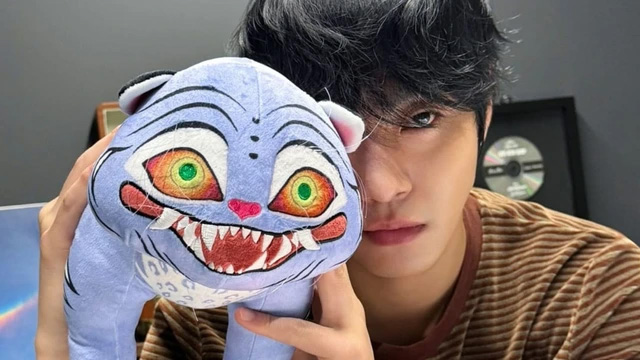
These goofy characters have deep roots in Korean culture.

Paintings of this duo were sometimes placed on the front gates or doors of houses, as magpies represented bearers of good news and tigers were believed to expel evil spirits. However, in the movie, the blue tiger is linked to the demonic world as it’s Jinu’s pet. It is one of several spiritual inversions found in the film.
As the story progresses, we realize that the movie’s climax is not about the demon hunters successfully defeating the demons but about Rumi coming to terms with her demonic side. This fact ends up affecting the entire world: Rumi wants to see the Honmoon—the protective barrier against demons—destroyed to see a new one emerge, one that is more accepting of her dual nature.

When the other members of Rumi’s group discover she’s a demon, they break up. This destroys the barrier, enabling the Saja Boys to take over and turn the masses into brainwashed zombies. To harvest these souls, the group organizes a massive show.


While things seemed grim, Huntr/x came back to save the day.


All of this energy creates a new Honmoon—one that is more accepting of the demonic world. This is portrayed as a good thing because Rumi can finally be herself.

The message of this final scene: It’s not over. Proof: There’s already a sequel in the works, which will probably be darker.
In Conclusion
Some interpreted KPop Demon Hunters as an empowering tale where the shame and guilt caused by one’s flaws, past and identity are overcome in a journey for healing and self-acceptance. Some even described the narrative as “echoing the Christian gospel.” With that said, in efforts to dig into metaphorical meanings, many overlook the very blatant narrative of the movie: The “demon hunters” stopped hunting demons and accepted a half-demon as their own. The demonic world is humanized and made enticing as the protagonist finds love with an appealing demon who shares and understands her struggles.
If this movie were made a few decades ago, the demon hunters would have defeated the demons and banished them to hell. Because good prevailed and evil failed. However, in recent years, we’ve been seeing narratives that err on the side of moral relativism, where good and evil aren’t exclusive or at odds. In this case, the concept of duality is at the story’s core as the protagonist needs to accept her dual nature to triumph. Some might argue that, behind its references to Korean spirituality and shamanism, the movie is gnostic at its core, as Rumi learns to embrace both her light and dark sides to achieve a form of godhood. Appropriately enough, this is the core teaching of occult schools throughout history.
With this fact in mind, one can appreciate the profound meaning of the one-eye sign and its constant presence in KPop Demon Hunters and the entertainment industry in general.