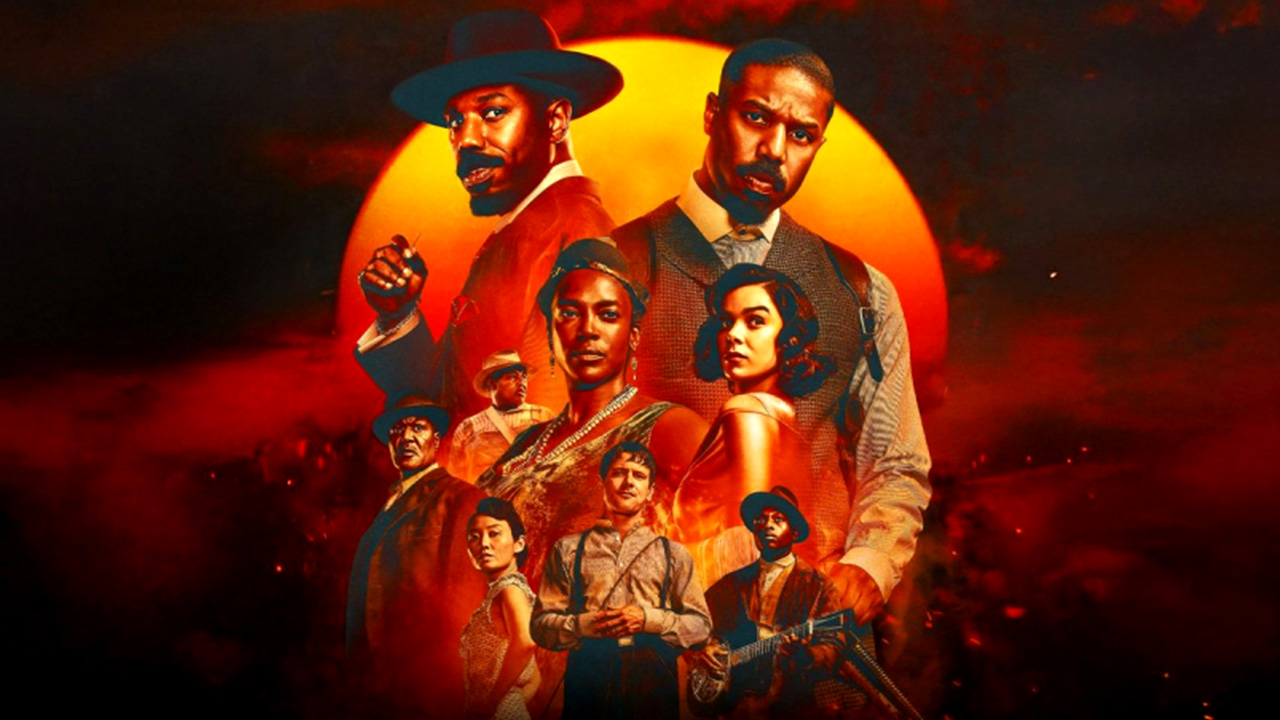
Warning: Stupendous spoilers ahead!
As soon as Sinners was released, it was lauded for its “masterful visual storytelling and toe-tapping music.” The praise was universal and relentless, as any criticism of this movie usually results in scorn and nearly being shunned by society. At the very least, one is perceived as Family Guy‘s Peter Griffin when he dared to state that he did not care for The Godfather because “it insists upon itself.”
Does Sinners also “insist upon itself?” Well, with a running time of 137 minutes and the inclusion of prolongued scenes that can only be described as “revenge porn”, there’s definitely some insisting going on. But there’s more to this movie than Michael B. Jordan killing KKK members in slow motion.
The movie’s first half is a period piece that paints a fascinating picture of the Mississippi Delta in the 1930s, where Black, White, Native, and Chinese populations intersect and collide. With this rich cultural tapestry as a backdrop, we follow the story of two gangster twins and a talented bluesman who decide to open a juke joint inside an old sawmill.
Interesting premise. But then, everybody gets possessed by the devil or dies horrifically. Modern movies tend to be that way.
Numerous critics and movie buffs analyzed the story’s metaphorical meaning, comparing the movie’s juke joint to American society in general. However, despite the thousands of words written about Sinners, nearly all ignore its obvious core message: It is a spiritual battle where Satan is a main character. Does he win in the end? Well, the movie is literally called Sinners.


Even though some believe Sinners is some kind of anti-establishment, pro-black statement piece, its core message is 100% aligned with the occult elite’s philosophy. Here’s a look at the deeper meaning of Sinners.
The Power of Music

The movie’s introduction sets the musical and spiritual tone of Sinners as a narrator explains:
“There are legends of people born with the gift of making music so true it can pierce the veil between life and death, conjuring spirits from the past and the future. In Ancient Ireland, they were called Fili. In Choctaw land, they call them firekeepers. And in West Africa, they were called griots.
This gift can being healing to their communities but it also attracts evil.”
In opposition to these ancient pagan traditions, the movie’s first scene occurs in a church where the protagonist’s father preaches.


After the sermon, the pastor urges his son to quit playing the blues, saying:
“Son, you keep dancing with the devil, one day he’s gonna follow you home.”

Sinners is one of those movies that starts with the ending, so this opening scene occurs after Samuel encounters Satan himself. In the end, Samuel still chooses the guitar and rejects religion. On several occasions, the movie presents Christianity as a religion that was forced on several cultures and that is disconnected from their true roots.

As the movie’s symbolism strongly suggests, Samuel’s choosing the guitar implies that he’s siding with the devil. One of these hints comes from the guitar’s origins: It was a gift from his cousins.

With money they’ve earned doing gangster things in Chicago, the twins purchase an old sawmill from a Klansman and convert it into a juke joint.
As we’ll see, this place will eventually have a “magical” feel. And it can also be compared to hell.
The Juke Joint

On the juke joint’s opening night, there’s drinking, gambling, fighting, fornicating, and murdering. In other words, it houses various activities that some might call sinful. At one point, Samuel takes the stage and sings about rejecting his father’s Bible.

Meanwhile, the piano player Delta Slim explains:
“Blues wasn’t forced on us like that religion. Nah son, we brought this with us from home. It’s magic, what we do. It’s sacred. It’s big. With this here ritual, we heal our people and we be free.”

Although the devil is a terrifying figure that turns people into soulless vampires by feasting on their blood, the movie sends a strange message about him: He’s not that bad.
Dancing With the Devil
After hearing Samuel’s transcendent music, Remmick looks to “recruit” him, knowing his talents will be of great use to build his army on Earth.

Furthermore, Remmick – the devil – promises people freedom. He says:
“I am your way out. This world already left you for dead. Won’t let you build. Won’t let you fellowship. We will do just that. Together. Forever.”
He’s advocating for a New World Order that unites all cultures in “fellowship”. Under his rule, of course. Isn’t it exactly what’s happening today?
Remmick also shares views on Christianity similar to those of Delta Slim.
“Those men lied to themselves and lied to us. They told stories of a God above and a devil below. And lies of a dominion of man over beast and Earth. We are earth, and beast and god. We are woman and man. We are connected.”
At this point, the movie turns into a vampire movie, and many people in the juke joint get bitten by Remmick’s minions. After lying dead for a while, the victims wake up as immortal vampires. Once again, the movie has a message about being under Satan’s control: It’s not that bad.

While numerous people in the juke joint turned vampires, Remmick is mostly after Samuel. He tells him:
“I want your stories and I want your songs. And you’re gon have mine.”
These words sum up why the occult elite recruits talented artists to turn them into satanic minions: To tell “their” stories.
In the end, Remmick never actually turns Samuel into a vampire. However, when one understands the symbolic meaning of Samuel’s interactions with the devil, his fate seems worse.


After much grossness, the sun goes up, the vampires burn, and Samuel returns home.

He didn’t. And the words “in the name of God” were purposely added in this scene to clearly convey the fact that Samuel playing the blues means that he’s rejecting God.

Although Samuel was spared from being bitten and turned into a vampire, he was “baptised” by the devil himself, and he bears his mark on his face. While he might not be a minion, he’s clearly on his side. The movie’s final scene confirms this fact.

The couple offers Samuel the chance to become an immortal vampire one last time, but he declines. Maybe because he’s at a “higher level” with the dark lord?

The moral of the story? Satan won. Those who went against him? Very dead.
In Conclusion
By mixing genres such as period drama and supernatural horror, Sinners tackles topics such as racism, segregation, and life in the American South during the 1930s. This is where most critics stopped interpreting the movie. With that said, as the movie’s title suggests, the movie’s central theme goes far beyond worldly concerns. It is about religion and spirituality, where the concepts of good and evil are somewhat muddled to the point of confusion.
Throughout the movie, the Christian pastor is portrayed as an oppressive figure who wants to stifle the protagonist’s musical calling. Conversely, despite routinely feasting on human blood, Satan promises freedom and allows Samuel to play music. Also, his vampire minions seem quite happy and look pretty cool, while everyone else just dies miserably.
While one can analyze this movie from all kinds of angles, its true message is quite simple and it happens to be fully in line with the occult elite’s relentless cultural agenda: Satan is cool, and Michael B. Jordan wearing sunglasses is the only proof you need.
Combining elements of period drama and supernatural horror, “Sinners” was praised for its ambitious depiction of the 1930s American South. However, behind the blues music and the vampire slashing, the movie’s core message is about a spiritual battle involving Satan himself. Does he win? Well, the movie’s title provides a strong hint.