Warning: Major spoilers ahead!
“Howl’s Moving Castle” is a 2004 animated movie written and directed by Hayao Miyazaki and produced by Studio Ghibli. At first glance, the story seems like an innocent tale of love and fantasy, but with large doses of esoteric references that lead the viewer to wonder if there’s something more behind it. Perhaps the movie’s charm lies precisely in this duality—a theme quite present throughout the animation.
Indeed, “Howl’s Moving Castle” follows the hidden initiation journey of a young woman who discovers and develops her inner power in the underworld of witchcraft. However, none of this is explicitly stated. Miyazaki is known for making movies that communicate through symbols, archetypes, and images laden with mysticism, including a strong influence of Shintoism and pseudo-Luciferianism.
Thus, throughout the plot, we realize that it is not a simple romantic animation, but rather a literal relationship between a young woman and her demon. Here is an analysis of the messages present in this movie.
Cursed
At the beginning of the movie, we are introduced to a kingdom that blends magic and early 20th-century technology, where Sophie Hatter, an 18-year-old girl, lives and diligently works in her late mother’s hat shop in the city of Market Chipping.

The fact that Sophie works in a hat shop is significant, considering that in the movie hair symbolizes the soul. While the young woman leads a simple life making hats (protecting her hair), her soul remains protected from external influences. This symbolism will soon become more apparent later on.
At one point, Sophie is harassed by two soldiers in the street.


In this scene, this guy is the only character not wearing a hat, a way for the movie to tell us that he’s not an ordinary person from the region. Furthermore, he also wears a coat with a dualistic pattern, indicating that he has access to both the earthly and spiritual worlds. In fact, shortly after, it’s revealed that he’s not only an important wizard named Howl, but also a demon.
After being rescued, Sophie apparently falls in love with Howl, even though she’s only seen him once. This provokes the wrath of the Witch of the Desert, a powerful sorceress jealous of the attention Howl receives.

The Desert Witch casts a spell and transforms Sophie into a 90-year-old woman, preventing her from revealing the curse to others. The movie then begins to portray the spell as a necessary evil that allowed Sophie to discover who she truly is.
Discovering the Spiritual World
Discouraged and isolated, Sophie leaves home and walks towards the barren hills.


Sophie soon finds Howl’s Moving Castle, which is basically a huge, walking fortress on mechanical legs similar to those of a chicken.

The fact that one of the main characters is named Calcifer is one of the many clues pointing to the movie’s philosophical basis. The name Calcifer derives from Lucifer, which means “light-bearer” in Latin and is considered by Luciferians to be the one who brought divine knowledge to humans after being expelled from heaven by God. In Luciferian circles, Lucifer is seen as a “savior” who gave humans the knowledge necessary to ascend to divinity. In the movie, Calcifer is a cute and funny demon, constantly portrayed with bulging eyes and oppressed by being trapped in the castle’s fireplace.
Appropriately, Sophie makes a deal with Calcifer: she will break the contract that binds him to Howl if he strives to break the curse that aged her. She takes on the role of cleaning lady, befriends Howl’s young apprentice, Markl, and meets Howl, who accepts her as a member of the household staff.

In addition to discovering a portal in the castle, which connects to various locations through colorful patterns, Sophie also explores the fortress.


Despite his impulsive, selfish, and even cowardly actions throughout the movie, Howl is portrayed as a hero. Furthermore, he also displays strong metrosexual and narcissistic tendencies. This narrative is part of an agenda promoted by mass media that dilutes the absolute values of right and wrong, and even the simplest concepts of life, such as gender.

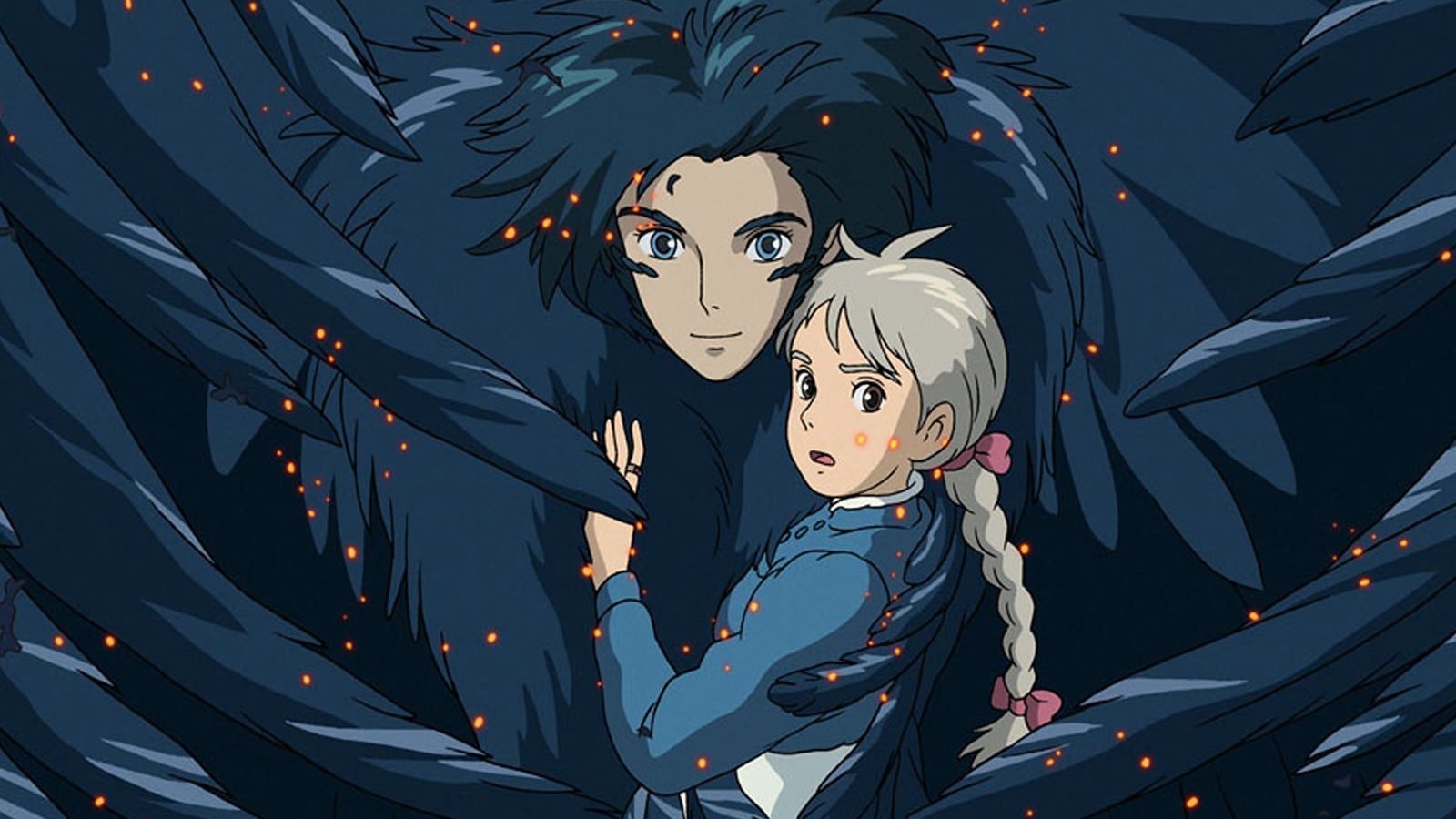
Disguised as Howl’s mother, Sophie infiltrates Suliman’s palace seeking relief from the curse, inadvertently escorting the Witch of the Waste, whose powers Suliman removes. Later, Suliman reveals visions of Howl’s war-induced mutations, transforming him into a destructive bird-beast, prompting Sophie to summon him.
Meanwhile, Howl wreaks havoc in his avian form, devastating the palace gardens before escaping with the group, which now includes the weakened witch.
Giving in to Evil

Caused by the merciless attacks of the birds, Howl’s increasing corruption alarms Sophie, who deduces that his vital organ resides within Calcifer.

As you may know, Lucifer was also expelled and fell from heaven. According to Luciferian philosophy, he exiled himself out of moral indignation against the oppressive demiurge God and brought fire and light (representing divine knowledge) to struggling humans. The movie directly points to this when it reveals that Howl gave his heart to Calcifer in exchange for immense power.
At the end of the movie, Sophie returns Howl’s heart to her chest, breaking the bond with Calcifer. Furthermore, the scarecrow Turnip Head is revealed as the prince whose return ends the war. Also, Sophie and Howl kiss. Happy ending?

In Conclusion
At first glance, “Howl’s Moving Castle” seems like a fable about the power of love and hope in times of war. However, behind the welcoming atmosphere typical of Studio Ghibli, the images and overall context reveal the story of a young girl’s hidden initiation, with touches of pseudo-Luciferianism.
Sophie’s entire journey revolves around a spell and how she tries to break it through other spells. With each step, she sinks deeper into the underworld of witchcraft, even surrendering her hair/soul and becoming dependent on Calcifer, a demon who dominates Howl’s heart. In the end, it seems that everyone has been freed, but the truth is that they still need to pay homage to Calcifer.
With all its delicate aesthetics, the movie promotes the spiritual philosophy of the elite. It is art being used as a means of indoctrination. Like so many other mass media productions, “Howl’s Moving Castle” communicates through symbols and subtext. Only those who “protect their hair” can truly understand what is being shown.