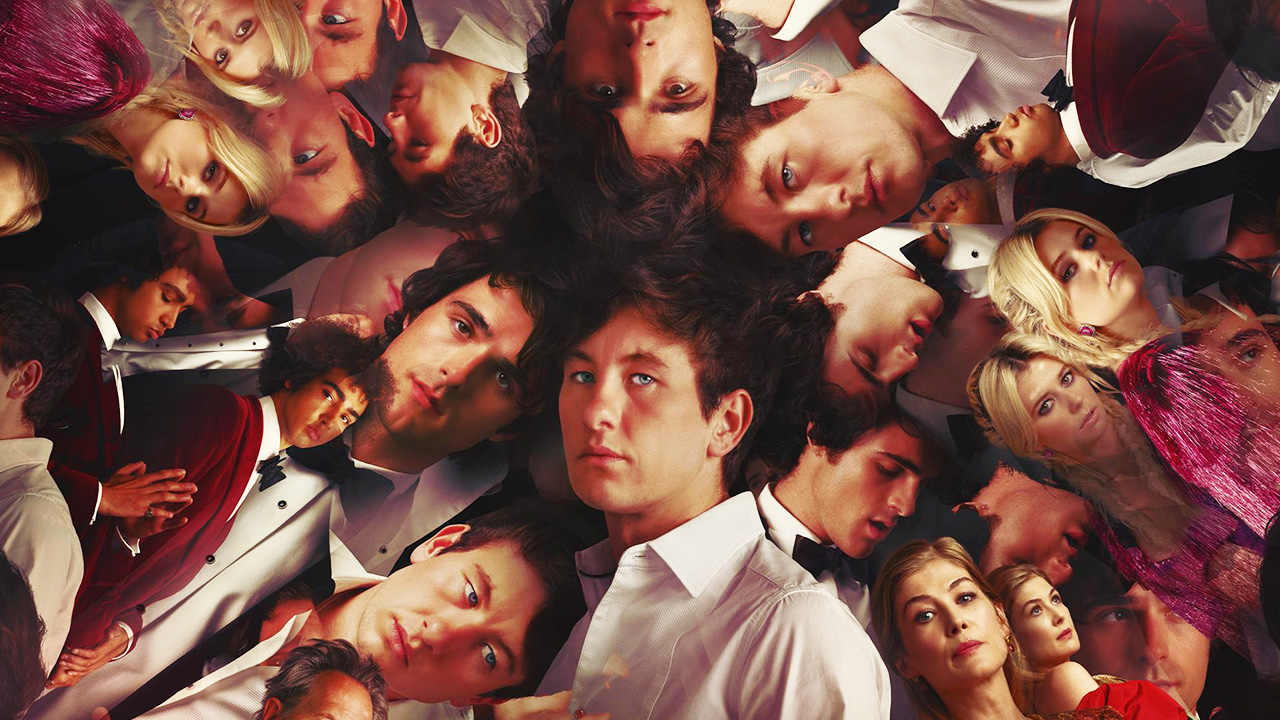
Warning: Monumental spoilers ahead!
Shortly after its US release in late 2023, Saltburn’s “iconic” scenes became viral on social media. As word of mouth spread, the movie quickly became one of the most-watched movies on streaming platforms.
Like numerous “viral” films today, the publicity surrounding Saltburn mainly focused on shock and controversy. As people tuned in to see what the fuss was about, critics firmly separated into two camps: those who thought the movie was degenerate garbage and those who thought it was pure genius.

Other movie critics like to claim that viewers are “missing the point” of Saltburn.

As usual, mainstream movie reviewers celebrated Saltburn but purposely ignored its most critical aspect: symbolism. Is it on purpose? Because, if they diligently decoded these symbols and explained their meaning, readers would be like, “So why are you celebrating this?”
Indeed, beyond its controversial scenes, Saltburn is replete with blatant symbols begging to be deciphered. Nearly every shot is calculated to convey a message and integrates elements that contribute to the narrative. When this symbolism is pieced together, an occult and spiritual dimension to the story is revealed.
Although the movie’s symbols and references are complex and elaborate, Saltburn‘s can actually be summed up in two simple words: Evil prevails. That’s it. And in the grossest, most perverse way possible.
This battle between opposing forces is represented using classic esoteric symbolism throughout the movie.


In many ways, Saltburn mirrors and inverts tropes found in classic tales to communicate a dark message about modern society. Here’s a look at the movie’s symbolism.
It’s All a Ritual
The basic premise of Saltburn has been seen countless times: A poor person gets invited to the estate of a wealthy family. At that point, the rich usually turn into cruel jerks, and the poor person realizes they were invited for ridicule, entertainment, or, in some cases, much worse. However, Saltburn provides an unexpected twist to this classic premise.

The movie’s protagonist is Oliver Quick, a nerdy Oxford University student who comes from a modest background.

As we get introduced to the movie’s characters, we notice a lot of “fluidity” happening. Everybody’s vaguely bisexual, everybody’s into anybody, and jokes about child abuse and incest are thrown nonchalantly.
At social gatherings around Oxford, Oliver meets (and becomes obsessed with) Felix, a popular student from an ultra-wealthy family.

Oliver manages to gain Felix’s trust and sympathy by telling him childhood stories about his drug-addicted parents (which turn out to be false). Felix then invites him to spend the summer at his family estate.


Through numerous scenes, we understand that the Cattons are not a Machiavellian, world-controlling elite family. They’re bored, spoiled, and clueless descendants of British nobility. They’re disconnected from reality and like to invite “regular” people for entertainment, making them perfect preys. At the movie’s end, Oliver calls the Cattons “spoiled dogs sleeping belly up with no natural predators.”

As Oliver settles into the estate, an initiatic process begins.

In secret societies, labyrinths play an essential role in initiatic rituals..
“Labyrinths and mazes were favored places of initiation among many ancient cults. (…) The famous labyrinth of Crete, in which roamed the bull-headed Minotaur, was unquestionably a place of initiation into the Cretan Mysteries.”
– Manly P. Hall, The Secret Teachings of All Ages
As we’ll see, a highly symbolic Minotaur stands at the center of the Catton’s labyrinth, confirming the story’s “initiatic” dimension.
Other works of art around the estate silently add to the movie’s narrative.


While Oliver attempts to fit in with the Cattons, he is sometimes made to feel inferior due to his modest background. His revenge on this wealthy family is therefore compared to Samson’s divine retribution. However, there’s absolutely nothing divine about Oliver’s revenge. Quite to the contrary, it appears to be inspired by the devil himself.
Black Magic

In the scene above, Oliver interacts with Felix’s sister, Venetia. She mentions it is a full moon, meaning “we’re all about to lose our minds.”
Occult rituals are believed to reach maximum potency during the full moon, and the “sexy” scene that follows has a strong “magikal” component.


In another infamous Saltburn scene, Oliver spies on Felix masturbating in the bathtub. When Felix goes back to his room … *shudders*

Felix eventually realizes that Oliver is a creepy liar who invented a story to impress him and gain sympathy.

In the movie’s final act, the Cattons organize a birthday party for Oliver themed around Shakespeare’s play A Midsummer Night’s Dream. Everything about this play is relevant to the Cattons.
A Midsummer Night’s Dream is said to have been initially written for an “aristocratic festival,” not unlike Catton’s party. The story takes place in a dream-like context at the summer solstice and is filled with magical creatures engaging in intrigue and sexually ambiguous activities.

Every guest wears a costume inspired by A Midsummer Night’s Dream, and they’re all significant.


In the 19th century, occultists began to apply the name Robin Goodfellow to the Devil, which is rather appropriate in Oliver’s case. This fact is further emphasized when he opposes Felix.

Although one would expect Felix to become an evil and manipulative character in the movie, he’s friendly and welcoming throughout. However, he does not tolerate Oliver’s lies, which leads to his sacrificial demise.

At one point, Oliver catches Felix running off inside the maze with a girl. He follows them like the creep he is.

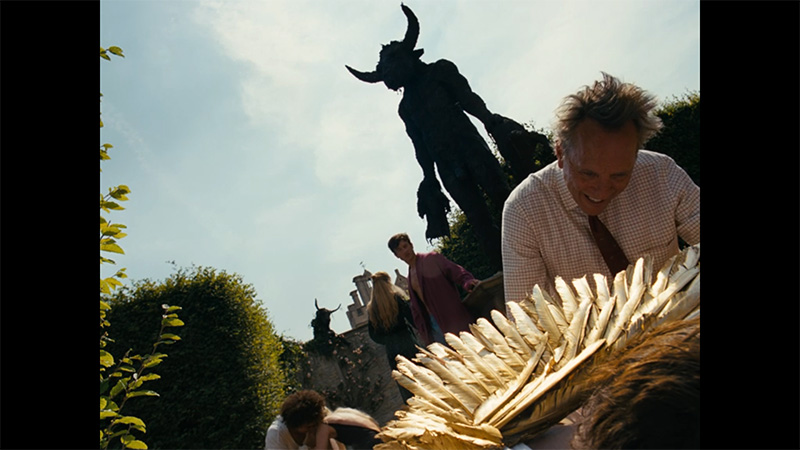
The scene above is highly symbolic for numerous reasons. First, the Minotaur at the maze’s center esoterically represents humans’ animal nature that needs to be slain to gain enlightenment. However, in the movie’s context, the Minotaur is not slain. He stands victoriously (and phallically) as he rips a pig apart—a throwback to the cannibalized pig mentioned above.
Furthermore, the Minotaur is said to be modelled after Oliver’s body, creating in the viewer a subconscious association between the two figures. Also, both are horned, creating a very conscious association between the two figures.
After Oliver interrupts Felix’s sexual encounter, they get in an argument, and Oliver poisons and kills him. The following morning, the Cattons discover Felix dead at the center of the maze.
But murdering Felix is not enough for Oliver.

The Catton family is unaware of Oliver’s wrongdoings and is manipulated to trust him with the family legacy. Big mistake. Each family member eventually dies in events that Oliver directly or indirectly triggers.

Saltburn ends with the protagonist prevailing specifically because he is evil. During the movie, he does not grow, evolve, or learn anything. He was a lying manipulator from the start, and that’s what caused him to succeed.
In Conclusion
While Saltburn is infamous for its revolting scenes, its core message is the most sinister part of the movie. It is about inverting familiar stories involving aristocratic families to have audiences identify with evil, under the guise of “eating the rich.”
In the movie, the wealthy family became weak and lazy due to generations of wealth and privilege. Then comes Oliver, who is evil, perverse, manipulative, and sick-minded like the rest of the occult elite. In the movie’s logic, he’s the one who deserves this wealth.
Through deceitful actions, Oliver takes advantage of the family’s trusting nature and knocks them out of existence in the vilest ways possible. The process is symbolically likened to an initiatic ritual where the protagonist engages in increasingly dark and depraved acts, culminating in all-out murder.
That said, Oliver’s takeover is framed as the ordinary people’s revenge against the privileged elite, and the audience is made to revel in Oliver’s devilish ways. However, what actually happened is that he became one of “them.” And, once again, they tricked the audience into cheering for evil.